


AI shifts from threat to growth driver in software industry
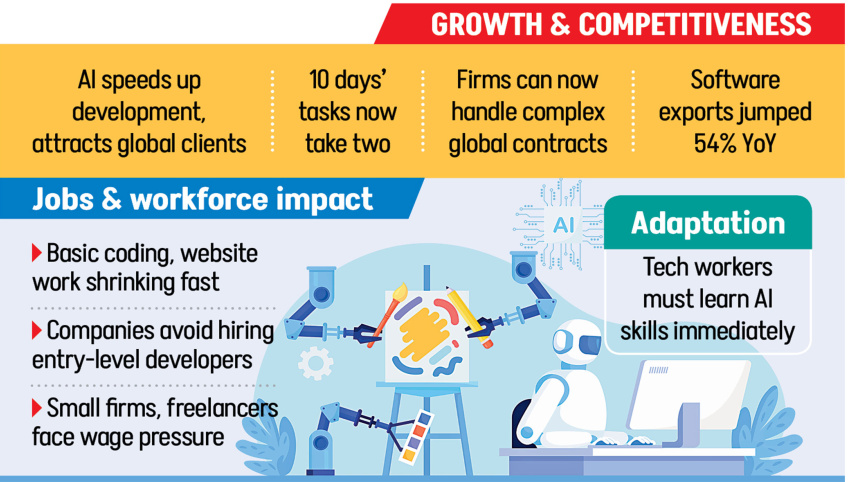
Just a year ago, the growing adoption of artificial intelligence (AI) raised concerns across Bangladesh’s software industry. The biggest fear was simple: AI would replace jobs. Today, that fear has not disappeared entirely, but the conversation has clearly shifted.For many of Bangladesh’s leading software companies, AI is now seen less as a threat and more as a driver of growth in an industry that had been struggling to expand.
Industry leaders say AI is supporting growth in two main ways. First, companies are using AI internally to speed up software development, testing and deployment, while also reducing costs and improving quality.Second, the global AI boom is opening new business opportunities, as international clients increasingly demand AI-powered automation and upgrades to existing systems.
 For all latest news, follow The Daily Star's Google News channel.
 “The fear of AI has largely faded, at least for now,” said M Manjur Mahmud, president of DataSoft Systems Bangladesh Ltd.
“Companies are now focused on understanding how AI can reshape business models and create new opportunities. Global clients increasingly want to upgrade their existing software with AI, agent-based AI and machine learning capabilities,” he added.
However, he noted that demand for traditional software development is declining.
“Companies that relied on low-value services, such as basic website development and routine software work, are already losing business,” he said.
NEW TYPES OF WORK AND RISING PRODUCTIVITY
For Brain Station 23, one of Bangladesh’s largest software firms with nearly 1,000 employees, AI is driving growth rather than slowing it.
“Because of AI, we are seeing about a 25 percent to 30 percent increase in entirely new types of work,” said Raisul Kabir.
“At the same time, traditional workloads have fallen by around 10 percent to 15 percent. Overall growth is about 15 percent to 20 percent, which is reflected in our revenue,” he said.
Kabir acknowledged that AI is reducing traditional software work.
“There is no doubt that AI has reduced a lot of our traditional workload. The work is shrinking,” he said.
However, he added that AI has also greatly improved productivity.
“A task or piece of code that used to take 10 days can now be completed in one or two days with AI.”
This efficiency is also helping firms take on more advanced global projects.
“We can now take on projects that we could not handle before. For example, we could not work with Magento (an open-source e-commerce platform) earlier, but now we can manage Magento projects easily thanks to AI,” Kabir added.
The industry’s AI-driven expansion is also visible in export data. According to the Export Promotion Bureau (EPB), software exports rose 54 percent year-on-year to $21.39 million between July and November last year, driven by rising global demand for automation tools, AI-integrated applications and custom software solutions.
Industry leaders say the actual size of Bangladesh’s software exports is significantly higher than official figures suggest. They argue that many companies’ earnings are not fully captured in official data, and a large share of income from freelancers and independent tech professionals is also missing from reporting.
FREELANCERS, JUNIOR DEVELOPERS UNDER PRESSURE
However, while established software firms are benefiting, the outlook is more uncertain for freelancers, small firms and entry-level developers.
Senior software engineer Shadman Sakib Sorbo warned that Bangladesh’s software export model still relies heavily on cost advantages in low- to medium-complexity work.
“AI is reshaping the global software industry, and Bangladesh is no exception. As someone working in this space, I see both real opportunities and real concerns,” he added.
Sorbo said entry-level and repetitive coding jobs are now most at risk.
“These roles have traditionally been the entry point for fresh graduates into the software industry. If AI takes over boilerplate code and routine tasks, junior developers may find it harder to get started.”
He also warned of wage pressure across the sector.
“As AI reduces the cost of basic software work globally, clients may expect more for less. If the local industry does not upskill quickly, higher-value AI-driven work could move to more advanced markets,” he said.
At the same time, he said AI is creating new opportunities.
“AI is a powerful productivity tool. Developers who learn to use AI for code generation, testing and debugging can become far more competitive globally,” he said.
He added that new roles are emerging, including prompt engineering, AI model fine-tuning, data annotation and AI quality assurance.
“Our large, young and tech-focused workforce is a major advantage in this shift,” he said.
Rezwanul Haque Jami, chief executive officer of Digibox Limited, said AI’s impact is already visible in hiring patterns.
“In my company, I used to hire fresh software developers regularly. Now, a senior developer using AI tools like Claude can effectively do the work of two or three junior coders,” he said.
“I have not hired a fresher in over a year,” he added.
Jami also said that tasks such as prototyping and wireframing, which once required significant manpower, are increasingly being automated by AI tools.
ADAPT OR FALL BEHIND
Industry experts agree on one point: AI will not eliminate jobs overnight, but it is already reshaping the software industry.
The divide, they say, will increasingly be between those who adapt and those who fail to keep pace.
“AI will not eliminate Bangladeshi tech jobs overnight, but it will sharply separate those who adapt from those who do not,” said Sorbo.
“The time to invest in AI literacy -- in universities, bootcamps and companies -- is now, not after the transformation fully arrives,” he added.


Comments