


AL kept people ‘hostage’ to IMF by taking loans: Titumir
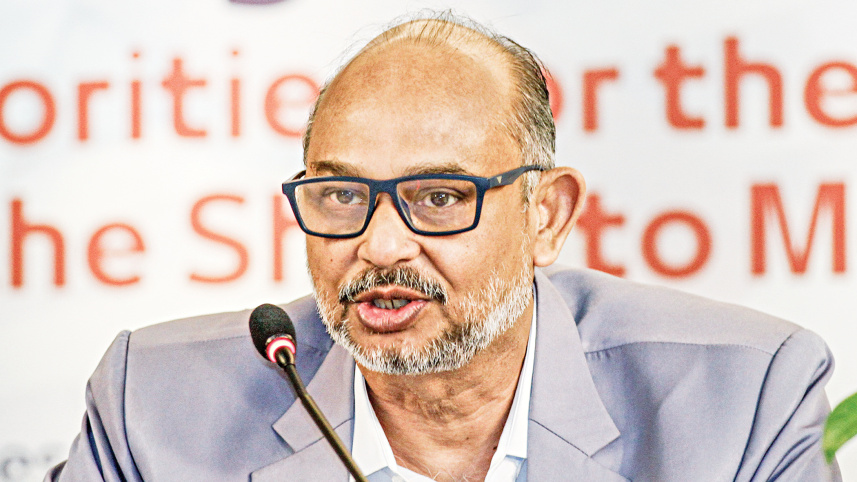
The ousted Awami League-led government effectively held the people “hostage” by taking the bailout loan from the International Monetary Fund (IMF) with difficult conditions in 2022, said Rashed Al Mahmud Titumir, finance and planning adviser to the prime minister.
The AL took the loans after using public projects as tools of appeasement and plunder, he alleged yesterday while addressing a seminar on economic challenges and planning of the government for the next 180 days.
 For all latest news, follow The Daily Star's Google News channel.
 He, however, acknowledged that the agreements inked by previous governments, both with the IMF and the United States, must be honoured under international norms.
“What we can do is review the conditions of those agreements,” he said at the event organised by the Economic Reporters’ Forum at its own auditorium in the capital.
The IMF loan conditions mandate that Bangladesh significantly increase its tax-GDP ratio, which is one of the lowest globally at under 7 percent, through ambitious reforms under its loan programme.
Titumir, however, said there is no way to increase the GDP-to-revenue ratio overnight as the BNP-led government inherited a “troubled” economy.
Citing an example, he said if the government raised domestic fuel prices following outside prescriptions amid global price hikes caused by the US-Israeli war on Iran, inflation would have surged to an unbearable level. “We cannot do that because we are accountable to the people.”
Referring to the BNP’s election manifesto, he stated that the government aims to “realistically” increase the tax-GDP ratio to 10 percent by 2030 and 15 percent by 2035.
“The problems we face must be addressed through our own domestic solutions, and the government has already begun that process,” he said.
Citing examples of such steps, he mentioned that the government waived loans of up to Tk 10,000 for farmers, initiated efforts to universalise social safety net programmes through “family cards” and is planning to re-excavate canals across the country.
“Many more reforms will be undertaken, but these will be realistic and based on domestic realities,” he added.
In future, he said, the government will increase the reserves of strategic commodities such as fuel oil, edible oil, rice, and wheat. “We will also increase investment expenditure at a higher rate than the government’s operational expenditure.”
Meanwhile, responding to a question, the premier’s adviser informed that equal opportunity would be ensured for all individuals accused of looting struggling banks to regain their ownership of the institutions.
Any disputes, he said, would be resolved in the Supreme Court.
Prof Mustafizur Rahman, a distinguished fellow of Centre for Policy Dialogue, said over the past three years, the largest portion of the government’s budget has been spent on debt servicing.
He explained that since revenue has not increased sufficiently, the government has had to take on more loans to service existing debt.
“To escape this type of debt trap, the current government must formulate a roadmap,” he said while addressing the event as guest of honour.
The policy expert added, “The development narrative we have heard for years is essentially debt-driven growth, and the country must move away from it. Financing could be sourced from the equity market, alongside a stronger focus on increasing revenue.”
The current government faced a tough test in its initial days. On one hand, it inherited macroeconomic instability; on the other, it must address the challenge of graduating from least developed country status, even if it manages to defer the graduation once.
“People’s expectations are also very high, so inclusive development and reform must continue despite these challenges,” he said.
Meanwhile, apparel sector leaders called for ensuring policy stability and energy security if the government wants to use the sector for employment growth and private sector investment.
To increase investment, sudden policy changes must be stopped, said Mahmud Hasan Khan, president of the Bangladesh Garment Manufacturers and Exporters Association. “Entrepreneurs make decisions based on existing policies, and sudden changes cause losses.”
Referring to BNP’s election promise, he noted that one crore jobs will not be created solely by the ready-made garment sector, so diversification is necessary.
He suggested shifting from diesel to solar energy for irrigation, which would reduce dependence on diesel, create employment opportunities, and lower costs for farmers.
Mohammad Hatem, president of the Bangladesh Knitwear Manufacturers and Exporters Association, said although the government talks about creating 1 crore jobs, a large portion is expected to come from the garment sector. “However, entrepreneurs from this sector are saying that they are fighting to survive.”
“The IMF and ILO impose various conditions and regulations on us, yet they say nothing about buyers not offering ethical prices,” he added.


Comments