


Starlink in Bangladesh: Blazing fast, but few can afford

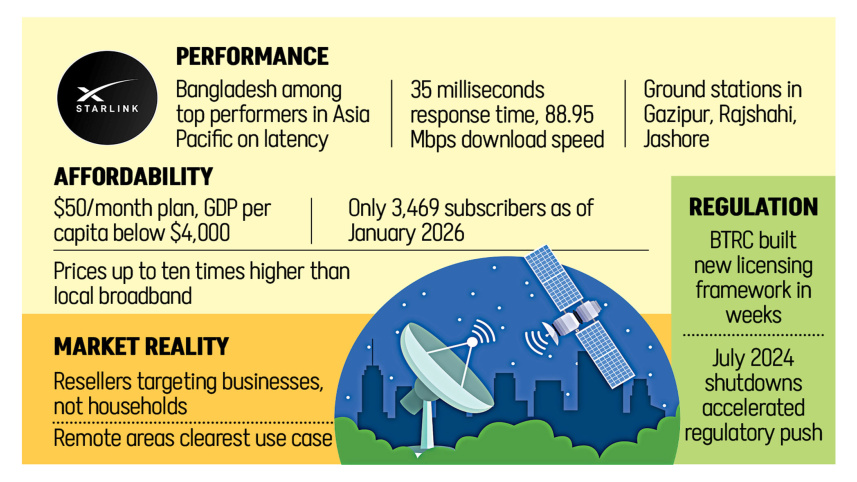
Bangladesh’s Starlink service is currently among the most responsive in Asia-Pacific, but high package prices make it unaffordable for ordinary households, according to a new report by Ookla, a global internet performance tracking firm.
The milestone in latency came within just two operational quarters of its commercial launch. Starlink received its operating licence in Bangladesh on April 29, 2025, and officially launched on May 20, initially offering two residential packages priced at Tk 6,000 and Tk 4,200 per month.

The report states that the monthly fees consume a disproportionately large share of household income in Bangladesh -- placing it among lower-income markets where affordability remains a serious obstacle to mass adoption.
LOWEST LATENCY IN THE REGION
Internet latency is the time delay -- measured in milliseconds -- for data to travel from your device to a server and back. Low latency is crucial for responsive, real-time internet, while high latency causes lag. It is caused by physical distance, network congestion, or hardware issues.
Starlink in Bangladesh has the lowest latency compared to neighbouring countries.
By the fourth quarter of 2025, Bangladesh recorded a median download speed of 88.95 Mbps and a response time of 35 milliseconds(ms) -- matching New Zealand and marginally faster than Australia’s 36 milliseconds, despite those markets having used Starlink since April 2021.
The performance gap between markets, Ookla’s report explains, comes down to where Starlink’s ground equipment is located.
Starlink Points of Presence (PoPs) are critical data centres where Starlink satellites connect to the terrestrial internet backbone. Deploying a Starlink PoP in Nairobi in January 2025 reduced Kenya’s latency from 289 milliseconds to 53 milliseconds.
Countries with local ground stations get a faster, more responsive connection, while those routed through distant facilities experience noticeable lag. For instance, East Timor recorded 157 milliseconds and the Maldives 118 milliseconds in the same period, as they don’t have local ground stations and use distant gateways.
Among neighbouring countries, Sri Lanka, which launched in July 2025, reached a faster download speed of 140.68 Mbps by Q4 2025 -- but its latency of 103 milliseconds was nearly three times worse than Bangladesh’s, a direct consequence of fewer local ground stations.
Bangladesh’s strong figure reflects the ground facilities secured as a condition of its licensing agreement. Starlink has built infrastructure at Hi-Tech City in Kaliakair, Gazipur, with additional sites in Rajshahi and Jashore.
“For governments negotiating licensing terms, ground-station commitments are a meaningful lever on the quality of service their populations receive,” the Ookla report notes.
Ookla also holds Bangladesh’s regulatory process as a model for the region.
The Bangladesh Telecommunication Regulatory Commission (BTRC) built an entirely new Non-Geostationary Orbit licensing framework for satellite internet in weeks, a regulatory push that was partly “shaped by public demand following internet shutdowns” during the mass uprising in July 2024.
“The speed with which Bangladesh’s BTRC built and approved a new licensing framework -- weeks rather than years -- shows what becomes possible when a government treats satellite broadband as a policy priority rather than a regulatory challenge,” it states.
UNAFFORDABLE FOR ORDINARY HOUSEHOLDS
Starlink’s monthly residential fee is broadly similar across Asia-Pacific, ranging from roughly $45 in Australia to $68 in the Philippines, but its weight on household budgets varies sharply by income.
Bangladesh’s GDP per capita sits below $4,000, meaning the approximately $50 monthly plan takes up a far larger share of household income than it does in Japan, Australia, or even Malaysia.
The pattern repeats across lower-income markets in the region. In Indonesia, where Starlink’s entry-level plan costs more than double the typical household internet spend, growth has been driven largely by institutional users -- government health programmes, maritime operators, and industries in remote areas -- rather than ordinary households.
 For all latest news, follow The Daily Star's Google News channel.
 “Starlink’s pricing responds to demand and capacity conditions in ways that fixed-line operators typically do not,” states Ookla. For instance, Starlink introduced surge fees of roughly $490 to $574 for new subscribers in high-demand areas in Indonesia in July 2025, a pricing dynamic with no equivalent in fixed-line broadband.
Bangladesh appears to be heading in the same direction in terms of usage in ordinary households. The country’s three authorised resellers, Robi Axiata, Felicity IDC, and Bangladesh Satellite Company, have each signed $2.5 million distribution agreements focused on business and priority plans.
As of January 2026, the satellite internet service attracted only 3,469 customers as of January 2026, according to BTRC data, mostly due to prices up to ten times higher than local broadband failing to attract subscribers.
All three authorised dealers report difficulty finding customers willing to pay premium prices, The Daily Star reported last month.
“General users are concentrated in areas with fibre coverage,” said Shah Ahmedul Kabir, general manager for sales and marketing at Bangladesh Satellite Company.
“So, we are focusing on niche markets such as hill tracts, remote char areas, maritime applications for fishing boats, and mobile connectivity on long-haul buses and trains,” he added.
Sharful Alam, chief executive of Felicity IDC, said enterprises view Starlink primarily as backup internet connectivity rather than a core service.
“It’s unlikely that people will abandon existing broadband services, given the significant price difference,” he said.
Felicity IDC’s Starlink packages, offering 1 TB (terabyte) to 4 TB data allowances, range from Tk 25,000 to Tk 75,000.
For remote and underserved areas, however, the case for Starlink is clearer. Bangladesh Satellite Company has already connected 12 schools across three hill tract districts, with plans to expand to over 150 -- the kind of use case where satellite internet faces little competition from fibre or mobile alternatives.
Looking ahead, Ookla’s report notes that the competitive landscape across Asia-Pacific is shifting. Amazon’s Project Kuiper is set to enter the region, while China’s Qianfan Constellation has signed wholesale agreements with local operators in Malaysia and Thailand through a partnership model that sidesteps the foreign ownership constraints Starlink has had to negotiate market by market.
For Bangladesh, Starlink has also proposed exporting bandwidth to neighbouring countries through its local infrastructure -- a proposal BTRC is currently reviewing.
Experts say approval could position Bangladesh as a regional data transit point and generate foreign currency for local operators.
Comments