


Bangladesh makes final push to defer LDC graduation

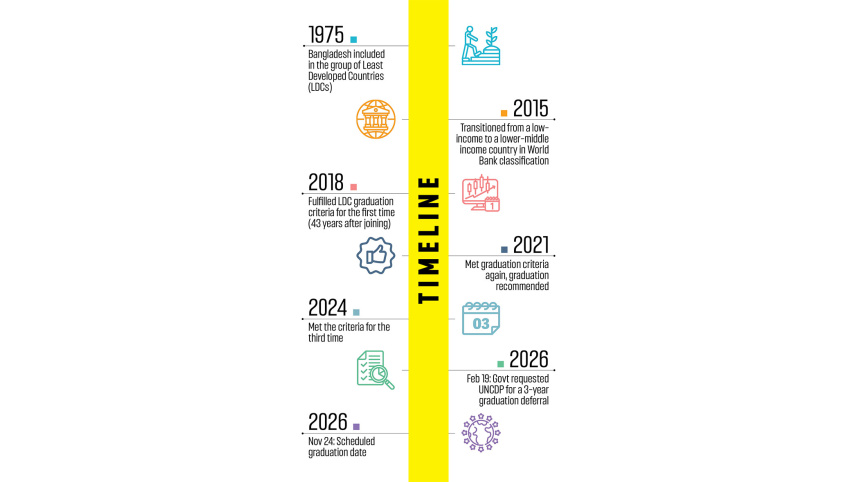
Bangladesh is making a final push to win support from countries and trade blocs for a three-year delay to its graduation from the UN list of Least Developed Countries (LDCs), as the 81st session of the UN General Assembly begins in New York.
The decision on Bangladesh and Nepal’s requests to defer their LDC graduations by three years is expected at the session.

The 81st UNGA begins today, with the main high-level meetings of heads of state and government scheduled for September 18 to 28, according to the UN.
Bangladesh’s request to defer its graduation has already been recommended by the UN Committee for Development Policy (UNCDP). Following that, the UN Economic and Social Council (ECOSOC) agreed to put the proposal before the General Assembly.
“The decision on Bangladesh’s issue of LDC graduation deferment may be taken in the high-level meeting between September 22 and September 23,” Commerce Secretary Md Ataur Rahman Khan told The Daily Star over the phone yesterday.
Bangladesh has been lobbying different countries and trade blocs, including the European Union (EU), for support for its request for a three-year deferral, Ataur said.
The commerce secretary recently visited New Zealand and Australia to seek their support, arguing that the country needs more time to prepare for a smooth graduation.
“Bangladesh has also sought the backing of the G77, a group of 135 developing countries, and its members have committed to supporting the proposal at the UNGA,” Ataur said.
Bangladesh is also in close contact with the EU and African LDCs to seek their support. Nepal is backing Bangladesh’s efforts as it has also sought a deferral, he said.
The commerce secretary said that senior government officials have been seeking support directly from governments and trade blocs, while Bangladesh’s high commissioners in different countries have also been lobbying on the issue.
The deferral request could be decided in one of two ways. If Bangladesh’s proposal is approved unanimously, there will be no need for a vote.
But if there is no consensus, the proposal will go to a vote among member states. Bangladesh will need a two-thirds majority for its request to be approved.
“I am very much hopeful that we can secure the support of the required member countries for the deferment of the LDC graduation, as we have been working on it over the last few months and still continuing our efforts. They have also committed to supporting us,” the commerce secretary also said.
Earlier, on February 19, the BNP government sent a letter to the chair of the UNCDP, requesting that the preparatory period be extended until November 24, 2029, saying more time was needed to ensure adequate preparedness.
Following Bangladesh’s request, the UNCDP discussed the issue at its annual meeting in February and agreed on a process to assess the proposal.
The country’s business community has also been pressing the current government and the previous interim administration to delay graduation, saying businesses need more time to prepare.
Business leaders said high bank interest rates and the political changeover in 2024 following widespread protest and political uncertainty have hit the economy.
A UN assessment report in March said Bangladesh still faced serious gaps in its readiness for graduation, as its economy continued to be affected by domestic and international shocks, including the US-Israel’s war on Iran.
The report highlighted disruptions between 2017 and 2026, including climate vulnerability, the Rohingya crisis, the Covid-19 pandemic, the Russia-Ukraine war, inflation, pressure on the balance of payments and a prolonged macroeconomic slowdown that predated the regime change.
It said that while Bangladesh met all three criteria for graduation, significant risks persist, including the loss of trade preferences, fiscal and financial vulnerabilities, and weak institutional coordination.
 For all latest news, follow The Daily Star's Google News channel.
 Rising import costs for fossil fuels have created operational constraints, while gas shortages have worsened because of the Middle East conflict, said the UN report.
Economic growth slowed from 7.1 percent in FY22 to 3.5 percent in FY25, weakening momentum ahead of graduation. Inflation has outpaced wages, pushing millions into hardship and vulnerability.
A recent UN Trade and Development assessment estimated that Bangladesh could lose more than $17.5 billion in annual exports after graduation.
Mustafizur Rahman, distinguished fellow at the local think tank Centre for Policy Dialogue (CPD), said Bangladesh’s preparation has been taken in two ways. First, Bangladesh applied for the deferment; second, the UN itself conducted an assessment based on Bangladesh’s plea for deferment.
Bangladesh will have to secure the deferment at this session as the country’s LDC graduation is scheduled for November 24 this year, he added. He also said the support of African LDCs is important.
Mohammad Abdur Razzaque, chairman of Research and Policy Integration for Development (RAPID), said Bangladesh should now build consensus among UN member states so that the proposal can be passed smoothly at the General Assembly.
“Bangladesh should continue lobbying the G77 and the EU, while securing support from African LDCs is particularly important because most LDCs are in Africa,” he said.
Moreover, a consensus should be built between the UNCDP and UN ECOSOC that Bangladesh is facing a crisis, said the economist, specialising in applied international trade and development issues.
“The main partners are the EU, UK, Scandinavian countries, G77 countries and the African LDC group,” he added. “The government should also send letters to different sub-committees of the UN body seeking their support for the deferment.”
However, it may be difficult to obtain US support. But Bangladesh will have to manage US support carefully as there is a reciprocal trade agreement with America, Razzaque also said.
On the other hand, Bangladesh may obtain support from the EU and UK more easily, the economist also said.
Md Fazlul Hoque, administrator of the Federation of Bangladesh Chambers of Commerce and Industry, said Bangladesh needs the deferment as businesses are in big trouble.
“I am very hopeful that Bangladesh’s LDC graduation deferment will take place as it is needed for us,” he added.
He said that if the deferment does not take place, Bangladeshi trade and business will face a lot of trouble as they are not ready for a smooth graduation.
Finance ministry officials said the national committee on LDC graduation has also held a final preparatory meeting on the deferment proposal at the ministry.
A good number of ministers, advisers and secretaries from different ministries attended the meeting, chaired by Finance Minister Amir Khosru Mahmud Chowdhury.
Ministry officials also said Prime Minister Tarique Rahman may lead the Bangladesh delegation at the 81st session of the UNGA, although the schedule has not been fixed yet.
Comments