


Bangladesh’s revenue-to-GDP ratio just above Sudan, Yemen

Highlights
- Revenue-to-GDP ratio stood at 8.34 percent in 2024
- Corruption and tax exemptions drag down revenue collection
- Economists urge expanding the tax net and digitalisation
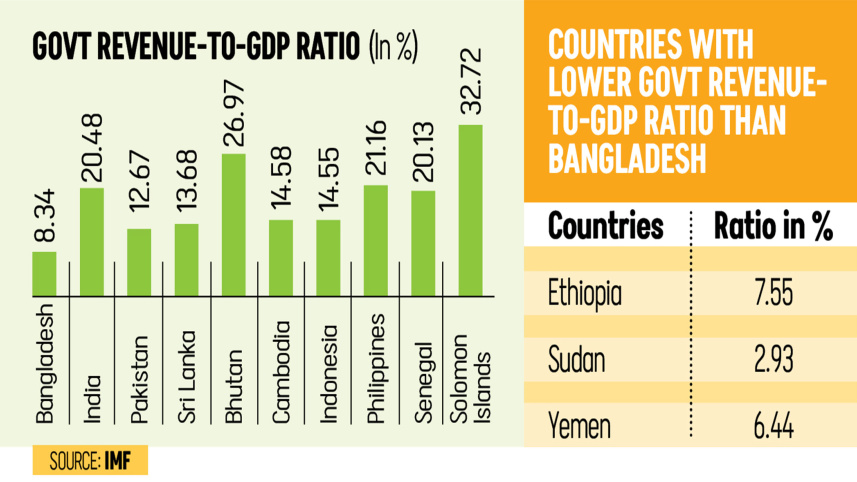
The amount of money Bangladesh collects in government revenue each year relative to the size of its economy is among the lowest in the world, ranking just above war-torn Yemen and Sudan, according to data from the International Monetary Fund (IMF).
The shortfall leaves the government with less money to invest in health, education, infrastructure and other public services, while limiting its ability to respond to economic shocks.

This measure, known as the revenue-to-GDP ratio, stood at 8.34 percent in 2024, the lowest among Asian countries and many of Bangladesh’s peer economies.
There are at least half a dozen reasons why the government’s revenue compared with the size of the economy has remained low for such a long time.
According to the London-based International Growth Centre (IGC), Bangladeshis have weak trust in government spending because of high levels of corruption, which reduces willingness to pay taxes. Tax compliance also depends on the quality of public services people receive.
Meanwhile, economists say the low revenue-to-GDP ratio is also the result of a narrow tax base, the dominance of the hard-to-tax informal sector, generous tax exemptions and holidays, weak compliance and enforcement, and heavy reliance on indirect taxes instead of broad-based income and property taxes.
“Due to the country’s low revenue-to-GDP ratio, the government’s fiscal space remained limited over the years. It had negative consequences for development,” said Mohammad Abdur Razzaque, chairman of Research and Policy Integration for Development (RAPID).
As an example, the economist pointed to long-standing underinvestment in the health and education sectors.
He said Bangladesh’s spending on health and education is among the lowest in the world. As a result, the country has not achieved the expected growth in human capital. Other infrastructure projects that should have been developed also failed to materialise.
The RAPID chairman said the low revenue-to-GDP ratio supported economic growth up to a certain point because it benefited the private sector.
“With lower tax collection, people paid less tax and retained greater purchasing power, helping private sector growth,” he added.
HOW BANGLADESH COMPARES WITH ITS PEERS
In neighbouring India, the revenue-to-GDP ratio stands at 20.48 percent. It is at 12.67 percent in Pakistan and 13.68 percent in Sri Lanka. In Bhutan, government revenue amounts to 26.97 percent of GDP.
Among countries graduating from the least developed country (LDC) club, data for Lao PDR and Nepal were unavailable. Even so, Bangladesh ranked lowest within the group.
The IMF data showed that the Solomon Islands recorded a revenue-to-GDP ratio of 32.7 percent, while the figure stood at 14.58 percent in Cambodia and 20.13 percent in Senegal.
Internationally, a tax-to-GDP ratio of 15 percent is often regarded as a minimum benchmark. Falling below that level can hamper economic growth and development.
Below this threshold, government effectiveness, financial development and economic growth tend to stagnate. Yet more than 70 developing economies still collect less than 15 percent of GDP in taxes, constraining development and leaving governments vulnerable to economic shocks.
War-torn Sudan and Yemen recorded tax-to-GDP ratios of 2.93 percent and 6.44 percent, respectively. The figure was 7.55 percent in Ethiopia, which has faced prolonged political instability.
While these countries collect less than 10 percent of GDP in revenue, several countries, such as Austria, Belgium, Denmark, Dominica, Finland, France, Kiribati, Kuwait, Lesotho, Norway and Ukraine, collect more than 50 percent, according to IMF data.
 For all latest news, follow The Daily Star's Google News channel.
 HIGH TAX RATES, WEAK RETURNS
Razzaque said that despite weak tax collection, Bangladesh’s corporate tax rate is among the highest in the world. However, corporate tax is only one component of total government revenue.
He added that not only is revenue collection low, but part of the revenue that is collected is also wasted through inefficient spending, reducing the quality of public goods and services.
In a report, the International Growth Centre said corruption has significant negative effects on revenue collection. “Corruption, especially extreme levels of corruption, can significantly erode people’s trust in the system leading to tax evasion,” it said.
“The push to raise taxes in Bangladesh is contemporaneous with these excesses in government spending. Unsurprisingly, people are reluctant to forgo their earnings only to see them squandered, pushing taxpayers to seek out ways to evade taxes,” it added.
Jean Pesme, the World Bank’s division director for Bangladesh and Bhutan, wrote in a blog that although Bangladesh collects relatively little tax, some of its tax rates are higher than those of peer countries.
He said the real problem lies in a complex and distortionary tax system marked by multiple tax rates and large, regressive exemptions on value-added tax (VAT) and income taxes.
Pesme said, “Worryingly, tax exemptions are estimated to be nearly as large as the actual tax collection. Such distortions result in significant leakage of revenues, opportunities for corruption, and a relatively low share of individuals and businesses paying taxes.”
“Also, Bangladesh’s heavy reliance on trade-related taxes discourages trade, a key driver of economic growth, through high tariffs and supplementary duties that create an anti-exports bias.”
Bangladesh urgently needs bold and comprehensive tax reforms, combining policy changes with institutional restructuring and capacity building, he said.
An immediate priority is to rationalise tax exemptions and incentives and reform the VAT system. Expanding digital automation is also central to transforming tax administration, Pesme added.
BROADENING TAX NET THE KEY
Razzaque said the level of tax rates was not the main issue. Instead, expanding the tax net should be the priority.
He said many growth centres, such as rural bazaars and peri-urban industrial hubs, remain outside the tax system. These should be brought under tax coverage.
“As the tax net has not expanded, a large portion of our economy has still not been formalised,” said the economist.
According to Razzaque, Bangladesh also has significant gaps in income taxation. For example, land values are often underreported, reducing tax payments and depriving the government of revenue.
He said wealth has accumulated rapidly in Bangladesh. Citing a RAPID research, he noted that more than 50 percent of the country’s wealth is concentrated in the hands of just 1 percent of the population.
This has widened inequality, he said. “Policymakers should consider taxing wealth transfers between generations rather than focusing solely on a wealth tax.”
Tax collection must be digitalised to minimise evasion, he said. Greater emphasis should also be placed on direct taxes rather than indirect taxation.
Comments