


CETP crisis threatens leather export ambitions
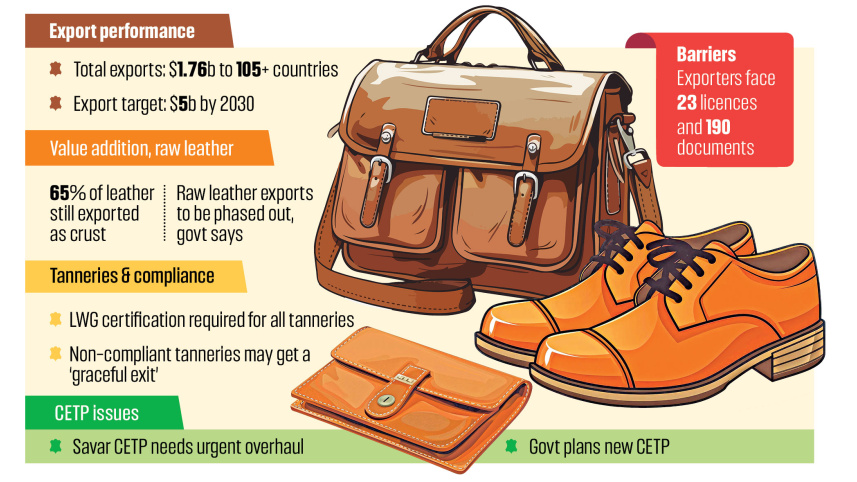
Bangladesh’s plan to turn its leather and footwear industry into a $5 billion export sector by 2030 could remain out of reach unless long-standing environmental and compliance problems at the Savar tannery estate are fixed, industry leaders said yesterday.
They made the remarks at a policy dialogue on the country’s leather industry organised by the South Asian Network on Economic Modeling (SANEM) and the Footwear Leathergoods and Accessories Exporters Association (FLAXA) at BRAC Centre Inn.

At the centre of the problem is the Central Effluent Treatment Plant (CETP) at the Savar tannery estate. Although the plant was designed to treat 25,000 cubic metres of liquid waste a day, verification assessments and recent official statements put its actual operating capacity at around 14,000 to 18,000 cubic metres.
The problem becomes much worse during Eid-ul-Azha, when the volume of waste can rise to 40,000-45,000 cubic metres a day, Commerce and Industry Minister Khandaker Abdul Muktadir said.
“The existing CETP has several shortcomings,” he said, adding that the government would build a new CETP through a transparent bidding process and appoint a world-class operator. Steps will also be taken to improve the existing facility.
Under the plan, larger tanneries will eventually have to install their own effluent treatment plants, with technical and financial support from the government.
Smaller units will have to meet compliance requirements and use the central facility by paying the required charges.
The government will also help struggling or non-compliant tanneries leave the sector, Muktadir said.
“We want to give them a graceful exit from this sector,” he said.
Those that remain will have to become fully compliant and obtain certification from the Leather Working Group (LWG), he added.
FIXING THE SYSTEM, NOT JUST THE CETP
Selim Raihan, executive director of SANEM, said the industry needed urgent action to improve environmental compliance, governance and competitiveness.
He proposed a technical review of the CETP, emergency funding to restore its treatment capacity and independent monitoring, with the findings made public. He also called for stronger penalties for polluters and for government incentives to be linked to compliance with LWG and ZDHC (zero discharge of hazardous chemicals) standards.
Selim also proposed creating a leather sector development authority involving the government, industry and labour. He called for a five- to 10-year policy framework with clear and measurable targets.
Ziaur Rahman, managing director of Bay Group, said fixing the CETP alone would not solve the industry’s problems.
“Fixing the CETP is not enough; the environmental limits must also be revised,” he said.
He said current environmental rules make it difficult for local leather processors to meet LWG certification requirements.
The industry also faces poor roads, gas shortages and high solid-waste disposal costs at the Savar estate, Ziaur said. His company alone spent nearly Tk3 crore on solid-waste disposal last year.
He urged the government to extend export incentives to products made from imported hides and attract foreign tanners to Bangladesh’s underused tannery capacity.
Bangladesh currently exports around $1.76 billion worth of footwear and leather goods to more than 105 countries, despite being the world’s seventh-largest footwear producer.
 For all latest news, follow The Daily Star's Google News channel.
 Yet much of the industry’s potential value is still created abroad. About 65 percent of Bangladesh’s leather is exported as crust leather, which means it is only partly processed before being shipped overseas.
Muktadir said he wanted Bangladesh to eventually stop exporting raw and semi-finished leather.
“Not a single piece of leather should go abroad,” he said, arguing that producing finished leather goods locally would create more value and jobs.
The minister also pledged to simplify business and customs procedures. He said the government would negotiate with Japan to secure wider market access for Bangladeshi leather and non-leather products.
“We need to focus more on finished products,” said Syed Nasim Manzur, president of FLAXA.
Manzur said the industry had discussed its potential for years but had failed to fully realise it.
The sector continues to struggle with gas and power shortages, poor roads and inadequate infrastructure at the Savar tannery estate.
Non-leather footwear, however, offers a major opportunity. It accounts for nearly 31 percent of sector exports, but Bangladesh has less than 0.5 percent of the global market.
According to FLAXA, raising that share to 5 percent could generate about $3.5 billion in exports.
However, exporters face a maze of paperwork. They need 23 certificates and licences and must prepare about 190 documents, compared with only four in Vietnam.
Nasir Khan, chairman and managing director of Jennys Group, said complex licensing procedures and frequent regulatory changes were discouraging investment.
He said a proposal submitted in April to obtain a bond licence for new machinery was still pending five months later.
“This is holding my factory back,” Khan said, adding that his Chinese joint-venture partner had also questioned the business environment.
Australian Deputy High Commissioner Clinton Pobke said Bangladesh must prepare for the loss of trade preferences after graduating from least developed country status.
“Graduation will come,” he said. “The time to pretend otherwise is past.”
The challenge now is no longer identifying the reforms Bangladesh needs, but implementing them despite resistance, Pobke said.
Comments