


DSE resumes halting trade in real time

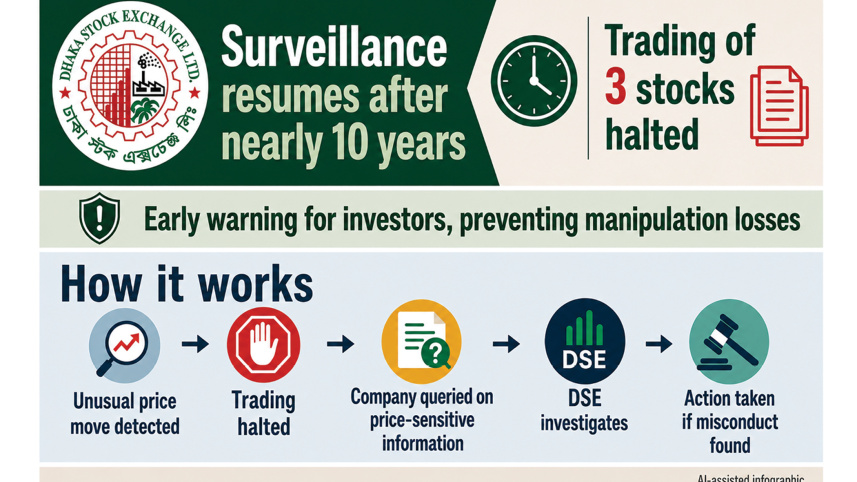
The Dhaka Stock Exchange (DSE) has resumed halting share trading under its real-time surveillance mechanism, a practice that had largely fallen out of use for nearly a decade.
In the past two weeks, the DSE halted trading in Sonargaon Textiles, Shyampur Sugar Mills and Bangladesh National Insurance, each after citing “unusual price movements”.
 For all latest news, follow The Daily Star's Google News channel.
 Trading resumed in all three the following day, but industry officials say the monitoring provides early warning signals to investors that there might be suspicious trading, which helps them make critical decisions.
“As this type of trading halt has not been practised in the market for many years, it seems unusual -- however, it’s business as usual,” said Nuzhat Anwar, managing director of the DSE. “We will always do that to protect investors’ interests.”
Real-time surveillance is a common practice to correct market distortions, and the DSE is equipped to do that, she said, adding that the stock exchange is getting support from the regulator in this regard.
The mechanism works in stages. Once a halt is triggered, the exchange asks the company whether it has any undisclosed price-sensitive information. If irregularities are suspected, it investigates whether unusual trading or malpractice occurred, and can take action accordingly.
Abul Kalam, spokesperson of Bangladesh Securities and Exchange Commission, said the halts serve as an early warning signal to investors that trading in a particular security may be suspicious.
He explained that previously, formal enquiries into suspicious trading took too long, that ordinary investors would buy into the stock in the meantime, unaware of the suspected irregularity, and suffer losses when the correction came.
“Now they are receiving early warning signals,” he said.
The real-time monitoring practice was last used around a decade ago before being discontinued. The DSE has authority under its listing rules to halt, suspend or delist securities.
The price data illustrates how sharply the targeted stocks had run up. Shyampur Sugar Mills, a junk-category stock, had surged 66 percent to Tk 239 in the month before the halt. It has since corrected around 30 percent to Tk 167, according to DSE data.
Shares of Sonargaon Textiles more than doubled from Tk 42 to Tk 87 over a month, and fell about 8 percent to Tk 80 after trading was halted.
Bangladesh National Insurance rose 46 percent to Tk 116 before the halt, and has since dropped around 9 percent.
Separately, the DSE board has decided to develop software to monitor investors’ funds and shareholding positions in real time, aimed at curbing misappropriation by brokers through consolidated customer accounts.
The move comes against the backdrop of thousands of investors falling victim to embezzlement at several brokerage firms over the past five years.
Saiful Islam, president of the DSE Brokers’ Association, welcomed the real-time surveillance but said a one-day suspension alone is not sufficient.
He noted that shares of companies that have been out of production for years continue to surge periodically, misleading investors.
Islam called on the exchange to publicly disclose the names of companies that have remained out of production for extended periods and to follow global practice, where such companies face trade suspension until they resume operations and are eventually delisted if they do not.
According to listing regulations, a company will be delisted if it remains out of production for three years. However, stock exchanges are reluctant to delist companies in Bangladesh as investors have strongly protested such decisions in the past, a top official of the Dhaka bourse said.
Islam hopes that the current DSE board will begin enforcing the rule. “Otherwise, the market will remain full of junk stocks year after year.”
The scale of the problem is significant. Of 396 listed shares, 125 are classified as Z category or junk stocks, while 75 are low-performing B category companies. Only 196 are A-category stocks, according to DSE data.


Comments