


Eid fails to lift electronics sales amid weak demand
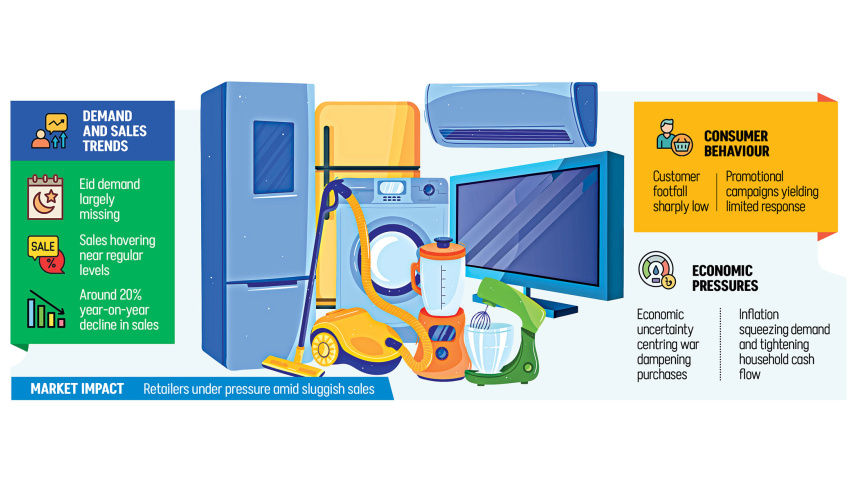
Sales of electronics and home appliances are witnessing an unusual slowdown even close to Eid-ul-Fitr, with demand for products such as televisions and refrigerators showing only marginal improvement and remaining near regular-day levels instead of the customary festive surge.
Saikat Azad, head of distributors at Transcom Electronics Limited, said the usual pre-Eid sales momentum is largely absent this year, even with only a few days left before the festival. Despite visiting multiple markets outside Dhaka, including in northern regions, he observed a similar lack of demand across the board.

“Customers are not coming to stores. Many seem concerned about the near-term outlook,” he said.
The slowdown has weighed heavily on key Eid-driven product categories such as televisions and refrigerators. Both segments -- especially refrigerators -- are performing well below expectations this time.
Azad estimates demand has fallen by 30 to 40 percent compared to a typical Eid season. Even with flat discounts of 30 percent and ongoing promotional campaigns, customer response has been minimal, with limited inquiries.
He said the late surge in buying -- common in previous years -- has yet to materialise, raising doubts about a significant recovery before Eid.
Usually, demand rises during Eid as people buy products like refrigerators and televisions. But this year, sales are about 30 percent below expectations
Nurul Afser, deputy managing director of Electro Mart Group, echoed the concerns.
Sales have fallen about 20 percent year-on-year, he said. Even typically strong segments like televisions and refrigerators are underperforming, as global uncertainty and cautious consumer spending weigh on buying decisions.
Despite a “Gold Offer” campaign offering ornaments or cash with purchases of high-end TVs, microwaves and other appliances, demand remains weak.
“Business is poor for everyone. Sales are almost like regular days, whereas Eid usually brings a significant boost,” said Mahmudul Islam Raz, brand manager of Rangs eMart.
“Usually, during Eid, demand rises as people buy products like refrigerators and televisions. But this year, sales are about 30 percent below expectations,” he said.
Raz attributed the slowdown partly to economic pressure and cautious consumer spending.
“Inflation remains high, and many people appear to have less cash flow, which is affecting purchasing decisions,” he said.
He also pointed to seasonal factors, noting that electronics sales often peak during hotter months when demand for products such as air conditioners and refrigerators increases.
“But this year, that seasonal demand has not picked up yet,” he added.
To attract customers, Rangs eMart has introduced Eid promotions offering cashback, gifts and discounts of up to 48 percent on selected products.
“The impact of these offers has not yet been visible in the market,” he said, adding that most retailers are facing similar conditions this season.
Salim Uddin, director (marketing) at Jamuna Electronics, said Eid typically accounts for a major share of annual sales for consumer electronics brands.
“More than 70 percent of consumer electronics sales are driven by the two Eid festivals,” he said.
 For all latest news, follow The Daily Star's Google News channel.
 According to him, Eid-ul-Fitr usually boosts sales of televisions and small home appliances such as juicers, blenders and rice cookers, while Eid-ul-Azha sees higher demand for refrigerators and deep freezers.
However, he said the usual festive sales momentum has yet to build this year.
“In previous years, all electronics brands used to run extensive campaigns on television, newspapers and digital platforms. But this year, such promotions are much less visible,” he said.
Jamuna Electronics has launched its “Eid-e Double Khushi” consumer promotion campaign, offering special discounts, gifts and a digital lottery featuring a car as a mega prize.
“Despite these initiatives, the expected sales momentum has not yet materialised,” he added.
Zoheb Ahmed, chief marketing officer at Walton Hi-Tech Industries Plc, said sales have been strong ahead of Eid, but profit margins have not improved despite higher demand for electronic devices.
He attributed this to a sharp rise in the cost of importing raw materials and components, driven by the strengthening US dollar, which has pushed up production expenses.
However, Walton has not raised product prices in line with the increased costs in order to keep them within consumers’ purchasing power. As a result, profit margins have remained largely unchanged despite the Eid sales boost.
Comments