


Exports snap 8-month decline with 33% surge in April

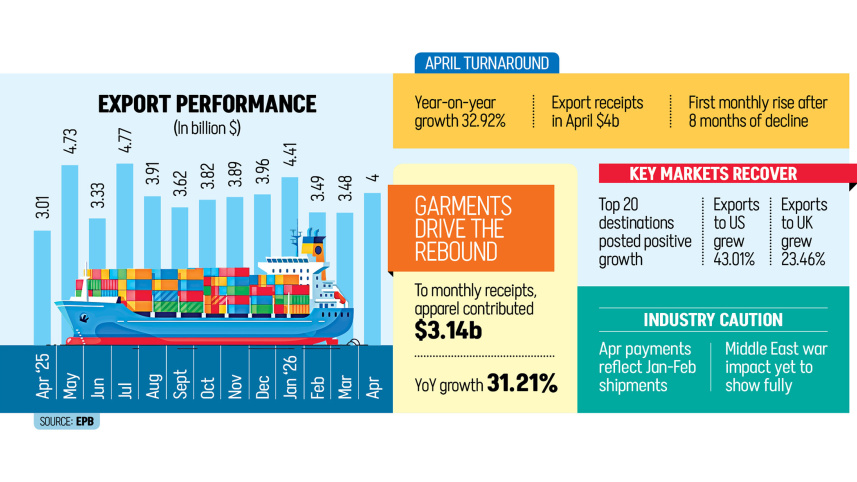
The country’s merchandise shipments rebounded strongly in April, ending eight consecutive months of decline as demand recovered in key markets including the US and the UK.
Outbound trade rose almost 33 percent year-on-year to $4 billion in April, according to data released by the Export Promotion Bureau (EPB) yesterday.
 For all latest news, follow The Daily Star's Google News channel.
 Despite the strong monthly performance, overall earnings in the first ten months of fiscal year 2025-26 remain slightly behind last year. In the July-April period of the current fiscal year, exports totalled $39.39 billion, about 2 percent lower than in the same period of FY 2024-25.
While the EPB says export destinations are showing encouraging signs, exporters, in a cautious tone, note that April receipts largely reflected payments for consignments shipped in January and February.
According to them, it was before the war in the Middle East began and before domestic energy shocks severely affected manufacturers.
Garments, which account for more than 80 percent of national exports, drove the April rebound. Apparel shipments increased 31.21 percent year-on-year to $3.14 billion.
Of that, knitwear earned $1.70 billion, up 30.02 percent, while woven garments brought in $1.43 billion, up 32.65 percent.
In the July-April period, garment exports fell 2.82 percent year-on-year to $31.71 billion. Knitwear declined 3.68 percent to $16.81 billion, while woven dropped 1.83 percent to $14.90 billion compared with the same period a year earlier.
The EPB said that major markets posted strong gains in April. Exports to the US rose 43.01 percent year-on-year, while shipments to the UK increased 23.46 percent.
The bureau said all of Bangladesh’s top 20 export destinations recorded positive growth in the month.
Faisal Samad, a director of the Bangladesh Garment Manufacturers and Exporters Association (BGMEA), said the Iran war was not expected, and the shipments of January and February of this year were booked by international clothing retailers and brands in September and October last year.
“And the payment of those work orders came in April,” he said. “However, overall response from the buyers is positive now as the general election is over in February and reciprocal tariffs in the US market have also been reduced to 10 percent.”
He said the export growth in April was positive after a decline in eight straight months. Manufacturers need to observe what happens in June and July this year.
Inamul Haq Khan, senior vice-president of BGMEA, said the rise in exports has been anticipated as the Bangladesh Bank data showed imports were increasing.
“If the import grows, the export also goes up,” he said. “In general, the condition of export work orders was not bad, although the buyers were cautious,” he said.
Mohammad Hatem, president of the Bangladesh Knitwear Manufacturers and Exporters Association (BKMEA), said the April export data may be a bit different from the practical field, as most of the garment exporters are saying that their export situation is not good now because of the Iran war and the volatile global supply chain.
Apart from garments, several sectors recorded growth in the July-April period.
Leather and leather goods exports rose 5.95 percent to $988.06 million, jute and jute goods increased 2.52 percent to $702.76 million, and engineering products grew 20.14 percent to $537.50 million.
In the first ten months of the current fiscal year, home textile exports climbed 3.46 percent to $766.08 million. Frozen and live fish, chemical products, plastic goods, carpets and pharmaceuticals also performed well.
However, cotton and cotton products fell 12.76 percent to $427.83 million, non-leather footwear declined 1.98 percent to $437.38 million, and agricultural product exports dropped 4.69 percent to $818.66 million, according to EPB data.
Comments