


As factories close, thousands hunt for jobs at gates
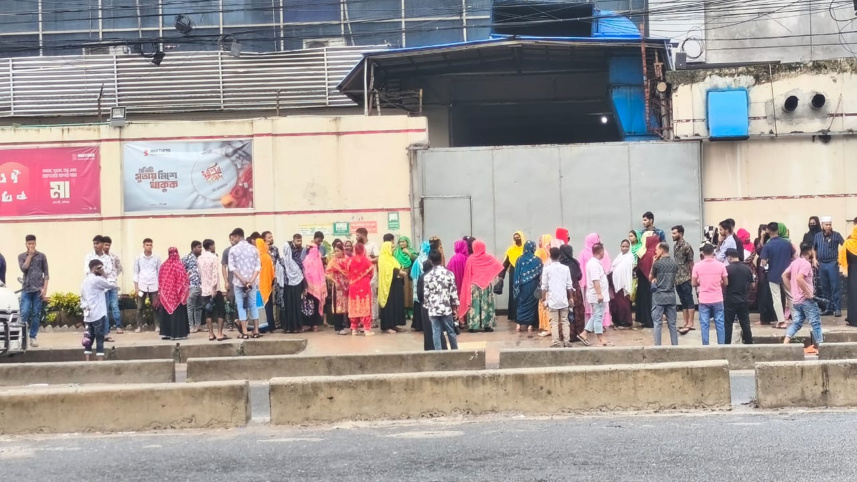
Minara Begum stood outside Rouf Style Company in Bhogra, with a red-bordered scarf draped over her shoulders, a face mask pulled up against the dust of passing trucks and buses. In her palms, she held a photocopy of her national ID and a job application. She had heard the factory was hiring operators.
For the 55-year-old veteran operator, who has worked in factories across the country, it seemed like a good opportunity. “But when I arrived, recruitment had already been completed.”

It has been like this for the last 15 days since the factory she last worked in shut down. “I don’t know how I will manage my house rent, my children’s education expenses, and unpaid bills. Five others and I go out every day looking for work, but none of us has been able to find a job.”
“Some factories do not want to hire after they hear the name of the last factory we worked in,” she added, declining to name her former employer.
Minara is one of thousands of unemployed workers who’s morning now starts by gathering outside factories across Gazipur’s industrial zones, hoping to get recruited.
Many wait for hours without securing so much as an interview, as hundreds compete for a handful of vacancies, a situation worsened by the closure of numerous garment and industrial factories.
158 FACTORIES CLOSED IN 13 MONTHS
Visits to industrial areas including Chandana Chowrasta, Basan, Bhogra, Konabari, Kashimpur, Tongi, Gazipur Sadar, Sreepur, and Kaliakair recently revealed long queues of male and female job seekers from early morning. However, due to limited recruitment opportunities, most return home disappointed.
A total of 158 garment factories in the district shut down between May 3, 2025, and April 11, 2026, Gazipur Industrial Police Superintendent Amzad Hossain told The Daily Star. The district currently has 2,674 factories in operation.
Of the closures, 51 were attributed to financial crises, 83 to insufficient work orders, seven to labour unrest, and two to shareholder disputes. The rest halted production due to raw material shortages and other causes.
When asked about the number of factories currently under temporary closure in Gazipur, MM Mamun Or Rashid, deputy chief inspector of the Department of Inspection for Factories and Establishments, could not provide the data immediately.
Units belonging to Lithi Group, Keya Group, Dird Group, Beximco Group, and several other companies have suspended operations indefinitely or halted production, leaving hundreds of thousands of workers unemployed. And repeated rejections are stripping many of hopes.
Lithi Group Director Mohammad Nazmul said, “We have decided to shut down four of our units due to market instability and banking complexities.”
DATABASE MISUSE AND GENDER BIAS
Mohammad Ashrafuzzaman, central organising secretary of the National Garments Workers’ Alliance Bangladesh, said the closure of large and medium-sized factories has created a humanitarian and economic crisis alongside the industrial one.
He alleged that settlement agreements often reduce the compensation workers are legally owed.
Besides, he added that many struggle to find new jobs due to misuse of biometric and fingerprint databases by previous employers.
He said workers who participated in protests or demanded unpaid wages are being unofficially blacklisted.
Shafiul Alam, central joint general secretary of the Bangladesh Garments and Industrial Workers Federation and president of its Gazipur Metropolitan unit, said most workers affected by permanent closures and layoffs have yet to find new employment.
He alleged some factories add negative information about workers to the BGMEA database, making it difficult for skilled workers to find jobs elsewhere, while recruitment has also slowed at factories still operating.
 For all latest news, follow The Daily Star's Google News channel.
 “Women workers have been affected the most,” he said.
Asma Akter, 40, who worked as an operator at Dird Group in Rajendrapur for more than three years, said 18,000 workers lost their jobs during labour unrest a year ago. She claims that 70 percent of them were women.
“My database record was marked as ‘dismissed’, so no factory wanted to hire me,” she said. She has been unable to find work since.
Women made up roughly 80 percent of Bangladesh’s garment workforce between 1980 and 1994, according to the Bangladesh Garment Manufacturers and Exporters Association (BGMEA) data. The figure fell to around 53 percent in 2023, according to BIDS.
The future appears bleak for most of the unemployed. Waiting outside Brothers Fashion Limited’s factory in Chandana Chowrasta, 40-year-old Ashfia says she is considering giving up job hunting. “I heard they were hiring. This is my last attempt. If I don’t get a job today, I’ll return to my village.”
Two others who had come with her had already gone home after failing to find work. She said she might have to work as a domestic helper to survive.
Comments