


Frequent power cuts put small businesses under pressure



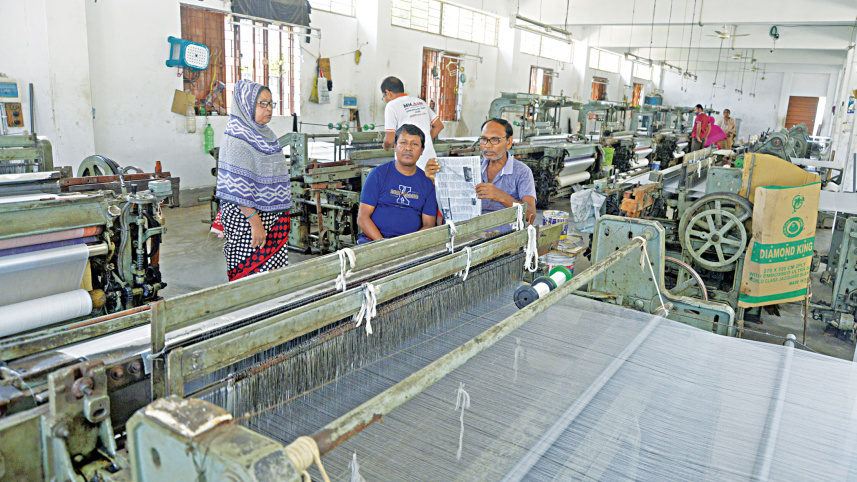
Each time the electricity goes out, Abdus Salam’s lathes at a workshop in Pabna grind to a halt. Workers at Rezbin Hafiz’s small shoe factory in Dhamrai also have to stop work and wait for hours for power to return. At Abul Kashem’s engineering unit in Keraniganj, production comes to a standstill, leaving workers battling the heat and falling behind on delivery deadlines.
All of these are small and medium-sized businesses. Unlike large manufacturers and exporters, they cannot afford to run generators to keep their machines going during power cuts. Therefore, frequent outages directly hurt their productivity and revenue.

As load shedding now lasts for around half the day in some areas, these businesses are facing serious disruption.
“We cannot manufacture a shoe properly due to load shedding, and time gets lost, and production is delayed,” said Rezbin Hafiz, managing director of Peoples Footwear and Leathergoods at Dhamrai BSCIC Industrial Estate.
She said production costs had already risen over the past three years because of higher raw material prices. “Our buyers have cut their orders,” she told The Daily Star over the phone yesterday.
Against this backdrop, repeated power cuts are delaying production and pushing up costs further, said Rezbin.
Similar to her factory, Bangladesh has 1.20 crore cottage, micro, small and medium enterprises. They contribute more than 30 percent of the country’s gross domestic product and employ 3 crore people.
From light engineering and agro-processing to welding shops, leather goods makers and neighbourhood laundries, these businesses are widely seen as the backbone of the economy.
But amid the rolling blackouts, some are spending more to produce the same amount of goods, while others are taking much longer to meet delivery deadlines. For some entrepreneurs, the situation has become so difficult that they are dipping into their savings to pay workers’ wages.
Abdus Salam, a small entrepreneur in Pabna, said load shedding has sharply reduced his revenue recently. He could earn Tk 2,000 to Tk 3,000 on a normal business day, but load shedding has sharply cut the amount.
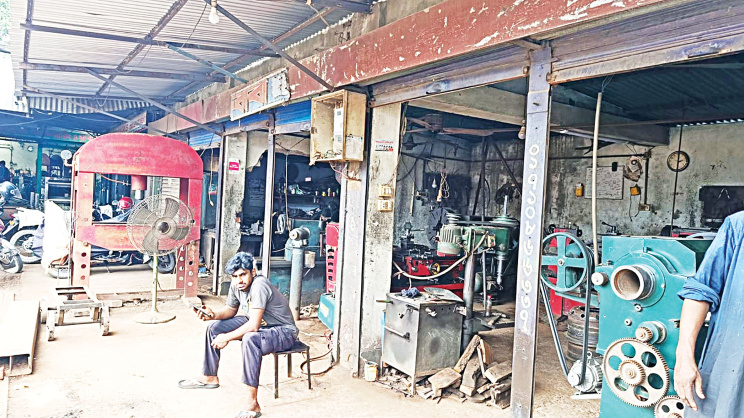
“I have four heavy machines, including two lathe machines. But I am unable to run those for 3 to 4 hours on most working days. This is the common picture over the last couple of months due to the excessive power outages,” said the entrepreneur.
“I am forced to pay salaries to my workers from my savings,” he said.
“It will be tough to sustain the business if the power outage continues this way,” added Salam, who has been in the trade for the last 30 years.
The country has 29,500MW of power generation capacity, but fuel shortages mean it can produce only around half of that. The nation has struggled with power and energy shortages for decades, making load shedding common for much of the year, except in winter.
The situation has worsened over the past couple of weeks after gas supplies fell following an accident at a floating liquefied natural gas terminal in Cox’s Bazar. As a result, gas-fired power plants have cut production.
On August 11, nationwide load shedding reached 3,007MW, the highest level in recent days.
“We do not get electricity for half the day,” said Abul Kashem Titu, owner of Mafia Engineering, a workshop in Dhaka’s Keraniganj.
He said they have tried shifting working hours to the night, but even then they could not get an uninterrupted electricity supply. The outages are now simply delaying deliveries.
“We could deliver a packaging machine in 40 days. As the load shedding is severe, we are struggling to finish the same work in two months,” Kashem said. “Those of us in production are really in a very bad situation.”
“We have to pay Tk 4 lakh in salaries to workers and employees. Now, we are paying salaries while our workers cannot work,” said the small entrepreneur.
 For all latest news, follow The Daily Star's Google News channel.
 Small entrepreneurs are facing the power crisis as economic pressures are already mounting, with persistent inflation, falling exports, weak private-sector investment and factory closures adding to their difficulties.
In Khulna, the largest city in the southwest, power cuts are also disrupting small businesses.
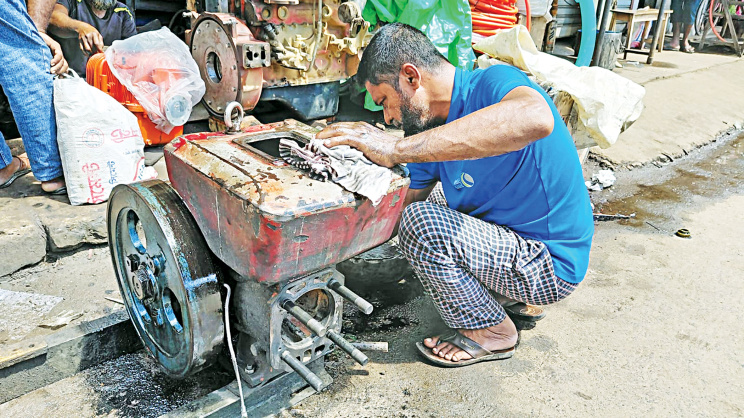
Early this week, Bulbul Mia, owner of a small lathe workshop in the city, was found cleaning a handful of nuts and bolts. His co-worker, Tofazzal, was dipping the parts in used black motor oil to separate and clean them.
Whenever the electricity goes out, the two turn to such small maintenance jobs to keep themselves occupied.
With lathes, Bulbul mainly makes machinery and spare parts used in power tillers, easy bikes and shallow-engine vehicles locally known as Nasimons. He usually receives eight to 10 small and large orders a day. After covering all expenses, he could earn Tk 1,000 to Tk 1,500 a day.
“But things have become so difficult that I can hardly cover my costs now,” Bulbul said.
His monthly costs, including electricity and other expenses, approach Tk 20,000. Yet he earned only around Tk 5,000 over the past 10 days.
Anwar Hossain Chowdhury, managing director of the SME Foundation, said small and medium-sized businesses remain vulnerable because of numerous challenges.
“Load shedding is hurting their production, which is putting them in greater difficulty,” he said.
“If they cannot produce properly, they will be unable to market their products and generate enough revenue to meet their payments, including loan repayments. So, there is a risk of a chain effect,” said Anwar.
Comments