


SSC Results: When students fail in such numbers, we must rethink the system

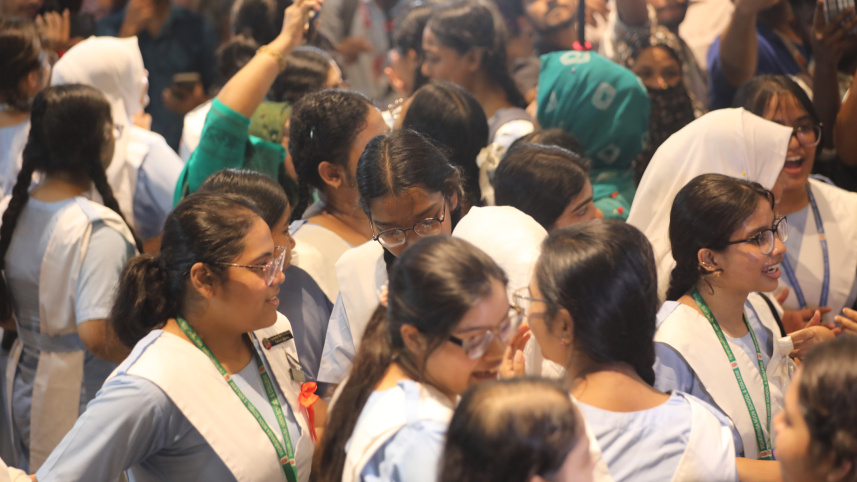
SSC results day usually reveals two opposing realities: in one, families celebrate, students hug their parents, and social media fills with photographs of GPA-5 achievers. In the other, a teenager sits quietly in a corner, worried over facing their parents, relatives, and friends. After about 10 years of schooling, one examination result suddenly seems to define their future. We congratulate those who succeed, but we must also stand beside those who do not. At the same time, we must raise a difficult question: when so many students fail after spending almost a decade in the education system, can it really be considered their personal failure alone?
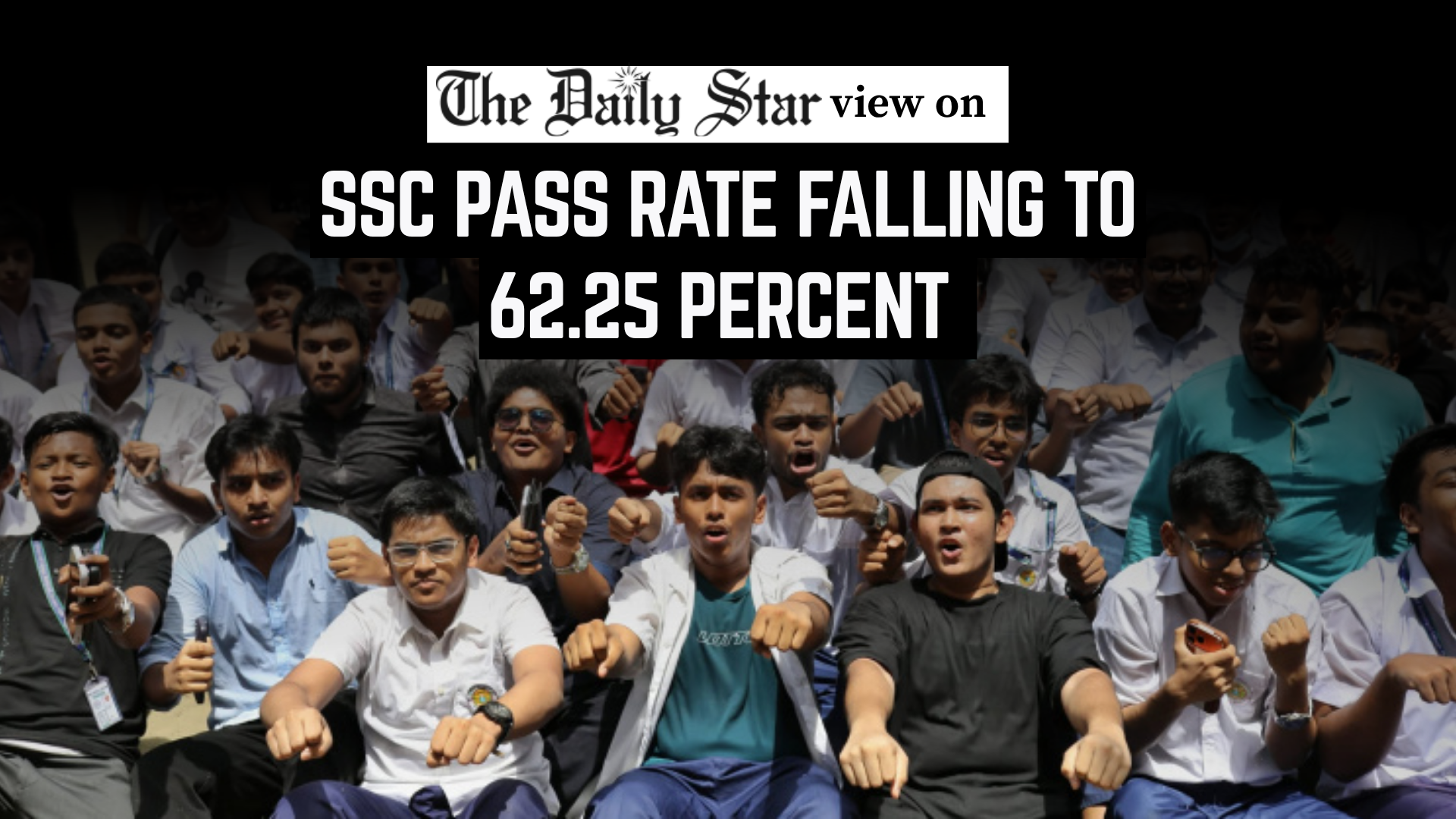
This year, the SSC and equivalent examinations recorded a pass rate of 62.25 percent, the lowest in 19 years. The rate was 68.45 percent in 2025 and 83.04 percent in 2024. Even more concerning, in 312 educational institutions, not a single student passed the exam.

These figures should be treated not merely as examination statistics, but as warning signals from the education system. Why are so many students failing? There is unlikely to be a single reason. The issue appears to reflect accumulated weaknesses throughout a child’s schooling. The pass rates in English and mathematics present a glaring example. Across the general education boards, the pass rate in English ranged from 66.64 percent to 81.29 percent, with seven of the nine boards recording rates below 75 percent. Pass rates for maths ranged from 69.61 percent to 83.34 percent.
But students do not suddenly become weak in English or mathematics in Class 10. If a child progresses through primary school without adequate reading comprehension, language ability, numeracy, or problem-solving skills, those gaps become larger as they move up classes.
A recent report published by the Compulsory Primary Education Implementation and Monitoring Unit (CPEIMU), under the Ministry of Primary and Mass Education, reveals that a significant number of students in 2,100 public primary schools in Dhaka, Narayanganj, and Munshiganj struggle with basic multiplication and division, and cannot read simple English instructions. And this information is not new. A 2024 World Bank report found that 50 percent of students do not achieve the Minimum Proficiency Level by the end of Class 5. So, by the time students reach SSC level, a few months of exam preparation fail to compensate for years of accumulated learning deficits. This is why SSC failures, to some extent, should be seen as the final manifestation of a much earlier problem.
In this context, teachers clearly have an important responsibility. But blaming teachers alone would be too simplistic. We must also ask whether schools have enough subject teachers, whether teachers receive effective professional development and academic support, whether classrooms are manageable, and whether school leadership and supervision are strong enough. More than half of the country’s 65,567 government primary schools do not have a headteacher, while 13,500 assistant teacher posts remain vacant. A similar situation exists in secondary educational institutions, as 55 percent of high schools lack headteachers. Under such circumstances, it should not be a surprise if teachers are overworked and therefore unable to provide students with adequate support.
Besides, there is the issue of student attendance. A child may remain formally enrolled while attending irregularly. Economic pressures, family responsibilities, loss of motivation, and other circumstances can weaken participation in learning. Once attendance declines, learning gaps can grow quickly. In fact, last year a survey by the Bangladesh Bureau of Statistics (BBS) and Unicef highlighted not only the significant decline in student numbers from primary to secondary but also the increasingly poor attendance rate among students as they move to upper classes. According to the survey, while the net attendance rate at the primary level was 84.3 percent, it dropped to 59.6 percent in Classes 6, 7, and 8 and to 50.5 percent in Classes 9 and 10.
These findings make it imperative to investigate the 312 institutions from which not a single student passed this year’s SSC exam. When every examinee in a school fails, the issue can no longer be treated simply as individual student failure. It must be probed to determine whether there were enough teachers available. Were classes held regularly? What were the student attendance levels? Were weak learners identified early? What kinds of academic support did they receive? How effective were the headteacher (if they had one), school management committee, and local education officials?

The government should conduct a rapid diagnostic review of each institution and develop a time-bound improvement plan. The purpose should not simply be to punish teachers or administrators, but to identify why the institution failed to ensure minimum learning.
Then, we must ask what should be done for unsuccessful students. The first priority must be to ensure that they are not abandoned. Schools should provide counselling and academic guidance. Students need to understand where they struggled and what they can do next. Subject-specific remedial programmes, particularly for English and mathematics, should be introduced. These programmes should begin by first identifying individual learning gaps rather than simply repeating normal classroom lessons. Here, parents also have an important role to play. They should not humiliate their children, compare them with successful friends or relatives, or treat one examination result as a judgement on their overall abilities.
Finally, the focus should be on preventing future failure. The long-term solution must begin much earlier than in Class 10. We need an early-warning system to identify students who are falling behind in literacy, numeracy, language, attendance, and classroom participation from the primary level onwards. Students who struggle should receive support quickly, rather than being promoted year after year with unresolved weaknesses.
English and mathematics require particular attention, including stronger subject-teacher capacity and targeted support for poorly performing schools. Teachers’ professional development should also shift from occasional training towards continuous, classroom-focused academic support. Academic supervision should focus not only on administration, but on whether students are actually learning. School leadership is equally important. Headteachers should be responsible for monitoring student progress, identifying children who are at risk and ensuring timely intervention.
The government should conduct a comprehensive post-result analysis covering subjects, boards, geographical areas, institution types, and student groups. It should identify not only where students failed, but also why. Passing SSC exams should be the natural outcome of about 10 years of meaningful learning—not the result of last-minute preparation in Class 10. This year’s results can either be waved aside as another temporary controversy or be seen as a catalyst for reform. Our responsibility is twofold: to give today’s unsuccessful students another genuine opportunity, and to ensure that tomorrow’s struggling students are identified and supported long before they reach the point of failure. That would be a far more meaningful measure of educational success than any pass rate.
Dr Md Mostafizur Rahaman is an education researcher and policy analyst. He can be reached at smostafiz_r@yahoo.com.
Views expressed in this article are the author's own.
Follow The Daily Star Opinion on Facebook for the latest opinions, commentaries, and analyses by experts and professionals. To contribute your article or letter to The Daily Star Opinion, see our guidelines for submission.
 For all latest news, follow The Daily Star's Google News channel.
Comments