


Govt drafts 5-year strategic plan
The government has drafted a five-year strategic framework proposing to designate ICT as a special priority sector and send 20 lakh workers abroad annually.
The draft framework has been made in line with the government’s aim of achieving a trillion-dollar economy by 2034, according to a presentation by the General Economics Division (GED) of the Bangladesh Planning Commission at an advisory council meeting yesterday.

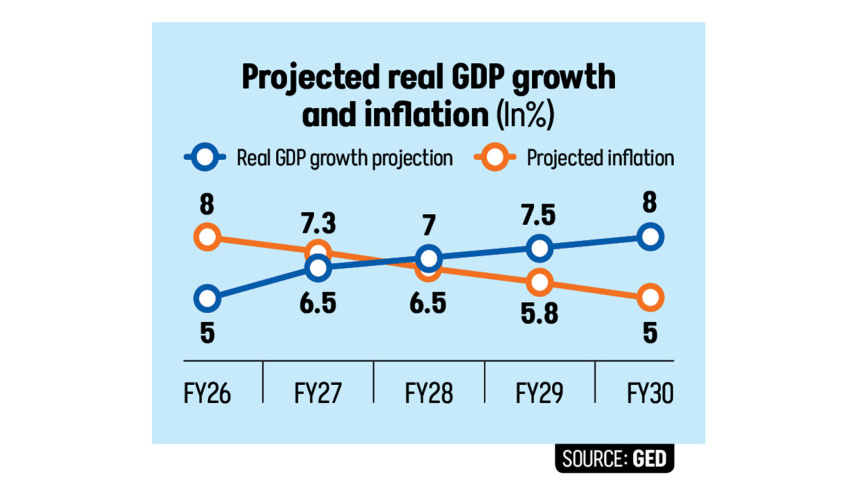
It projects real GDP growth reaching 8 percent by fiscal year 2029-30 (FY30), nominal GDP at $749 billion, inflation falling to 5 percent, and gross investment rising to 37.6 percent of GDP.
The outline will go through further consultations with relevant stakeholders before being finalised.
ICT AND JOBS
As per the draft, within the ICT sector alone, the government is targeting 10 lakh direct and indirect jobs.
Of the 10 lakh ICT jobs, 2 lakh are targeted in five areas -- cybersecurity, business process outsourcing (BPO), artificial intelligence (AI) and data, semiconductors, and Industry 4.0. The remaining 8 lakh are to be created indirectly through freelancing.
A national initiative will strengthen software, hardware, and BPO industries, backed by a commitment to universal high-speed internet, the GED said.
The draft also states plans to introduce a national e-wallet, including PayPal access, for freelancers and tech professionals.
Beyond ICT, the government aims to send 20 lakh people abroad annually through short-term language and skills training.
More than 5 lakh vacant government posts are to be filled through a transparent recruitment process.
EXPORT AND ENERGY
As per the draft plan, the garment sector will see stronger “Made in Bangladesh” branding through new product innovation.
The draft aims to broaden the export base by prioritising pharmaceuticals, leather, footwear, and agriculture and fisheries-based products.
Strategic free trade agreements at bilateral, multilateral, and minilateral levels are planned with key economic blocs across East and Far East Asia, Europe, Africa, and the Middle East.
On the energy front, the draft proposes ensuring supply of at least 20 percent of electricity from renewable sources -- solar, wind, hydropower, and waste-to-energy -- by 2030.
The power generation capacity is set at 35,000 megawatts, with transmission lines to be expanded to 25,000 circuit kilometres.
INVESTMENT AND BUSINESS
The outlined framework aims to increase foreign direct investment (FDI) from 0.45 percent to 2.5 percent of GDP within the next five years.
 For all latest news, follow The Daily Star's Google News channel.
 It proposes dedicated liaison officers and a formal complaint resolution system to build investor confidence, alongside a commitment to avoid sudden policy changes in tariffs, taxes, and export incentives.
To improve the business environment, it has set a target to complete digitalisation of approval processes to eliminate red tape and reduce physical contact in business transactions.
Company registrations are to be completed within 48 hours, and work permits within seven days.
A Bangladesh International Commercial Court will be established for fast-tracking commercial dispute resolution, and a Deposit Protection Ordinance is planned to ensure repayment from distressed banks as quickly as possible.
Besides, the tax-to-GDP ratio is targeted at 15 percent by 2035, to be achieved through expanded economic activity rather than a higher tax burden.
BLUE, CREATIVE ECONOMIES
The blue economy -- covering oil and gas exploration, renewable energy, fish harvesting, and shipbuilding -- will be developed as a national priority within Bangladesh’s maritime area.
The proposed framework has also set a target for the government to raise the contribution of the creative economy -- spanning film, music, theatre, gaming, VFX, and content creation -- to 1.5 percent of GDP, and create 5 lakh new jobs by 2035.
TOURISM AND SMEs
A national tourism policy update has been proposed, alongside a programme to help each village produce and market its own traditional product through design support, order-based loans, and e-commerce connectivity.
The draft also recommends that government channels low-interest loans based on each district’s heritage and renowned products, support for cottage industries, links to global e-commerce platforms.
Comments