


Govt offers tax breaks to develop semiconductor sector
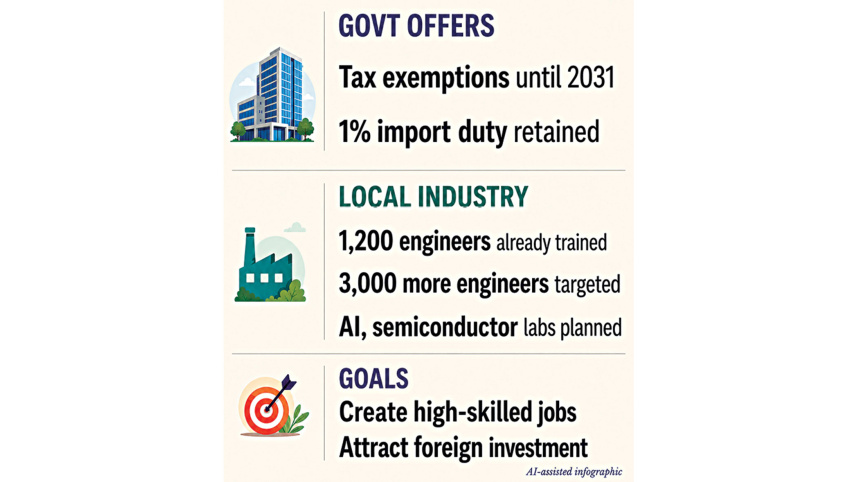
The government has announced a series of tax incentives for semiconductor and chip-related activities in a bid to develop a domestic ecosystem for the high-tech industry and create skilled jobs.
In his budget speech for FY2026-27 on Thursday, Finance Minister Amir Khosru Mahmud Chowdhury proposed exempting regulatory duty, supplementary duty, value added tax (VAT) and advance tax on raw materials used in semiconductor or chip design, testing and packaging until June 30, 2031. A 1 percent import duty will still apply on such imports.

The proposal is a part of a broader effort to strengthen the country’s capacity in advanced technologies and diversify its export base.
The finance minister said Bangladesh produces a large number of engineering graduates each year, and that many Bangladeshi professionals already work in the global semiconductor industry.
He said the government has proposed the incentives for the sector “to harness their talent, create high-skilled employment and promote export-oriented growth”.
The budget also set out plans to establish specialist laboratories for artificial intelligence (AI), semiconductors, robotics, machine learning and big data analytics.
It also outlined initiatives to strengthen national capacity in space research, semiconductor technology, and earthquake and seismographic research.
The government pledged continued support for researchers through the Science and Technology Fellowship Trust, saying investment in research and innovation would be critical to developing new technologies and preparing young people for the demands of the Fourth Industrial Revolution.
Industry stakeholders welcomed the move, saying the incentives could help attract investment in chip design, testing and packaging services, areas where Bangladesh already has a modest presence.
MA Jabbar, president of the Bangladesh Semiconductor Industry Association (BSIA), welcomed the proposed incentives, saying the industry had long engaged with policymakers to secure support.
“We have 21 member companies already invested in the local semiconductor sector,” he said. “We met officials from the National Board of Revenue and later the finance minister to explain the need for policy support.”
According to Jabbar, the country has strong potential to develop a skilled semiconductor workforce, particularly in chip design and related services.
“So far, we have trained around 1,200 semiconductor engineers and expect to develop another 3,000 within the next two years,” he said.
While the country has yet to enter semiconductor manufacturing, local firms have established a foothold in chip design, a key segment of the global semiconductor value chain.
“Our current focus is design. We are also working to establish testing laboratories to gradually move towards manufacturing,” Jabbar said.
He noted that the expanding global semiconductor market presents opportunities for countries able to supply skilled talent and specialised services.
“If we are to capture a share of this market, policy support must continue. The incentives announced in the budget are a positive step,” he said.
Jabbar added that sustained support could generate high-skilled jobs, boost exports and attract foreign investment. “There is considerable potential for foreign direct investment in this industry. But first, we must build the ecosystem and strengthen the sector domestically.”
In a statement, BSIA welcomed the fiscal and policy support for the semiconductor sector, saying it formally recognises activities such as IC design, electronic design automation (EDA), outsourced semiconductor assembly and testing (OSAT), packaging and fabrication within customs, tariff and VAT frameworks.
The association said exemptions from customs duty, regulatory duty, supplementary duty, VAT and advance tax on eligible inputs would lower costs, help attract investment, create skilled jobs and strengthen the country’s position in the global semiconductor and deep tech industries.
 For all latest news, follow The Daily Star's Google News channel.
 Syed Almas Kabir, president of the Bangladesh Association of Software and Information Services (BASIS), described the incentives as a strategic step towards high-value technology manufacturing.
“The incentives are timely and aligned with global industry trends. However, their success will depend not only on tax benefits but also on the ability to develop skilled talent, strengthen infrastructure and foster industry-academia collaboration,” he said.
According to Kabir, the tax relief for chip design, testing and packaging aligns policy support with the growing engineering talent base. “The real impact will come when these measures are backed by investment in advanced laboratories, stronger university-industry partnerships and a dedicated VLSI talent pipeline,” he added.
He said countries such as Vietnam and Malaysia built successful semiconductor industries by developing complete ecosystems rather than relying solely on incentives.
Kabir also highlighted the potential role of the Bangladeshi diaspora, many of whom work at leading global companies including TSMC, Intel, Qualcomm, NVIDIA, AMD and Synopsys. A structured programme to engage these professionals, he said, could significantly accelerate the country’s semiconductor capabilities.
Comments