


Import duty cuts on plug-in hybrids raise concerns

The government’s proposal to significantly reduce import duties on plug-in hybrid electric vehicles (PHEVs) has raised concerns among local automobile manufacturers, who say the move could encourage imports at the expense of domestic production.
In a letter to National Board of Revenue (NBR) Chairman on June 17, the Bangladesh Automobiles Assemblers and Manufacturers Association (BAAMA) urged the tax authority to revise the proposed fiscal measures, arguing that they create a policy imbalance between imports and local manufacturing.

“The existing budget framework will encourage imports of completely built vehicles rather than the establishment of PHEV manufacturing and assembly operations in Bangladesh,” Hafizur Rahman Khan, president of BAAMA, wrote in the letter.
In its letter, the association called for extending to local PHEV manufacturers the same level of support currently available to EV producers.
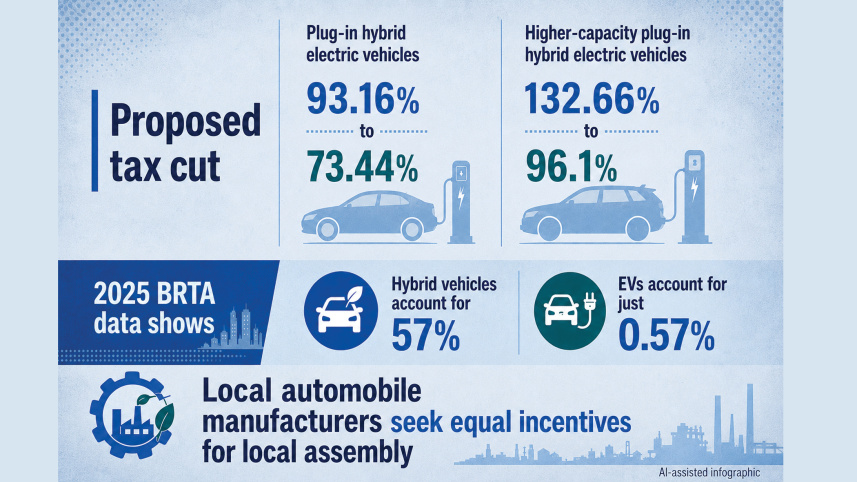
Under the proposed budget for fiscal year 2026-27, the total tax incidence on completely built-up (CBU) PHEVs with engine capacities of up to 1,800cc would fall to 73.44 percent from 93.16 percent. For vehicles between 1,801cc and 2,000cc, it would decline to 96.10 percent from 132.66 percent.
However, BAAMA says comparable incentives have not been offered for the local production, assembly and value addition of PHEVs.
The association noted that while the government recently introduced special incentives for locally manufactured electric vehicles (EVs) through SRO No. 163-Ion/2026/18/Customs, issued on June 8, no similar support has been announced for PHEV production.
Industry representatives say this could make importing fully built vehicles more attractive than investing in manufacturing facilities and supply chains in Bangladesh.
The concern comes as hybrid vehicles continue to gain popularity. Data cited by BAAMA from Bangladesh Road Transport Authority (BRTA) registrations show hybrids accounted for 57 percent of passenger vehicle registrations in 2025, up from 42 percent in 2021. Over the same period, the share of conventional internal combustion engine (ICE) vehicles fell from 58 percent to 42 percent.
Despite growing interest in cleaner transport, fully electric vehicles remain a niche segment, accounting for only 0.57 percent of registrations last year. Industry stakeholders attribute the slow uptake to limited charging infrastructure, high battery costs and concerns over long-distance travel.
BAAMA argues that Bangladesh is in a transition phase between conventional fuel-powered vehicles and full electrification, making PHEVs an effective intermediate technology that combines electric driving capability with the flexibility of a conventional engine.
The association said PHEVs can reduce fuel consumption by 40 percent to 60 percent, helping cut fuel import costs while lowering carbon emissions and air pollution.
The debate also has implications for Bangladesh’s emerging automotive industry. Several global brands, including Hyundai, Mitsubishi, Chery and Proton, have invested in local assembly operations through partnerships with Bangladeshi companies. Chinese EV manufacturer BYD has also initiated plans to establish manufacturing operations through a joint venture with Runner Automobiles.
According to BAAMA, policies that favour imports over domestic production could affect future investment decisions and discourage expansion by existing manufacturers.
The association also said the proposed tariff structure departs from the principle of tariff escalation, under which higher duties are imposed on finished vehicles while lower tariffs and incentives support local assembly, component manufacturing and value addition.
Such frameworks are intended to promote industrialisation, employment, technology transfer and the development of domestic supply chains.
BAAMA also referred to the Automobile Industry Development Policy 2021, which commits to supporting local manufacturing through fiscal incentives and investment-friendly measures while promoting fuel-efficient and environmentally friendly vehicle production.
An NBR official, speaking on condition of anonymity, said the proposed duty reduction on plug-in hybrid electric vehicles is part of the government’s broader strategy to promote energy-efficient and environmentally friendly transport
The measure is expected to reduce reliance on fossil fuels and accelerate the adoption of cleaner vehicle technologies.
The official said the government has not overlooked the interests of local manufacturers, noting that a range of fiscal and policy incentives has already been introduced to support the domestic production and assembly of electric vehicles.
 For all latest news, follow The Daily Star's Google News channel.
 Issues related to PHEVs remain under review, and any future policy decisions will seek to balance industrial development, investment promotion, technology transfer, and environmental sustainability.
Comments