


Imported at Tk 370, helmets sold for up to Tk 4,500


Highlights
- Helmet import values average less than $3 each
- Retail market prices reach up to Tk 4,500
- Under-invoicing hurts revenue and local helmet production
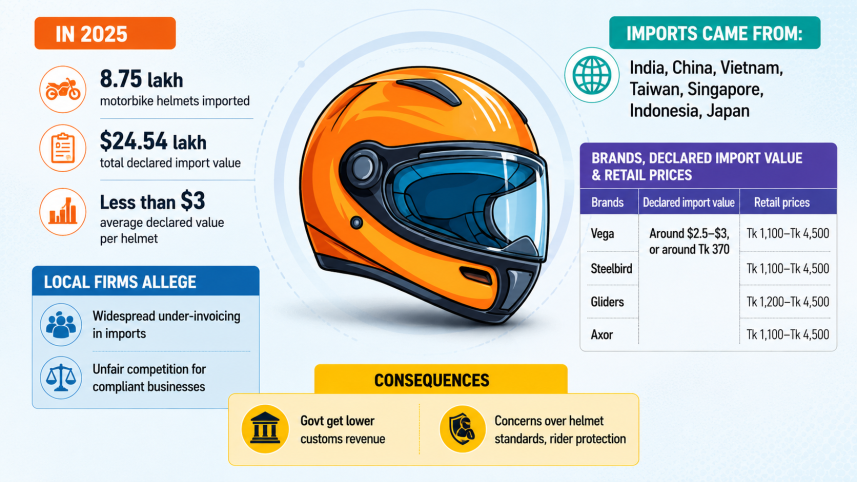
A motorcycle helmet declared at just $3, or about Tk 370, during import is being sold in the local market for as much as Tk 4,500.
The wide price difference between import values and retail rates has prompted local manufacturers and large importers to accuse customs authorities of failing to properly assess imports of the essential protective headgear for riding.

They allege that the failure encourages under-invoicing, deprives the government of revenue and undermines both local production and rider safety.
Meanwhile, a senior revenue official acknowledged that under-invoicing, where importers declare goods at lower-than-actual values to reduce taxes, remains a “major challenge” in helmet imports.
According to customs data, Bangladesh imported 8.75 lakh motorcycle helmets in 2025. The total declared value stood at $2.45 million. As per this estimate, the average import value per unit helmet is less than $3, or about Tk 370 at an exchange rate of Tk 123 to the dollar.
Last year, India supplied the majority of imports, accounting for 633,384 helmets, followed by China with 223,293 units. Smaller quantities arrived from Vietnam, Taiwan, Singapore, Indonesia and Japan.
Customs records show helmets imported from India were declared at an average value of $3.02 per unit, while those from China were valued at just $1.96.
But visits to markets in Dhaka, as well as in Chattogram, found many of the same brands selling for between Tk 1,200 and Tk 6,000, depending on model and quality.
Import data show that several Indian brands, including Vega, Steelbird, Gliders, Axor, Telish and Aerostar, were declared at prices ranging from $2.50 to $3 per unit. Many of those helmets are retailing in the local market for between Tk 1,100 and Tk 4,500.
In May this year, Narayanganj-based New Nation Automobiles imported 7,236 Gliders helmets from India, declaring a unit value of $2.52. Customs assessed the shipment at $3 per unit for duty purposes.
Even after adding duties, taxes and value-added tax (VAT), which together amount to 59 percent, the estimated landed cost would remain below Tk 600 per helmet, according to import documents. But the same brand is selling in the local market for between Tk 1,200 and Tk 4,500.
Contacted, Nurul Haque, proprietor of New Nation Automobiles, said the declared import value did not reflect the total cost of bringing a product to market.
“After adding LC commissions, shipping costs, customs duties and VAT, our cost exceeds Tk 800 per helmet. We sell to wholesalers at Tk 900-Tk 950. By the time the product reaches retailers through multiple distribution layers, the price increases further,” Haque told The Daily Star.
He said helmets priced between Tk 800 and Tk 1,200 account for nearly 80 percent of market demand.
Industry players, however, say the practice remains widespread and is hurting compliant businesses.
Rokon Sarkar, deputy director of ACI Motors, which imports helmet brands including SMK and Studds, said compliant importers are facing mounting pressure as some traders allegedly understate helmet values to reduce taxes.
“Some importers are declaring a helmet at only $2.5, while we declare the actual price, around $15, and pay taxes and VAT accordingly,” he told The Daily Star.
He said the practice allows some importers to avoid a substantial portion of the roughly 62 percent duty and tax on helmet imports, making it increasingly difficult for compliant businesses to compete.
According to Sarkar, under-declaration is also contributing to the spread of lower-quality helmets while reducing government revenue.
ACI Motors previously imported premium Italian brands Nolan and X-Lite, which sold for between Tk 25,000 and Tk 60,000.
 For all latest news, follow The Daily Star's Google News channel.
 Motorcycles have become increasingly popular in major cities as a fast and affordable means of transport. According to Bangladesh Road Transport Authority (BRTA) data, the number of registered motorcycles stood at 45.8 lakh at the end of 2024, up from 31.25 lakh four years ago.
At the same time, motorcycle crashes have emerged as the leading cause of road fatalities. According to the Road Safety Foundation, motorcycles were involved in around 40 percent of all fatal road crashes in 2025.
The organisation recorded 3,029 motorcycle-related accidents that year, killing 2,671 riders and passengers.
The World Health Organization (WHO) says quality helmets can reduce the risk of death in a road crash by more than six times and lower the risk of brain injury by up to 74 percent.
While most Vega, Steelbird and Gliders helmets were declared at around $3 per unit, premium brands such as Studds, SMK and Graphic were declared at values ranging from $8.50 to $30.80. These products usually retail for between Tk 2,200 and Tk 6,000 in Bangladesh.
An NBR official, speaking on condition of anonymity, said under-invoicing in helmet import remains a major problem.
According to an analysis by the NBR’s valuation committee, around 95 percent of helmets imported in 2025 were declared at $3 or less per unit. Another 4 percent were declared at values between $3.50 and $15, while only about 1 percent were declared within the $15-$31 range.
“Whenever importers declare values of $3 or less, we usually apply a loading of $0.20 to $0.50 cents during assessment. This helps recover part of the revenue loss, although we know the actual value is often much higher,” the official said on condition of anonymity.
Industry representatives argue that the consequences extend beyond lost revenue and are also affecting road safety and domestic manufacturing.
RN Paul, managing director of RFL, which manufactures Safemet helmets, said local manufacturers could expand production if imported helmets were assessed at their proper value during customs clearance.
“Increasing capacity is not difficult for us,” he said. “But if the existing duty structure continues, there is little point in expanding because consumers will not buy our products.”
Shah Muhammad Ashequr Rahman, chief marketing officer of Bangladesh Honda Private Limited, which imports Honda helmets, said quality-certified helmets are becoming less competitive because of lower import value declarations by non-compliant traders.
He said the practice allows cheaper and lower-quality helmets to dominate the market, discouraging imports of internationally certified products.
Rahman also said the BSTI approval process requires multiple sample units for each size and model, along with testing and certification fees, increasing costs for compliant importers.
“If regulatory costs, approval time and import duties are reduced while maintaining proper quality standards, internationally certified helmets will become more accessible and affordable,” Rahman said.
Comments