


Inflation hits 10-month high in February, crosses 9%

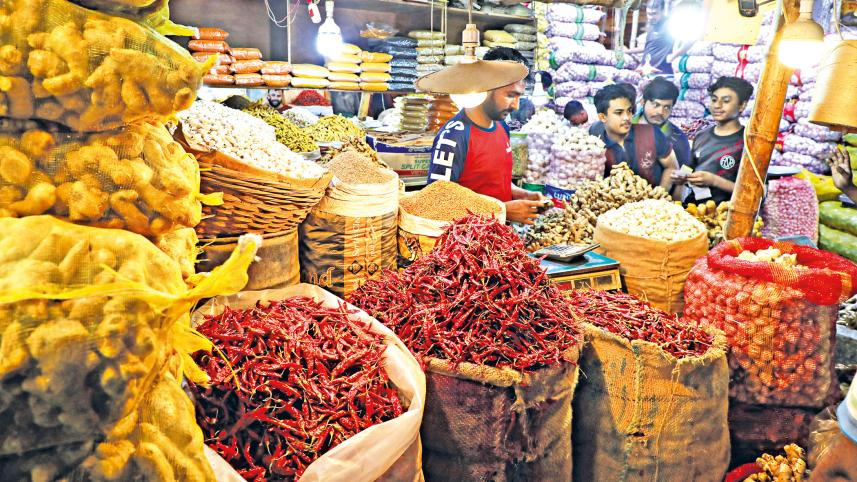
Overall inflation rose to its highest level in ten months in February, climbing to 9.13 percent from 8.58 percent in January, according to data released by the Bangladesh Bureau of Statistics yesterday.
Economists say rising food prices ahead of Ramadan and election-related spending added to demand pressures, pushing the Consumer Price Index (CPI), a measure of the prices of a basket of goods and services, above 9 percent for the first time since May last year.

February also marks the fourth consecutive monthly increase since inflation touched a 39-month low of 8.17 percent in October.
Food inflation bore the brunt of the rise, jumping to 9.30 percent in February from 8.29 percent the previous month. Non-food inflation also edged higher, reaching 9.01 percent from 8.81 percent, reflecting continued pressure in housing, transport and healthcare.
Bangladesh has been struggling with persistent inflation for more than three years. The burden falls hardest on the poor and low-income households, who spend a disproportionate share of their earnings on food and have the least capacity to absorb price shocks.
Inflation moderated slightly in recent months, but the 12-month annual average rate remained above 8.5 percent in January even though Bangladesh Bank maintains a hawkish monetary policy stance aimed at curbing demand-driven price increases and stabilising the economy.
As part of its tightening measures, the central bank has kept the policy rate at 10 percent for nearly one and a half years.
In its latest monthly economic updates, the General Economic Division under the Planning Commission said the recent trend indicates continued pressure from food prices within the overall inflation framework.
Sectoral contribution analysis shows that food remains the largest contributor to headline inflation in January.
Food accounted for 43.06 percent of overall inflation in January, up from 40 percent in December. Fish and dry fish remained the highest contributors, although their share decreased from 43.34 percent to 32.27 percent, it said.
ELECTION SPENDING, SUPPLY PRESSURE
Zahid Hussain, former lead economist at the World Bank’s Dhaka office, pointed to a convergence of February-specific factors. “We cannot look at this solely through the lens of monetary policy.”
Noting that urban food inflation rose the most, he explained, “part of this increase seems linked to election-related demand”.
Campaign spending, providing snacks at tea stalls or serving biryani, boosts the food component and contributes to higher prices, he said.
On the supply side, he noted, “A major disruption at the ports in February increased inflation expectations and hoarding tendencies.”
The economist also explained that combined with the lean season for food production -- the peak winter season has ended, but the spring harvest has not yet arrived -- this created a double burden on food prices.”
Hussain went on to point out that non-food inflation also rose, particularly in the miscellaneous category, which went from 21 to 24 percent. Understanding this category is key, as it recorded the highest inflation.
CONTRACTIONARY POLICY ESSENTIAL: ECONOMISTS
Regarding monetary policy, Hussain said, “Without the contractionary stance, the situation would have been even worse. The new governor had discussed reducing the policy rate, but that option has been postponed in light of recent challenges.”
 For all latest news, follow The Daily Star's Google News channel.
 With the Middle East conflict between Iran and US-Israel now threatening fuel and import costs, he warned the outlook was worsening.
“Now, with the war adding further pressure, it’s like rubbing salt on the wound. Inflation, growth, and employment are all under strain, and the situation ahead does not look positive from any perspective,” he said.
Ashikur Rahman, principal economist of the Policy Research Institute, also agrees that the central bank’s monetary policy stance is the right way to handle the situation.
“The twelve-month moving average clearly shows that inflation is on a downward trajectory, indicating that the current contractionary monetary stance is beginning to yield results,” he said.
“Bangladesh’s real policy rate, calculated by subtracting the inflation rate from the policy rate, stands at roughly 1.5 percent, one of the lowest in South Asia,” he added.
He cautioned that any premature easing risked reigniting inflation and undermining macroeconomic stability.
Md Deen Islam, a professor of economics at Dhaka University, echoed a similar tone on keeping monetary policy unchanged.
“The limited impact of higher policy rates largely reflects weak monetary transmission in the banking sector. Lending rates and credit flows often do not adjust fully to policy signals due to structural inefficiencies and high levels of non-performing loans.”
“Much of the recent inflation in Bangladesh has been driven by supply-side factors -- rising food prices, exchange rate depreciation, and higher import costs for fuel and essential commodities -- which monetary policy alone cannot easily control,” he noted.
He emphasised that addressing inflation effectively requires a broader policy mix that combines prudent monetary management with improvements in supply chains, enhanced market competition, exchange rate stability, and fiscal coordination.
Comments