


Inland waterway fees hiked, raising concerns over essential costs

Highlights
- Inland waterways carry most essential commodities
- Higher charges elevate factory production costs
- Persistent inflation complicates business cost recovery
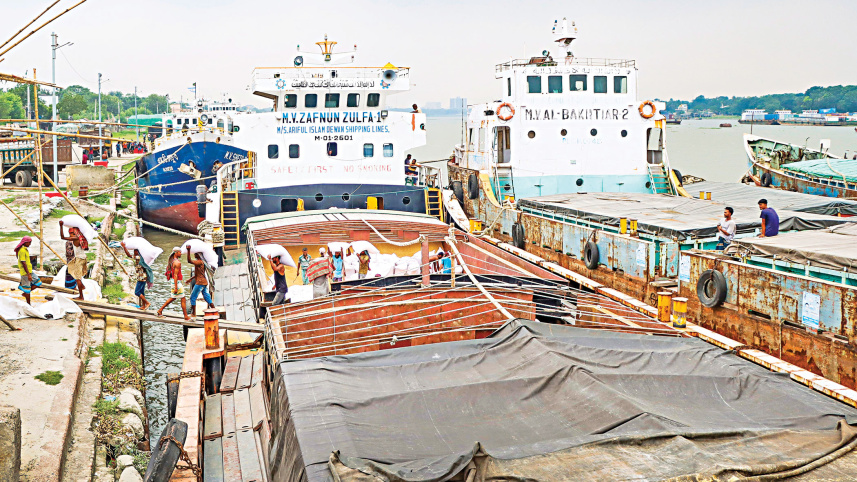
The government has increased charges and fees by up to 100 percent for passenger and cargo vessels operating in inland and coastal waters. Transport operators and businesses say the move could push up logistics costs for essential goods ranging from food items to construction materials.
The revised rates, announced by the shipping ministry last month, are scheduled to take effect from July 1.

From the next fiscal year, cargo vessels, bulkheads, fishing boats and other vessels will be required to pay Tk 100 per gross tonne as a conservancy charge, up from the current Tk 40.
Launch operators will have to pay Tk 150 annually per passenger as a conservancy charge, up 30 percent from Tk 115.
The pilotage fee will rise to Tk 750 for every eight-hour period, up from Tk 500, according to the notification issued by the shipping ministry, which has raised rates for services provided by the Bangladesh Inland Water Transport Authority (BIWTA).
The government last raised the rates in 2019.
The increased rates include berthing and mooring charges for all vessels, including goods-carrying and passenger transport vessels.
“We have already lost a lot of passengers due to the Padma Bridge. We are incurring losses because of a dearth of passengers. The increased charges and fees will hit us further as we lose passengers,” said Akter Hossain, director at Sundarbans Navigation Company Ltd, operator of the Sundarban launch service on the Dhaka-Barishal waterway.
He said launches operating on these routes are already charging fares below the officially fixed rates amid falling demand.
Cargo vessel and oil tanker operators said the higher charges would increase transportation costs.
Nazmul Hussain Hamdu, senior vice-president of the Coastal Ship Owners Association of Bangladesh, said the changes would affect everyone in the value chain.
“We will have no way but to hike rental rates. So, we will feel the hit initially. Later, everyone will be affected,” he said, adding that cargo vessels carry a wide range of raw materials and essential goods.
A large volume of goods is imported through Chattogram Port, where cargo is unloaded from mother vessels before being transported by lighter vessels to factories and other destinations across the country.
“From raw materials for cement to wheat, salt, pulses and stones, the list of items we handle is quite long,” he said.
Cement industry stakeholders said manufacturers depend heavily on inland waterways to transport imported inputs such as clinker, limestone, slag, fly ash and gypsum. Cement is also shipped across the country through the same network.
On condition of anonymity, an official at a cement manufacturer said the increased charge would raise production costs by more than Tk 3 per bag.
Mohammad Iqbal Chowdhury, chief executive officer of LafargeHolcim Bangladesh PLC, which is mostly owned by foreign investors, said the industry is going through a tough time due to slowing construction activity.
“The demand remains stagnant. Higher energy prices and increased raw material costs due to the war in the Middle East have dealt a further blow to the sector. At this stage, any rise in water transport-related costs will affect the supply chain,” he said.
Md Aminul Islam, managing director and chief executive officer of Nabil Group of Industries, estimated that transporting commodities such as wheat, lentils, soybean meal and maize would increase by Tk 36 per tonne through waterways.
He said inland waterways account for as much as 90 percent of transport for essential commodities.
 For all latest news, follow The Daily Star's Google News channel.
 “We ship commodities to various hubs such as Barishal and Ashuganj through lighter vessels after unloading them from mother vessels at the port,” he said.
“So, ultimately the increased cost will fall on customers,” he said.
Inflation has been staying above 8 percent for more than three years, with no sign of easing despite a tight monetary policy maintained by the Bangladesh Bank for more than a year and a half.
Cargo operators said business has declined as several large business groups now use their own vessels to move goods from ports to factories and distribution points.
Kazi Abdul Karim, legal affairs secretary of the Bangladesh Cargo Vessel Owners’ Association, said operators will not be able to pass on higher costs due to slowing imports and higher vessel supply.
A former executive committee member of the Bangladesh Oil Tanker Owners’ Association said the construction of a petroleum pipeline between Chattogram and Dhaka has affected the revenue of oil tanker owners.
“We are transporting roughly 45 percent less petroleum than in the past,” he said.
Comments