


LPG supply security hinges on boosting storage capacity

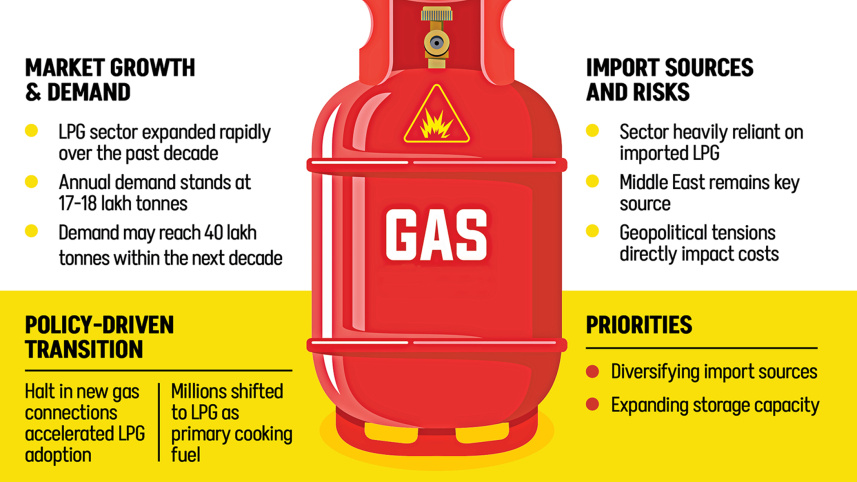
Bangladesh’s liquefied petroleum gas (LPG) sector has grown rapidly, yet lacks the storage capacity to buffer itself against global market shocks, according to the president of the LPG Operators Association of Bangladesh (LOAB).
“Expanding storage capacity is essential for improving supply security,” Mohammed Amirul Haque said in an interview with The Daily Star recently. “If operators can store larger volumes, they can better manage fluctuations in global supply and price movements.”

According to industry estimates, Bangladesh currently consumes around 17-18 lakh tonnes of LPG annually. Around 80 percent of this demand comes from households, mainly for cooking in areas where natural gas through pipeline is unavailable. Industrial, commercial, and autogas use together account for the remaining share.
Haque, also the managing director of Delta LPG Limited, said the country’s transition toward LPG took place over the last decade after the government decided to permanently halt new pipeline gas connections to households in order to manage limited domestic gas reserves.
He, however, pointed out that the industry’s dependence on imports means that the entire supply chain, from procurement to pricing, remains highly sensitive to global market conditions.
“Geopolitical tensions, disruptions in shipping routes, or volatility in international benchmark prices can directly affect supply costs and domestic pricing,” he said.
Most LPG used in Bangladesh is sourced from the Middle East, with prices typically linked to the Saudi Aramco Contract Price, which serves as a reference point for global LPG trade. Changes in that benchmark are quickly transmitted to the domestic market, leaving consumers exposed to international volatility.
“Any disruption in the international supply chain can affect Bangladesh’s LPG market because we do not have significant domestic production,” Haque said. “Even freight costs and insurance premiums can change depending on geopolitical developments, which ultimately affects the landed cost of LPG.”
Disruptions along major shipping corridors such as the Strait of Hormuz or the Red Sea can have immediate repercussions on global LPG trade flows.
When global shipping rates rise, the additional cost is reflected in the final price of LPG in the domestic market.
Haque argued that the country’s growing LPG demand has intensified the need for stronger storage and distribution infrastructure. Currently, most operators rely on coastal storage terminals and bottling plants to distribute LPG cylinders across the country.
“Expanding storage capacity is essential for improving supply security,” he said. “If operators can store larger volumes, they can better manage fluctuations in global supply and price movements.”
Without sufficient storage, the market remains more vulnerable to sudden price spikes or supply delays, he added.
Diversifying import sources is another important strategy for reducing supply risk, the LOAB president also said, noting that Bangladesh relies heavily on a relatively small number of international suppliers.
By broadening procurement sources and strengthening supply agreements with multiple exporting countries, the industry could reduce its exposure to regional disruptions, he said.
Haque also called for infrastructure improvements at ports and terminals to support the continued expansion of the sector, noting that such logistical bottlenecks can slow shipment movement and increase costs.
Domestically, he said, private sector investment has played a major role in expanding LPG infrastructure across Bangladesh. Over the past decade, operators have invested heavily in bottling plants, storage facilities and distribution networks to support the growing market.
However, regulatory stability and predictable pricing mechanisms are also crucial for maintaining investor confidence in a market that is closely tied to global energy dynamics.
Local LPG prices are regulated by the Bangladesh Energy Regulatory Commission, which adjusts retail prices in line with international benchmarks. While this mechanism provides transparency, sudden changes in global prices can still create challenges for both operators and consumers.
“Transparent and predictable pricing mechanisms are essential,” Haque said. “When international prices rise, adjustments should be gradual so that consumers are not suddenly burdened while the industry remains financially viable.”
 For all latest news, follow The Daily Star's Google News channel.
 He expects demand for LPG to continue growing as urbanisation increases and more households move away from traditional cooking fuels such as firewood and biomass.
Industrial and commercial sectors are also gradually expanding their use of LPG due to its efficiency and environmental advantages compared with some conventional fuels.
Industry projections suggest that Bangladesh’s LPG consumption could reach around 40 lakh tonnes annually over the next decade if infrastructure and policy support keep pace with demand.
However, the country’s continued reliance on imported LPG means that global market conditions will remain a defining factor in the sector’s long-term stability.
Strengthening storage capacity, diversifying supply sources, improving port infrastructure and ensuring regulatory consistency will be key steps toward building a more resilient LPG supply chain, said Haque.
Comments