


New venture eyes major share of garment hanger market
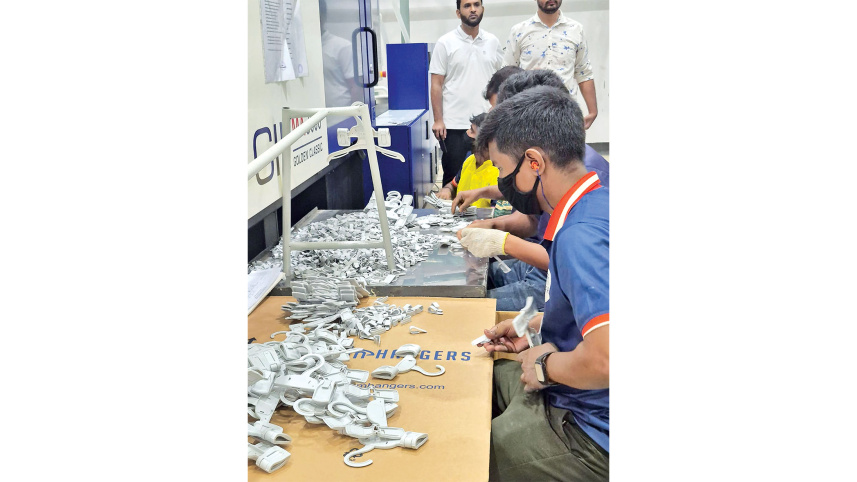
Bangladesh’s fast-growing garment exports are attracting fresh investment into support industries, with a new hanger manufacturing venture targeting a significant share of the $400 million apparel-related market.
The Bangladesh unit of Tam Hangers was launched yesterday in partnership with Meghna Group, aiming to bring in global standards and reduce import dependence.

The joint venture plans to invest up to $40 million and create thousands of jobs. However, it also highlights a long-standing concern among foreign investors: bureaucratic hurdles that continue to restrict higher-value activities such as recycling and circular manufacturing.
Mohammad Mizanur Rahman Bhuiyan, chairman of Meghna Group, said Bangladesh’s expanding apparel exports require stronger backward linkages, even for basic items like hangers.
“Every exported garment, especially high-end products for the EU and US, needs a hanger,” he said. “Right now, many of these are imported or made by small local firms.”
To address this gap, Meghna has partnered with Tam Hangers, a global supplier to brands such as H&M and Marks & Spencer. “Through this partnership, we are bringing world-class technology and standards to Bangladesh,” he added.
The project is in its initial phase, with a facility set up at Meghna’s industrial park in Mirzapur, Tangail. Investment currently stands at around $10 million, with plans to increase it to $40 million.
“We are targeting more than 100 injection moulding machines,” Rahman said, adding that the project could employ 3,000 to 4,000 people at full capacity.
“This is not just about manufacturing. It is about building technical skills in injection moulding and promoting sustainable packaging solutions.”
He said the venture aims to achieve an annual turnover of $200 million within five to seven years and capture at least half of the domestic hanger market.
Gokhan Tezsezer, chairman of Tam Hangers, said Bangladesh remains attractive due to its large export volumes and competitive labour costs, and the company plans to raise investment to $40 million over the next five years.
However, he said bureaucracy remains a major challenge, particularly in recycling operations. “Despite efforts over four years, the company could not get approval to set up a hanger reuse facility and eventually moved the project to Sri Lanka,” he said.
He added this was a missed opportunity for jobs and cost savings, noting such a facility could have employed thousands.
Tam Hangers aims to capture up to half of the hanger market within the next decade, but warned regulatory barriers may push investors to countries with smoother operations.
 For all latest news, follow The Daily Star's Google News channel.
Comments