


Promising export sectors to get RMG-style support: Amir Khosru
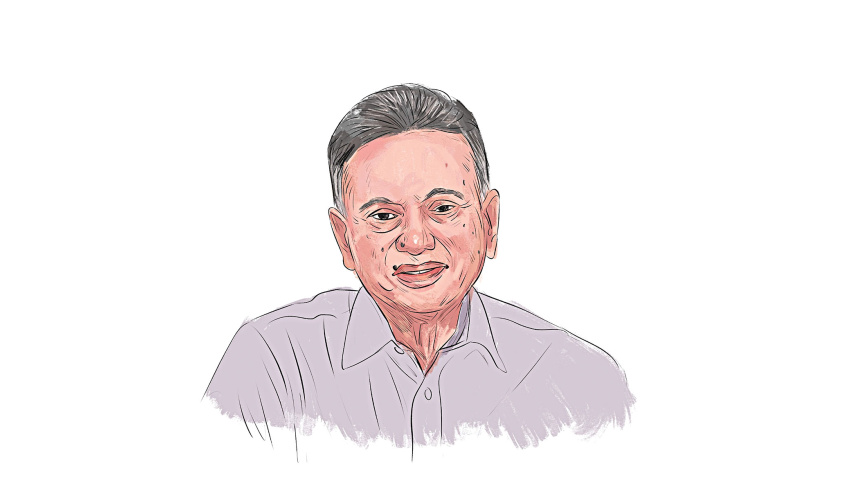
The government will provide all promising export sectors with the same facilities currently available to the readymade garment (RMG) industry, Finance Minister Amir Khosru Mahmud Chowdhury said yesterday at a meeting with business leaders.
“If any promising export sector comes to us with a proposal, we will extend to that sector the same facilities that are available to the garment industry,” he said at the pre-budget meeting organised by the Federation of Bangladesh Chambers of Commerce and Industry (FBCCI) and the revenue board at the Pan Pacific Sonargaon.
 For all latest news, follow The Daily Star's Google News channel.
 Bonded warehouse facilities, back-to-back arrangements, and all other relevant support will be provided, he added, citing the gold and diamond sectors as examples of industries held back by the absence of such support.
Goldsmiths, he noted, were leaving the country for a lack of opportunities.
Bonded warehouse facilities allow export-oriented industries to import raw materials duty-free, on the condition that finished goods are not sold domestically. Currently, only the RMG sector enjoys the facility in full; the leather goods sector receives it partially.
The National Board of Revenue (NBR) had long resisted broader extension, citing fears of duty-free materials being diverted to the local market, despite calls from economists to extend the facilities across the board.
The minister acknowledged those concerns but said they could not justify inaction. “It cannot be the case that we do nothing out of fear of theft,” he said, adding that preventing misuse is a separate issue, and solutions will be addressed accordingly.
On taxation, he said the government could not offer broad incentives at present but would work to lower the cost of doing business.
“Wherever you are facing obstacles, let us know, and we will remove them. Tell us where your costs are increasing, and we will directly address those issues within the next three months,” he told businessmen at the meeting.
This is already part of the ruling BNP’s manifesto, but businesses’ input will make it more effective, he noted, adding that while removing all obstacles might not be possible, the government will eliminate most of them. “Give us some time. If we fail, we will take responsibility.”
Stating that many have spoken about expanding the tax net, the minister requested business associations to assist in bringing those who are still outside the tax net into the system.
Painting a difficult economic picture, Khosru said the new government has inherited a damaged banking sector, weakened stock market and over Tk 40,000 crore in unpaid energy bills.
In addition, due to the ongoing conflict in the Middle East, the government is facing an additional energy cost of around $4 billion, he added.
“We are navigating through these challenges across all sectors, but the government does not have unlimited resources… It will take some time for the situation to improve,” the minister said, adding that the government and businesses need to work together to overcome this.
Noting that businesses are also experiencing a serious capital shortage, he said due to currency depreciation, many have seen about 40 percent of their capital wiped out. On top of this, a 13–14 percent inflation rate has further eroded value. “Altogether, nearly 50 percent of capital has been eroded.”
Describing the economy currently in a “low-level equilibrium”, Khosru said generating growth is necessary to move it upward and attract investment. “If poverty, which has risen significantly, is not reduced through higher expenditure, demand will not be generated.”
On the high borrowing costs, he said in the past, monetary supply was tightened to control inflation, but its effectiveness is uncertain.
With interest rates at 15 percent, he said the government would increase the development budget to stimulate growth, but cautioned that investment quality, not volume, was the priority. “If funds are misused or siphoned abroad in the name of mega projects, then a large budget serves no purpose.”
He projected a two-year adjustment period before the economy stabilises. “By the third year, the economy will turn around.”
Khandakar Abdul Muktadir, minister of commerce, industries, textiles and jute, said energy shortages and high borrowing costs had left many industrial sectors fragile, and that resolving those two issues was a prerequisite to new investment.
On reducing the cost of doing business, he said alongside providing targeted relief to the private sector, proposals will be made considering how to strengthen the national exchequer.
He also called for the jewellery sector to be brought fully into the formal economy, arguing that Bangladesh had a skilled workforce but lacked laboratories, design infrastructure, and supportive policy.
“If neighbouring countries can export several billion dollars’ worth of gold annually, why can’t we? We have the technical knowledge and skills. What we need are better laboratories, design facilities, and a supportive government policy,” he added.
Kamran T Rahman, president of the Metropolitan Chamber of Commerce and Industry, said the effective tax rate for many businesses reached 40-50 percent when advance and source taxes were factored in.
He called for unconditional corporate tax reductions, relaxed cash transaction rules, an integrated taxpayer profile system, and online appeal hearings for income tax, VAT, and customs disputes.
Comments