


Rotting onions, low prices hit farmers hard

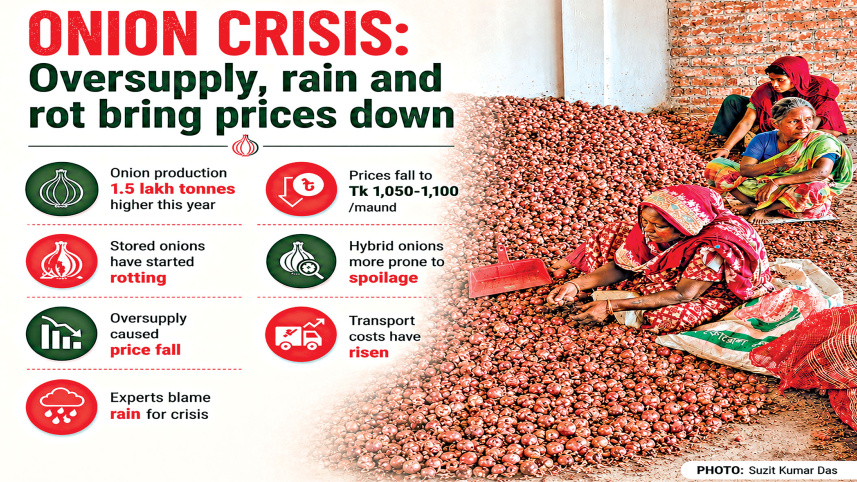
Onion farmers in several major producing districts are facing heavy losses as bumper production has driven prices down, while a large share of stored onions has started rotting.
Farmers in Rajbari, Kushtia, Pabna and Faridpur said production was higher this year than in the previous season. However, falling prices and post-harvest losses have left many unable to recover production costs.

Onions are now selling at around Tk 1,050 to Tk 1,100 per maund, down sharply from Tk 1,800 to Tk 2,000 during the same period last year, traders said.
Traders blamed oversupply for the price slump. Transport costs have also risen as trucks are being used to carry sacrificial animals ahead of Eid-ul-Azha.
Agriculture experts said onion prices are unusually low this year and advised farmers to store their produce until prices improve. However, many farmers cultivated hybrid varieties, which spoil more quickly and are unsuitable for long-term storage.
FARMERS COUNT LOSSES
According to the Department of Agricultural Extension (DAE), Bangladesh produced 31.41 lakh tonnes of onions in fiscal year 2025-26, up from 29.90 lakh tonnes a year earlier.
Biswajit Biswas, a farmer from Pangsha upazila in Rajbari, said he cultivated hybrid onions on 4.5 acres at a cost of Tk 4.7 lakh. He harvested around 600 maunds and stored 450 maunds in a government-supported facility, where nearly 90 percent later rotted. One maund equals about 40 kilogrammes. “If I sell the remaining onions now, I will not recover even Tk 1 lakh,” he said.
Another farmer from the same upazila, Bashar Molla, said he had stored onions hoping for better prices ahead of Eid.
“We thought we would celebrate Eid with the profit from onions. Now we cannot even recover our costs,” he said. “For onion farmers, there is no Eid this year.”
Jahidul Islam, a farmer from Rajbari Sadar upazila, said even selling 100 maunds of onions would not be enough to buy a sacrificial animal this Eid-ul-Azha.
Islam Khan, an onion trader at Banibaha market in Rajbari, said top-quality onions were selling for a maximum of Tk 1,050 per maund on Friday. “There is excess supply in the market compared to demand, which has pushed prices down,” he said.
He added that many farmers were rushing to sell onions after rot developed in storage, further increasing supply.
Another trader at the market, Selim Molla, said he buys onions locally and ships them to Khatunganj in Chattogram.
“Trucks are now hard to find because many are being used to transport sacrificial animals ahead of Eid,” he said, adding that freight costs had also increased.
According to him, onions bought at Tk 1,000 per maund cost Tk 1,050 to Tk 1,100 per maund by the time they reach Chattogram after transport expenses. Traders are also spending more on labour to separate rotten onions from good ones.
“Like farmers, traders are also incurring losses this year,” he said.
EXPERTS BLAME WEATHER
Md Shahaduzzaman, deputy director of the DAE in Faridpur, said onion production exceeded the national target this year, contributing to lower prices. “We are advising farmers to preserve onions for now instead of selling immediately. Prices may rise within the next month,” he said.
Md Mushfiqur Rahman, scientific officer at the Faridpur Spice Research Sub-centre, said excessive rainfall during harvesting increased rotting this year. Hybrid onion varieties, which contain more moisture, were particularly vulnerable. “Farmers cultivated more hybrid onions because of their higher yield, which increased the risk of spoilage,” he said.
 For all latest news, follow The Daily Star's Google News channel.
 He also said many farmers use self-produced seeds, resulting in mixed varieties and poor storage management.
According to him, onion production costs stand at around Tk 28 to Tk 30 per kilogramme, meaning farmers will incur losses if prices remain below Tk 30.
Md Shohidul Islam, deputy director of Rajbari DAE, said about 5 percent of onions produced in the district spoiled due to rain and low-quality seeds.
He added that the agriculture ministry had been asked to halt onion imports and take steps to raise prices to at least Tk 40 per kilogramme.
Comments