


Solar power, EVs set to gain from green budget measures

Highlights
- Zero tax facility likely for commercial solar power
- Advance tax on electric vehicles may drop significantly
- Import duty exemptions proposed for green battery materials
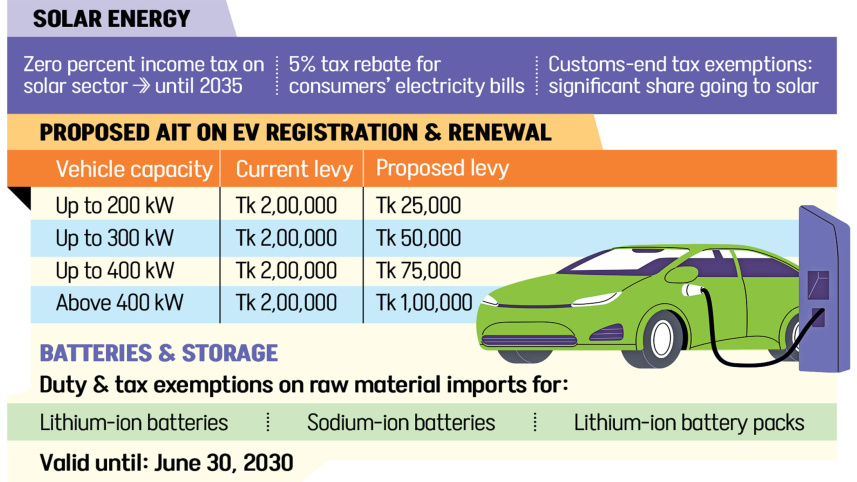
Commercial solar power generation is likely to receive a zero percent income tax benefit in the upcoming budget, while the government is considering a five percent rebate on electricity bills for retail consumers who use solar power.
Besides, the proposed budget for the 2026-27 fiscal year may exempt imports of raw materials used to manufacture lithium-ion batteries, sodium-ion batteries and lithium-ion battery packs from duties and taxes until 2030.

These batteries are widely used in solar power systems. Imports currently face a total tax incidence of about 60 percent.
Finance ministry officials familiar with the matter said a significant share of customs tax incentives in FY27 could be directed towards the solar sector as the government seeks to reduce dependence on conventional energy sources amid volatility in global fuel markets.
As part of its broader green energy agenda, the BNP government is also considering lowering advance income tax on electric vehicles (EVs) during registration and renewal.
The current levy of Tk 2 lakh would be reduced to Tk 25,000, Tk 50,000, Tk 75,000 and Tk 1 lakh, depending on vehicle capacity.
The proposed rates would apply to EVs with capacities of up to 200kW, 300kW, 400kW and above 400kW, respectively.
The government is also considering extending concessional import benefits to local EV parts makers, alongside manufacturers and assemblers.
“Duties on charging stations for e-bikes and EVs may also be reduced in the budget,” said one of the officials.
Finance Minister Amir Khosru Mahmud Chowdhury is expected to announce the measures when he presents the national budget in parliament on June 11.
Officials said the proposals have already received in-principle approval from Prime Minister Tarique Rahman at a high-level meeting last month.
Feroz Kabir, senior general manager of Runner Motors, which sells imported electric scooters, welcomed the proposals, saying they were in line with the global shift towards cleaner transport.
However, he said charging infrastructure remains a major concern.
“Government action will largely shape how EV demand grows,” said Kabir, adding that while most users still rely on home charging, a structured charging network will be crucial for wider adoption.
He said consumer acceptance is rising as vehicle range, comfort and practicality have improved. Although EVs cost more upfront, buyers focus on savings in day-to-day use.
Zakir Hossain Khan, chief executive officer of the Change Initiative, said the government’s green transition efforts should be accompanied by a broader overhaul of renewable energy and EV policies.
He argued that the current tax regime creates distortions and inefficiencies, noting that even low tariffs can lead to complex customs assessments and the risk of misclassification.
“We should move towards zero duty. This already exists in the garment sector.”
Khan also criticised the wide disparity between the taxation of fossil fuels and clean energy.
“For fossil fuel, when the government is giving zero or 1 percent duty, but here they are charging up to 65 percent. That is tax injustice,” he said.
 For all latest news, follow The Daily Star's Google News channel.
 He argued that energy taxation should be based on consumption rather than supply chains.
Last week, the Centre for Policy Dialogue (CPD) proposed a package of fiscal reforms to accelerate Bangladesh’s green energy transition.
The think tank called for the removal of advance tax on solar and wind equipment, lower customs duties on lithium-ion batteries, the elimination of supplementary duty on energy storage systems and reduced taxes on electric vehicles.
CPD recommended scrapping the existing 7.5 percent advance tax on solar and wind equipment, which raises total tax incidence to between 28 and 31 percent and increases project costs.
It also proposed reducing customs duty on lithium-ion batteries from 25 percent to 5 percent and eliminating the 20 percent supplementary duty on energy storage systems. According to the think tank, these measures would significantly lower tax burdens and support renewable energy integration.
On electric vehicles, CPD called for the removal of the 20 percent supplementary duty and the three percent regulatory duty, while reducing customs duty from 25 percent to 10 percent.
CPD said EVs currently face the highest tax burden among all energy-transition technologies.
Comments