


Taskforce formed to push deregulation
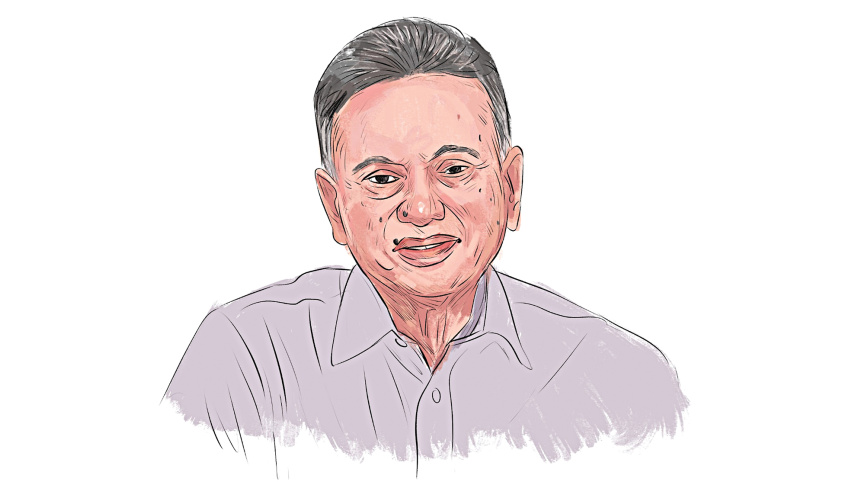
“Those who will create barriers in deregulation, we will show them the way out”
The government has formed a taskforce to oversee its deregulation drive and will launch a dashboard from the first week of next month to monitor the progress of project implementation in every ministry, Finance Minister Amir Khosru Mahmud Chowdhury said yesterday.
 For all latest news, follow The Daily Star's Google News channel.
 Running a business in Bangladesh is not possible without deregulation, the minister said at a discussion on the proposed national budget organised by the Centre for Policy Dialogue (CPD) at Lakeshore Hotel in Dhaka.
“Those who will create barriers in deregulation, we will show them the way out, as we are working for the country, for the people. We are an elected government,” he said.
He noted that project preparation alone currently takes more than one and a half years, with implementation taking considerably longer still, driving up project costs, the burden of which is ultimately borne by ordinary people.
To keep such delays in check, the government is rolling out dashboards in each ministry that will track implementation progress on a daily basis, said Khosru, who is also the planning minister.
As part of broader institutional reform, the government will also separate the National Board of Revenue’s (NBR) policy formulation and tax collection functions, he said. The policy formulation wing will be under a panel of experts, while a panel of bureaucrats will handle implementation.
He added that the traditional system of Letters of Credit will also be revised, as LC-related delays slow down trade and raise the cost of doing business.
Responding to criticism from various quarters over the budget’s size and targeted revenue mobilisation, the minister said the government would issue bonds to help finance the budget and reduce reliance on bank borrowing, in order to free up funds for the private sector.
He said he was hopeful these reforms would help raise the tax-to-GDP ratio.
Khosru also mentioned that the government has worked to make the Family Card programme transparent, with safeguards against political interference, to ensure intended beneficiaries receive the benefits.
He identified gas, electricity and reliable internet connectivity as major challenges, saying the government has been working to address them.
The minister projected that it may take around two years to stabilise the current fragile economy, with signs of broader prosperity expected to follow from the fourth and fifth years.
He also said the government has allocated Tk 800 crore for the creative economy, to provide loans for developing theatres and the sports economy and to support singers, bringing them into mainstream economic activity.
CPD FLAGS IMPLEMENTATION RISKS
Presenting the keynote paper at the event, CPD Executive Director Fahmida Khatun said the budget relies on optimistic assumptions and that its success will depend heavily on the quality of execution.
“This will require strong institutions that have the capacity to implement the budget efficiently and deliver tangible outcomes,” she said, adding that the budget represents the new government’s first major opportunity to demonstrate its ability to drive economic recovery through sustained structural reforms.
In the keynote paper, CPD laid out eight key observations on the proposed budget. The think tank said macroeconomic projections for FY2026-27 appear optimistic and warned that the proposed fiscal framework is unlikely to hold.
While public expenditure has been reprioritised towards human capital sectors, CPD noted that the Annual Development Programme, though ambitious, faces concerns over effective implementation.
The think tank also said fiscal measures reflect a degree of predictability but raise equity concerns, and flagged the absence of a comprehensive roadmap to support Bangladesh’s LDC graduation.
It further observed that the social sectors prioritised in the budget lack adequate implementation capacity, and that allocations meant to drive employment generation point to a deeper structural challenge.
Businessmen, ministers and economists participated in the discussion moderated by CPD Distinguished Fellow Mustafizur Rahman.
Hossain Zillur Rahman, executive chairman of the Power and Participation Research Centre (PPRC), called on the government to formulate a roadmap to implement the proposed budget, as there are concerns about its capacity for implementation.
The government should also publish a three-month progress report on budget implementation so that people can know its real status, he said.
Mohammad Abdur Razzaque, chairman of the Research and Policy Integration for Development (RAPID), said the proposed budget stands at 13 percent of GDP, while 23 percent of GDP would be required to achieve the government’s targeted outcomes.
He said the Family Card programme could reduce the poverty rate by 7 percentage points if properly implemented.
To reach the government’s target of a $1 trillion economy by 2034, Razzaque said GDP growth would need to reach 8 percent, and the investment-to-GDP ratio, combining public and private investment, would need to rise to 40 percent from the current 28 percent.
He said the government should act quickly to achieve this while also controlling high inflation, noting that the revenue target is ambitious even as official development assistance continues to decline.
Anwar-ul Alam Chowdhury Parvez, president of the Bangladesh Chamber of Industries, said the private sector continues to face significant difficulties due to inadequate energy supply and high bank interest rates, despite various measures taken to address them.
Montu Ghosh, president of the Bangladesh Garment Workers Trade Union Centre, said budget implementation will be difficult given existing capacity constraints, and that the lives of workers are unlikely to change significantly as their concerns have not been given adequate importance in the proposal.
He noted that workers and union leaders have long demanded a rationing system for garment workers, which has yet to be introduced.
He also criticised the government’s bank borrowing plans, warning that they could affect credit flow to the private sector.


Comments