


Transparency, labour rights major investment obstacles
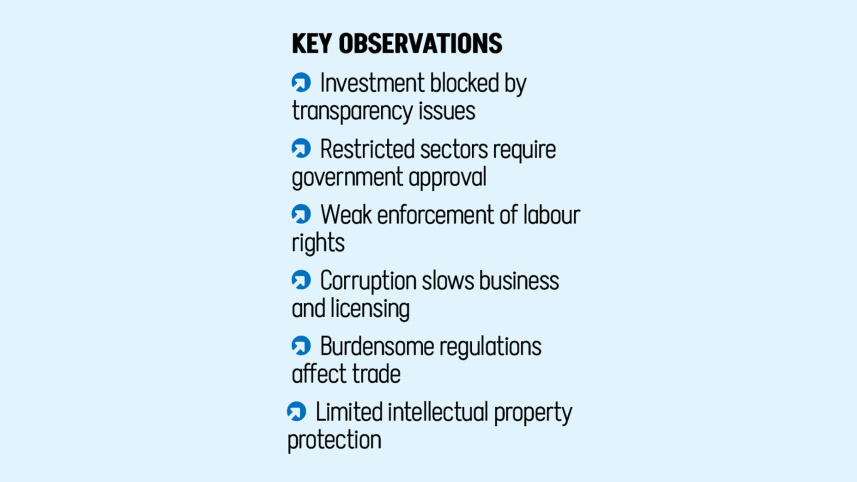
The US government has identified a lack of transparency in Bangladesh as a major obstacle to investment and raised concerns about labour rights.
The US Trade Representative (USTR) made this statement in its 2026 National Trade Estimate Report on Foreign Trade Barriers, published on Tuesday, which reviews trade issues in various countries.
 For all latest news, follow The Daily Star's Google News channel.
 The report said Bangladesh allows the repatriation of profits, revenue, dividends, and other external payments. However, US and other foreign investors have raised concerns that the procedures for transferring investment-related funds out of Bangladesh are complicated, lack transparency, and often cause long delays, with some companies waiting over a year for approval.
While Bangladesh generally permits 100 percent foreign ownership in most sectors, certain areas, such as petroleum marketing, gas distribution, and telecommunications, have limits on foreign equity.
Investors also need a No Objection Certificate (NOC) from relevant ministries to invest in 22 sectors, including banking, finance, insurance, power generation and distribution, large infrastructure projects, chemicals, and oil and gas.
LABOUR RIGHTS CONCERNS
The USTR expressed concern over labour rights in Bangladesh, particularly regarding the protection of internationally recognised rights, such as freedom of association and the effective recognition of collective bargaining.
Last year, during the interim government, Bangladesh amended its labour law to liberalise rules on freedom of association, following recommendations from the international community to meet global standards. Bangladesh also ratified all the required ILO conventions to modernise its labour laws.
Despite these changes, the US remains concerned about enforcement. Since suspending Bangladesh’s tariff benefits under the Generalised System of Preferences (GSP) programme in 2013, the US has repeatedly raised issues with freedom of association and acceptable working conditions with the Bangladeshi government.
Bangladesh does not yet ban the import of goods produced with forced or compulsory labour, allowing such products to enter and compete in the local market.
CORRUPTION AND BUSINESS CHALLENGES
The USTR said corruption is a long-standing and widespread problem in Bangladesh, and anti-corruption laws are poorly enforced. Although laws exist against facilitation payments and gifts, bribery and extortion remain common in business dealings.
US companies have complained about long delays in obtaining licenses and bid approvals, as some government officials demand bribes. While the previous interim government prioritised fighting corruption, the Anti-Corruption Commission (ACC), the main watchdog, has not always been able to operate independently.
Updates to the Public Service Act in 2025 removed barriers, allowing the ACC to investigate and prosecute government officials. The ACC has increasingly pursued cases against officials, mostly lower-level and some higher-level, but a large backlog of cases remains.
Under the recently signed US-sponsored Agreement on Reciprocal Trade (ART), Bangladesh has agreed to strengthen, implement, and enforce anti-corruption laws.
The country will also establish penalties for entities involved in corrupt practices and maintain standards of conduct for public officials to ensure proper performance and avoid conflicts of interest.
REGULATORY AND PROCUREMENT CONCERNS
US stakeholders have raised concerns about Bangladesh’s sanitary and phytosanitary regulations, which include many testing and certification requirements that do not appear to be science- or risk-based.
For example, animal feed must come with radioactivity test reports and certificates confirming it is free from chloramphenicol, nitrofurans, “harmful antibiotics,” and melamine. Bangladesh also tests all shipments of animal feed ingredients for porcine and bovine residues during customs clearance.
The USTR report also criticised Bangladesh’s public procurement system.
INTELLECTUAL PROPERTY CHALLENGES
Bangladesh continues to lack adequate protection and enforcement of intellectual property (IP) rights. The government devotes limited resources to IP enforcement, and counterfeit and pirated goods are widely available.
Several stakeholders have reported increases in potential IP violations across industries, including consumer goods, apparel, pharmaceuticals, and software. They also noted a growing trend of Bangladesh serving as a source country for counterfeits distributed globally.
The lack of investigative resources and expertise among the police, along with their reluctance to conduct independent investigations, makes it difficult for IP rights holders to enforce their rights. Concerns also exist over whether courts can fairly adjudicate IP cases.
While Bangladesh has made some legislative reforms in recent years to improve IP protection, the effectiveness of these changes remains uncertain because implementing rules have not yet been finalised.


Comments