


Two-thirds of registered taxpayers skip return filing

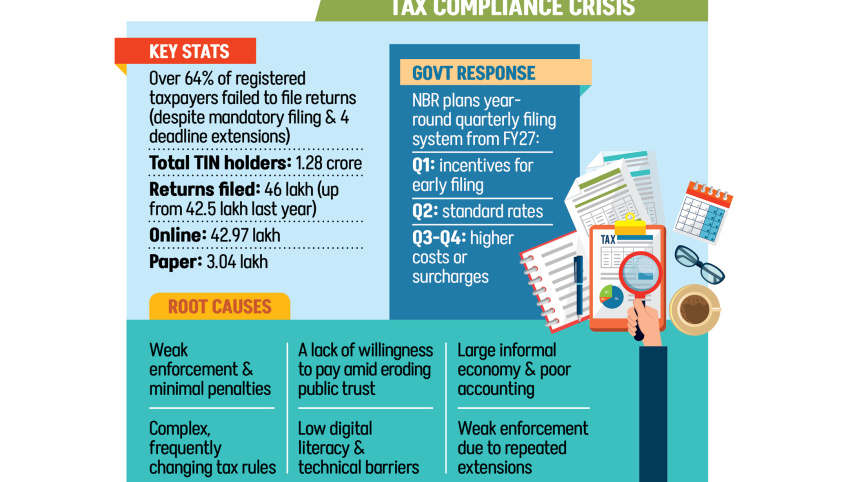
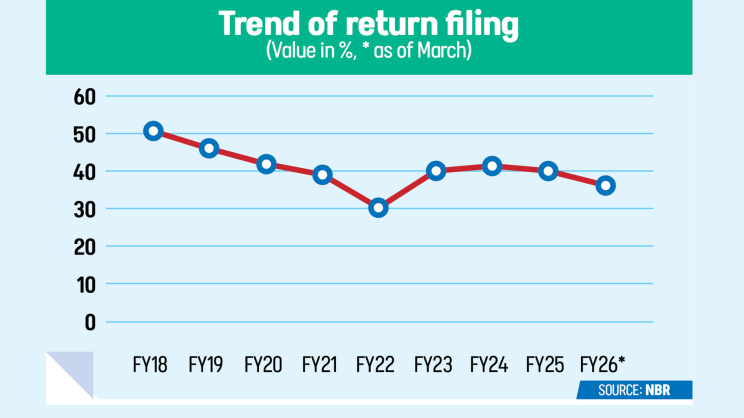
More than 64 percent of registered taxpayers, including individuals and companies, did not file income tax returns for the fiscal year 2025-26, even after authorities extended the deadline four times.
Of nearly 1.28 crore Taxpayer Identification Number (TIN) holders, only around 46 lakh, including nearly 20,000 companies, submitted returns by March, up from 42.5 lakh last year, according to the National Board of Revenue (NBR).

Most filings for FY26, which is around 42.97 lakh, were made online, while 3.04 lakh were paper-based.
The weak response comes at a moment when the government urgently needs revenue to ease mounting fiscal pressure. Tax compliance continues to pose a major challenge for Bangladesh, affecting revenue, administrative efficiency, and the broader tax system.
Despite reforms and efforts to widen the tax net, only about one-third of TIN holders submitted returns -- a key document detailing income, expenses, and other financial information. The low filing rate contributes to one of the world’s lowest tax-to-GDP ratios, even as the economy has grown over the past decade.
This shortfall comes as the government faces tighter fiscal space due to an increase in borrowing, higher social safety net spending, and surging energy costs caused by external shocks linked to the US-Israel war on Iran.
Low tax compliance restricts the government’s investment in infrastructure, education, and healthcare. In the first eight months of the current fiscal year, total tax revenue, including VAT and customs duties, fell nearly 28 percent short of the Tk 554,000 crore target, though collections rose 12 percent year-on-year.
Meanwhile, external debt repayments rose, with $2.9 billion paid in principal and interest in the July-February period of FY26, up from $2.63 billion a year earlier.
STRUCTURAL ISSUES DRIVE NON-COMPLIANCE
Prof Deen Islam, an economics teacher at Dhaka University, said low compliance reflects deeper structural problems rather than procedural gaps.
“Weak enforcement is a major issue. When many non-filers face little or no consequences, the cost of non-compliance becomes very low,” he said. “Many treat tax payment as optional in this situation.”
Islam highlighted the growing gap between registration and actual compliance.
“Many people obtain TINs for administrative reasons but lack the ability or incentive to file returns. This problem is made worse by the large informal economy, where many businesses operate without proper accounts or reliable records,” he further said.
Prof Islam also said the tax system itself can be a barrier. “Frequent legal changes, multiple requirements, and complex procedures make it harder to comply, especially for small businesses and individual taxpayers.”
While making online filing mandatory for individuals was a positive step, Islam said digitalisation alone cannot solve the problem. “Limited digital literacy and technical barriers can discourage timely filing. Repeated deadline extensions may weaken enforcement.”
“Tax compliance depends on trust and fairness. When people believe public funds are not used properly, they are less willing to pay taxes. At the same time, widespread non-compliance becomes the norm,” he said.
He said the economic impact could be serious. Low compliance leads to a low tax-to-GDP ratio, greater reliance on borrowing, and mounting fiscal pressure.
“A small group of compliant taxpayers ends up carrying most of the burden, which is unfair and distorts the business environment. In the long run, this weakens the state’s capacity,” he said.
“To fix the problem, Bangladesh needs stronger enforcement, a simpler tax system, better services, and greater trust between the government and taxpayers,” he added.
PROPOSED QUARTERLY FILING SYSTEM
 For all latest news, follow The Daily Star's Google News channel.
 Amid low submissions, the NBR is considering a year-round, quarterly tax filing system from the next fiscal year 2026-27.
Speaking at a pre-budget meeting on Wednesday, NBR Chairman Md Abdur Rahman Khan said the plan aims to improve compliance.
Under the proposal, the filing period would be divided into four quarters. Taxpayers would receive incentives for filing in the first quarter, pay standard rates in the second, and face higher costs or surcharges in the third and fourth quarters.
Comments