


$100b export target at risk without logistics reforms
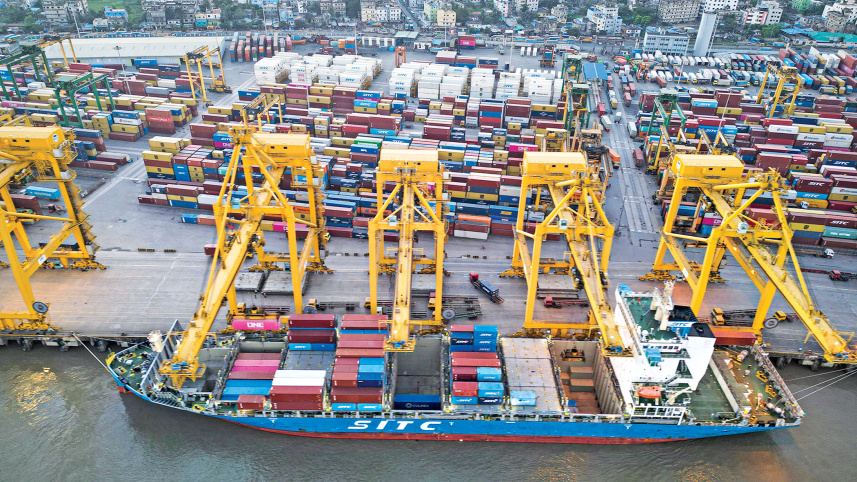
- Export goal requires major trade facilitation improvements
- Bangladesh’s export costs significantly higher than competitors
- Private investment essential for port and logistics development
Bangladesh’s goal of reaching $100 billion in export earnings by 2030 may not be achievable without major improvements in trade facilitation, port efficiency and logistics capacity, economist M Masrur Reaz warned yesterday.
He said exports are currently around $55 billion, but Bangladesh still faces high trade costs, long cargo waiting times, congestion and weak logistics infrastructure compared with regional competitors such as Vietnam and India.

Bangladesh’s export costs are about one and a half times higher than Vietnam’s and, in some cases, nearly double those of India
“Reaching $100 billion in exports by 2030 or even by 2033 with the current trade facilitation and logistics capacity will not be possible unless we significantly improve efficiency, reduce time and cut costs,” said Reaz, chairman of Policy Exchange of Bangladesh.
He made the remarks at a roundtable titled “Integrated Port and Logistics Development for a Trade-Driven Bangladesh”, organised by the Dhaka Chamber of Commerce and Industry (DCCI) in Dhaka.
Reaz said Bangladesh’s export costs are about one and a half times higher than Vietnam’s and, in some cases, nearly double those of India. He also noted that import processing takes significantly longer in Bangladesh.
He added that the country continues to lag in global competitiveness, logistics performance and productivity, which is weakening its ability to attract investment and integrate into global supply chains.
Comparing Bangladesh with Vietnam, he said Vietnam has increased its exports to nearly $400 billion through sustained reforms in trade facilitation and logistics. In contrast, Bangladesh remains at about $55 billion, even though both countries had similar export levels in the late 1990s.
Reaz said ports will play a crucial role in shaping Bangladesh’s future export competitiveness, especially as global supply chains shift and China moves away from low-value garment production worth around $35 to $40 billion annually.
Citing World Bank data, he noted that “cutting logistics costs by 25 percent could boost exports by 20 percent” and that “reducing port dwell time by just one day could increase exports by 7.4 percent.”
However, he said, relying only on public funding for port development is no longer realistic due to limited government resources and fiscal pressure.
“Developing ports through a fully public-sector model is neither feasible nor desirable. We have to move toward public-private partnerships,” he added.
Md Salim Ullah, director general of the Bangladesh Institute of Management (BIM), said Bangladesh is still far behind in managing integrated ports and logistics efficiently, which is keeping the cost of doing business high.
Md Habibur Rahman, former member (administration and planning) of the Chittagong Port Authority, said rail connectivity is the only long-term solution for cargo transport, as there is limited scope to further expand the Dhaka-Chattogram highway.
He also suggested involving the private sector in operating at least one seaport, saying it would improve competition, service quality and efficiency.
Razeev H Chowdhury, senior vice president of DCCI, said long cargo clearance procedures, slow transport systems and the lack of modern cold-chain facilities are making Bangladesh’s supply chain costly and inefficient.
He called for paperless and automated port systems, infrastructure development through public-private partnerships, and higher investment in cold-chain logistics.
Md Shamsul Hoque, professor of Civil Engineering at BUET, criticised Bangladesh’s fragmented infrastructure planning and called for an integrated multimodal transport system along with institutional reforms.
He said infrastructure development has mostly focused on passenger transport, while freight transport -- despite being more complex and economically important -- has been largely neglected.
He also pointed out the lack of integrated transport planning, noting that roads, railways, waterways and aviation are developed separately instead of as a unified system. Even when facilities are located close to each other, such as an airport and a railway station, there is still no seamless connectivity between rail, metro, road and air transport.
 For all latest news, follow The Daily Star's Google News channel.
Comments