


A free press cannot exist without editorial autonomy
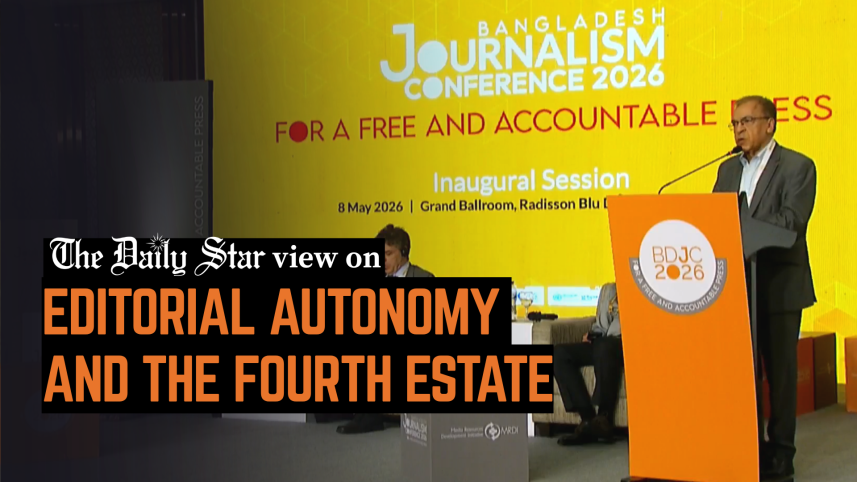
Journalism cannot act as a watchdog if a country’s news media houses fail to establish strong editorial institutions that can resist financial and political pressure. This truth was again reiterated by speakers at a journalism conference in the capital on Friday. Unfortunately, for decades, Bangladesh’s media houses have struggled with this core responsibility, often giving in to political, financial, and even societal pressure. A more recent threat, which throttles investigative reporting and even fact-based opinion, is mob violence—a phenomenon that this daily experienced first-hand last December.
Fear, partisanship, and subservience to the ruling party have long characterised Bangladesh’s media landscape, particularly during Sheikh Hasina’s regime. Any exposé of party leaders, security agencies, or private-sector actors that bolstered the regime’s grip on power was met with measures ranging from legal harassment to enforced disappearance. Media houses either resorted to self-censorship or became the government’s mouthpiece, not only exaggerating news but at times disseminating misinformation. This led to an erosion of trust in mainstream media, and many turned to social media newsfeeds that often spread misinformation and disinformation. Speaking at the conference, Zaffar Abbas, editor of Pakistan’s Dawn newspaper, aptly summarised the danger of self-censorship: it is often more damaging than direct censorship because media outlets cannot publicly admit to it.

Sadly, the situation of self-censorship has not improved significantly after the fall of Sheikh Hasina’s authoritarian regime. What is more, the recommendations of the Media Reform Commission formed by the interim government have remained unimplemented for more than a year. These recommendations not only aimed to secure the financial stability of the media but also proposed measures to ensure journalists’ protection, accountability, and ethical practices within the industry. Financial stability is essential for journalism, as emphasised by Tauhidul Islam of Transparency International Bangladesh at the conference.
However, in this era of clickbait and constant news bombardment, the space for investigative journalism is also shrinking. Zaffar Abbas observed that the prioritisation of profit over investment in investigative journalism by media owners—not only in Bangladesh but also in India and Pakistan—would endanger the very existence of journalism. He described how such important stories are being washed away by a “flood of information and misinformation”—a new form of censorship that does not threaten or abduct journalists but kills the stories that can hold power to account.
A society that relies on unverified social media noise can expect nothing but chaos—benefiting only a small circle close to power. The rest of the population bears the cost in rising poverty, lawlessness, and violations of rights. Therefore, we urge the government to take note of the wisdom shared at the conference and help build a free press in Bangladesh by implementing the recommendations of the Media Reform Commission seriously. Media house owners must also recognise the true purpose of this industry and act accordingly to ensure its proper functioning. Without commitment from both actors, the Fourth Estate will exist in name only, rather than in practice.
 For all latest news, follow The Daily Star's Google News channel.
Comments