


Asia thermal coal imports, prices rise amid war, China output drop
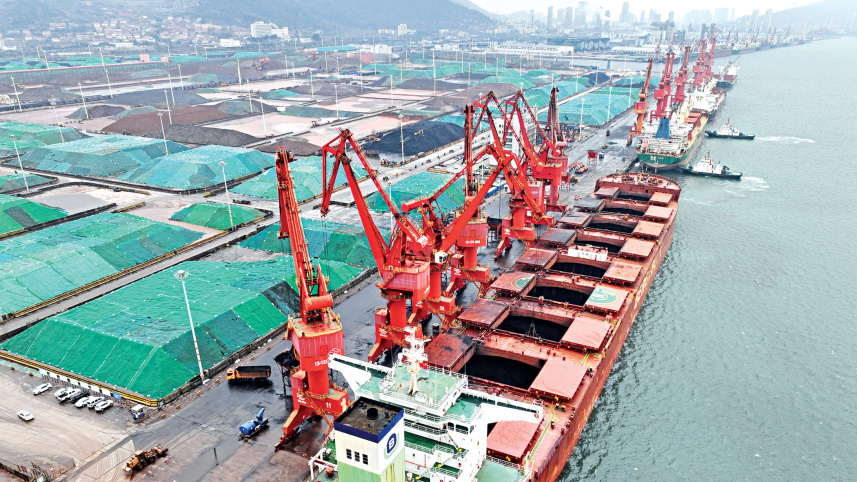
The Iran war has upended crude oil and liquefied natural gas markets, but the impact on coal has been more muted, even as prices for thermal grades have quietly climbed to multi-year highs.
While the conflict between the United States and Iran has resulted in the loss of at least 10 percent of the world’s crude oil and about a fifth of LNG, thermal coal supply remains largely unaffected, even if the cost of producing and shipping has risen on the back of higher fuel prices.

The Iran war is just one driver of coal prices, with soft Chinese domestic production and Indonesian regulatory changes likely more important factors.
Asia’s imports of seaborne thermal coal are on track to record their strongest month in May since December, according to data compiled by commodity analysts Kpler.
Asia’s thermal coal imports are forecast to reach 76.26 million metric tons in May, up 23 percent from April and also above the 72.83 million from May last year.
The stronger performance is broadly based with all of the region’s top buyers recording gains.
China, the world’s biggest coal importer, is on track to see seaborne thermal arrivals of 22.63 million tons, up from 16.0 million in April and the most since January.
China’s appetite for imports has been driven by weaker domestic output, with April production of 385.63 million tons being down sharply from the record 440.62 million in March, and also 1 percent below the level from April last year.
For the first four months of the year China’s output eased 0.1 percent to 1.58 billion tons.
Given that thermal electricity generation, the vast majority of it being coal-fired, rose 3.6 percent in the first four months of the year, it’s likely that China’s coal supply-demand balance has tightened in recent weeks, thereby encouraging imports.
The worst coal mine accident in 17 years last Friday at a metallurgical coal mine in Shanxi province that left 82 people dead may further tighten coal supplies as the authorities ramp up safety inspections of both thermal and coking coal mines.
China’s rising import demand has helped lift the prices of the grades that it typically seeks, with commodity price reporting agency Argus assessing Indonesian coal with an energy content of 4,200 kilocalories per kilogram (kcal/kg) at $64.43 a ton in the week to May 22, a three-year high and up 42 percent since the end of last year.
India, the second-biggest importer, is forecast by Kpler to see arrivals of 13.78 million tons of thermal coal in May, the most since June last year and 7.3 percent higher than the 12.84 million recorded for April.
Heat waves pushed electricity demand to record highs last week, spurring demand for coal-fired generation.
While both India and China are likely to seek more coal from Indonesia, regulatory changes announced last week by the world’s biggest exporter of the fuel will impact how cargoes are traded.
Indonesia plans to take control of the coal trade by routing exports through a state company, which will control contracts and prices.
While the government said it will honour existing long-term contracts, it also said it reserves the right to look at prices for such deals.
The idea is that by implementing state control over exports the government will stamp out under-invoicing and thereby collect more revenue.
But it’s also likely that trade flows may be hit while uncertainty persists over how the new system will operate in practice.
Japan’s imports of thermal coal are expected to reach 7.59 million tons in May, up from 6.63 million in April, while South Korea is on track for arrivals of 6.73 million, the most since January and up from April’s 4.79 million.
 For all latest news, follow The Daily Star's Google News channel.
 The two North Asian countries are the third- and fourth-biggest coal importers and are also the most capable of switching to coal-fired power generation from natural gas, which is imported in the form of LNG.
With both spot and oil-linked contract LNG prices rising sharply because of the Iran war, it’s likely that Japan and South Korea will seek to maximise coal-fired generation.
This has driven the price of high-grade Australian thermal coal higher, with the weekly assessment at Newcastle Port rising to $133.09 a ton in the week to May 22, up from $131.80 previously and just below the recent 18-month high of $140.53 from early April.
Australia, the second biggest coal exporter, may be best placed to capitalise on any regulatory-induced disruption to shipments from Indonesia, with its lower-grade coal a substitute for Indonesian grades.
Comments