


China’s EV export boom hits gasoline demand
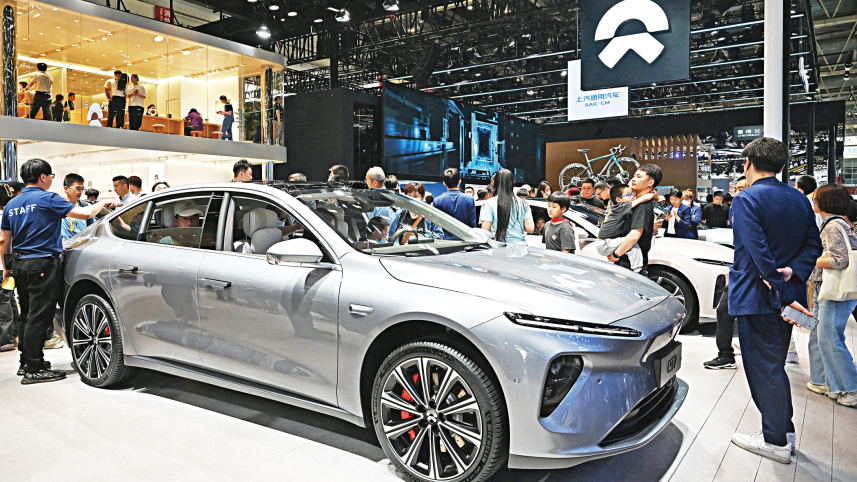
For years, forecasts of the energy transition followed a familiar script: electric vehicles would gradually dent gasoline demand in Europe and China before eventually spreading elsewhere.
The latest trade data suggest that process may already be accelerating across a much broader swath of the global economy.

A comparison of year-to-date gasoline imports and Chinese EV exports reveals a striking overlap in several major economies.
Australia, Brazil, South Korea, the United Arab Emirates, Canada, the United States, Nigeria and Japan have all sharply increased imports of Chinese EVs this year while simultaneously reducing gasoline imports.
No single dataset proves causation. Gasoline imports are influenced by refinery operations, inventories, economic growth and government policy.
But when the same pattern appears across multiple regions and income levels, it starts to look less like coincidence and more like an early signal of structural change.
The provocative possibility is that China’s EV export surge is beginning to show up in global gasoline trade flows.
For years, EV adoption and gasoline demand were largely treated as separate stories. Increasingly, they appear connected.
The countries highlighted here have collectively cut gasoline imports by roughly a third so far in 2026 compared to the same months last year, while simultaneously boosting imports of Chinese EVs to record highs.
If that relationship persists, fuel traders may need to start watching Chinese vehicle exports as closely as they watch refinery outages.
Australia offers perhaps the clearest example. Gasoline imports are down nearly 0.9 million metric tons or 15 percent year-to-date, while imports of Chinese EVs have surged by nearly 200 percent or by roughly $2.5 billion.
Chinese brands have rapidly gained market share by offering vehicles at prices many Western competitors struggle to match.
For consumers facing elevated living costs and uncertain fuel prices, the economics increasingly favor electrification.
South Korea and Japan are particularly noteworthy because both are automotive powerhouses.
South Korea has cut gasoline imports by about 0.4 million tons or by around 44 percent while boosting Chinese EV imports by more than $1 billion.
Japan has reduced gasoline imports by roughly 0.3 million tons, or 11 percent, while posting a 90 percent jump in purchases of Chinese EVs.
If Chinese manufacturers can gain traction in two of the world’s most sophisticated automotive markets, their competitive position globally may be stronger than many traditional automakers acknowledge.
The United Arab Emirates may be the most symbolically important case.
The country posted multiyear-low gasoline imports during the first half of the year, down 61 percent to just 1.43 million tons, while imports of Chinese EVs climbed to new highs of more than $1.4 billion.
Obviously, the conflict across the Middle East this year has impeded oil and product flows around the region, including into the UAE.
 For all latest news, follow The Daily Star's Google News channel.
 But the steep climb in EV purchases still matters because oil-producing economies have traditionally been viewed as laggards in vehicle electrification.
Yet falling EV prices and improving technology are making the appeal increasingly universal. If EVs can gain ground in an economy built on hydrocarbons, they can gain ground almost anywhere.
Canada and the United States also fit the pattern.
Canada has reduced gasoline imports by more than 1 million tons while increasing Chinese EV purchases substantially.
The United States has cut gasoline imports by nearly 2 million tons compared to the first half of 2025 and registered more than $1 billion of Chinese-linked EV imports despite trade barriers.
Refining dynamics undoubtedly play an important role in both markets.
Yet every electric vehicle replaces a future gasoline vehicle sale, gradually reducing fuel demand growth that refiners once took for granted.
Pakistan may be the most important market of all.
Conventional wisdom has long held that EV adoption would remain concentrated in wealthy economies because electric vehicles were too expensive for developing countries. Chinese manufacturers are challenging that assumption.
Pakistan has reduced total gasoline imports so far this year while increasing Chinese EV imports by a whopping 549 percent to nearly $500 million.
Nigeria has followed a similar pattern, with rising gasoline output from the Dangote refinery helping to cut gasoline imports by more than half from a year ago.
Just as EV imports by the country more than doubled to close to $72 million.
Nigeria is also partnering with South Korea’s development arm to build an EV manufacturing facility that will produce both cars and charging infrastructure in the country.
If low-cost EVs can gain traction in fuel-sensitive emerging markets, expectations for future gasoline demand growth may need to be revised.
WHY THIS MATTERS
The significance of these countries lies not in their individual numbers but in their diversity. Together they span North America, East Asia, South Asia, the Middle East, Africa and Oceania.
They include oil exporters and oil importers, rich economies, middle-income nations and emerging markets.
Historically, EV adoption could be dismissed as a largely European phenomenon supported by subsidies and regulation. That argument is becoming harder to sustain.
A growing number of consumers appear to be responding to a simple economic calculation: gasoline remains expensive and volatile, while Chinese EVs are becoming cheaper and more widely available.
THE TAKEAWAY
Gasoline demand is not about to collapse. Internal combustion vehicles will dominate global roads for years to come.
But major shifts rarely begin with dramatic headlines. They start with subtle changes in behavior that show up first in trade data and market flows.
The overlap between falling gasoline imports and rising Chinese EV purchases across several very different economies may be one of those early signals.
If so, the biggest long-term threat to gasoline demand may no longer be fuel efficiency or slower economic growth. It may be a growing wave of affordable Chinese electric cars.
Comments