


How one factory in China learned to live with Trump, tariffs and turmoil
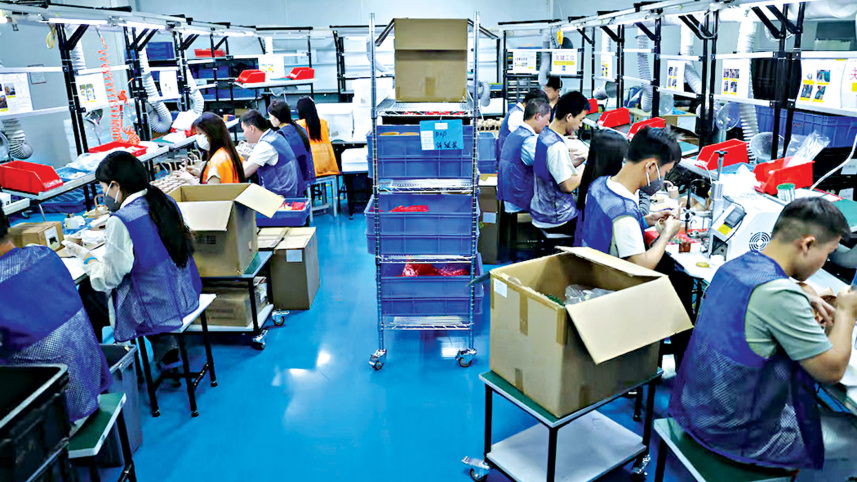
US President Donald Trump’s tariffs sought to hurt Chinese manufacturing, but for one electronics maker, a turbulent 2025 ended with a belief that China is a location that is difficult to replicate - as long as things don’t change too drastically.
Agilian Technology, which makes products mostly for Western brands, saw its US orders - accounting for more than half its revenue - frozen for months and clients demanded it set up production outside China.

Tariffs brought chaos to many Chinese companies; the country’s official purchasing managers’ index contracted for much of last year, with April 2025 being its weakest reading since December 2023.
But Beijing’s retaliation - export controls on minerals and metals that US firms need and are difficult to source - reduced the levies. In March, China’s official PMI grew at its fastest pace in a year.
This allowed Agilian, a $30-million-a-year business, to recover and appreciate its foothold, which it sees as crucial for growth - though it has pursued offshoring.
A recovery in China’s manufacturing sector might surprise Trump following the anniversary of his “Liberation Day” tariff rollout, given that he campaigned on using levies to reindustrialise the American economy and project US power.
“The data confirms that Trump’s tariffs indeed haven’t derailed the momentum that we’ve seen in China’s manufacturing sector,” said Nick Marro, principal economist for Asia and lead for global trade at the Economist Intelligence Unit. He added that levies “resulted in a restructuring of trade linkages and supply chains.”
China’s trade surplus for the first two months of 2026 rose to $213.6 billion, official data showed, from $169.21 billion a year earlier. And in 2025, China grew its trade surplus by a fifth to a record $1.2 trillion - equivalent to the GDP of the Netherlands.
But exports to the US slumped 20 percent in 2025, hurting manufacturers that rely on the market, said Agilian CEO Fabien Gaussorgues.
Gaussorgues, speaking at his factory in the southern city of Dongguan, wondered whether Trump would make a breakthrough when he visits China in May.
“The best we can hope for is probably a pledge for both sides to keep talking and maybe some type of framework to keep trade tensions from boiling over like they did last year,” Marro said.
Economists and industry executives expect Trump’s visit to extend a detente between the two rivals.
He Yadong, a spokesperson for China’s Ministry of Commerce, said the two countries should implement what they agreed to in previous meetings and subsequent rounds of talks.
“China has shown the rare earths (are) a leverage of mass destruction,” said Denis Depoux, the general manager of consultancy Roland Berger. “It’s a nuclear weapon of trade.”
Today, Agilian executives view Trump’s tariff policies as guideposts for how to deal with future flare-ups.
In 2024, as Trump was rising in election polls, Agilian’s clients wanted to get ahead of tariffs and asked the firm to ship products to North American warehouses. Other US importers had similar ideas and storage prices went “crazy,” said Renaud Anjoran, the firm’s vice-president.
Shortly after Trump was re-elected, post-midnight calls from “panicked” clients became frequent.
One customer with family in Penang, Malaysia, urged Agilian to set up a production base there.
Agilian had set up an entity in India, but most clients pushed back on operating there, worried about slow production and customs delays.
“India takes time,” Gaussorgues said. “It took us one year to have the official company.”
 For all latest news, follow The Daily Star's Google News channel.
 After Trump was inaugurated, two tariff hikes on China totalling 20 percent concerned clients, but they stuck around. Then on April 2, tariffs on Chinese exports rose another 34 percentage points.
For Agilian customers, “this was a disaster” and many cancelled orders. Soon after, pallets of goods piled up inside the 12,000-square-metre (130,000-square-foot) Dongguan factory.
China retaliated. Escalations pushed the levies above 100 percent on both sides before the end of the month. “Things were frozen,” said Anjoran.
The company decided to go with Penang and found a factory to partner with. It was preferred because it was removed from the South China Sea, where military conflicts can’t be ruled out.
Agilian also scouted industrial rental space in Dharwad, India, and even looked at moving production to the US But it found supply chains there were incomplete, leaving it reliant on tariffed Chinese components and higher labour costs.
By mid-2025, Agilian’s India team found a 4,000-square-metre industrial building and was discussing which products could be made there. Embargo-like conditions with China made India more palatable for clients as well.
But then a May Washington-Beijing deal removed most of the tariffs imposed on China. In August, with the Dharwad factory still not ready, Trump hiked tariffs on India by 50 percent to force it to stop buying Russian oil.
But Anjoran pressed ahead: “We want to be a multi-country manufacturer. Focus on the long arc of time.”
Pre-production runs in Penang also started in the middle of the year, with the team learning that “everything takes way, way, longer” than in China.
TARIFF CLIMBDOWN
Through the summer, China’s export controls exposed US dependence on materials processed almost exclusively in China, squeezing autos, defence and other industries.
An October meeting between Trump and Chinese President Xi Jinping brought tariffs down by 10 percentage points. By then, Agilian’s clients had stopped asking about levies and offshoring.
Agilian said the second half of 2025 was its busiest ever in terms of production hours, rising 29 percent from the first half. With tariffs steep but acceptable, clients unfroze orders and placed new ones.
Anjoran says if 100 percent tariffs returned, his US-exposed customers would freeze production and put shipments on hold.
Agilian will keep developing facilities in India and Malaysia “as an insurance policy,” Gaussorgues said. But the falling cost and rising quality of Chinese components made its base in Dongguan indispensable.
He hopes to grow the company’s revenue 30 percent in the next three years, though he fears Trump could get in the way again.
“I started in January saying, okay, this might be a good year and then the Iran war started,” he said.
Comments