Hair oil, bumblebees, and the lost world of Bengali advertising art
Exactly 144 years ago, artist Jatindra Kumar Sen was born in Darbhanga district, Bihar. An academic degree from an art college was simply not in his destiny. Faced with the pressing need to secure a livelihood quickly, he wrapped up his studies there and ventured out in search of work. But what could he do? It was only natural for him to seek work in drawing—the one thing he excelled at. However, freelancing with sporadic illustrations here and there could only take him so far. Relief came through Parashuram, the pen name of the celebrated writer Rajshekhar Basu. At the time, Basu was a high-ranking official at Bengal Chemicals, where Jatindra eventually found employment, most likely through Basu’s courtesy.
At Dr Prafulla Chandra Roy’s renowned institution, Jatindra was entrusted with various responsibilities, including designing packages and labels for medicine vials and cosmetic bottles. Alongside this, he was tasked with illustrating all of Bengal Chemicals’ advertisements. His professional journey began there in the very first year of the last century. From those early days, he became a master craftsman of advertising layout and design. Not only that, but, having been directly involved in the craft, he was uniquely positioned to observe how the entire advertising landscape was rapidly transforming.
We are well aware of his masterful illustrations that accompanied Rajshekhar Basu’s writings. Iconic drawings from Hanumaner Swapno to Mahesher Mahajatra, or those in Bhushundir Mathe and Girindrashekhar Basu’s Lalakalo, remain deeply etched in our collective memory. Yet analytical studies or discussions regarding the distinct characteristics of his advertising illustrations are rarely found. One thing, however, can be stated with certainty: when a man of such calibre writes an essay dissecting the nuances of advertising presentation, true connoisseurs of art are bound to devour it eagerly.
In 1950, at the age of sixty-eight, he did indeed pen an entire piece dedicated to advertising. Written with a touch of wit reminiscent of Shibram Chakraborty—a style he was always naturally fond of—Jatindra Kumar sought to capture the core essence of what advertising truly represents. He even categorised advertisements into three distinct types: Static (Achal), Dynamic (Sachal), and Stealth (Chorai). To him, Static advertisements comprised text, posters, and pictures—the very subject we are discussing. Dynamic advertisements were embodied by a priest draped in ritualistic shawls (Namavali) or a doctor with a stethoscope slung around his neck. Stealth advertising referred to the “reprehensible” act of surreptitiously pasting bills on people’s houses without permission.
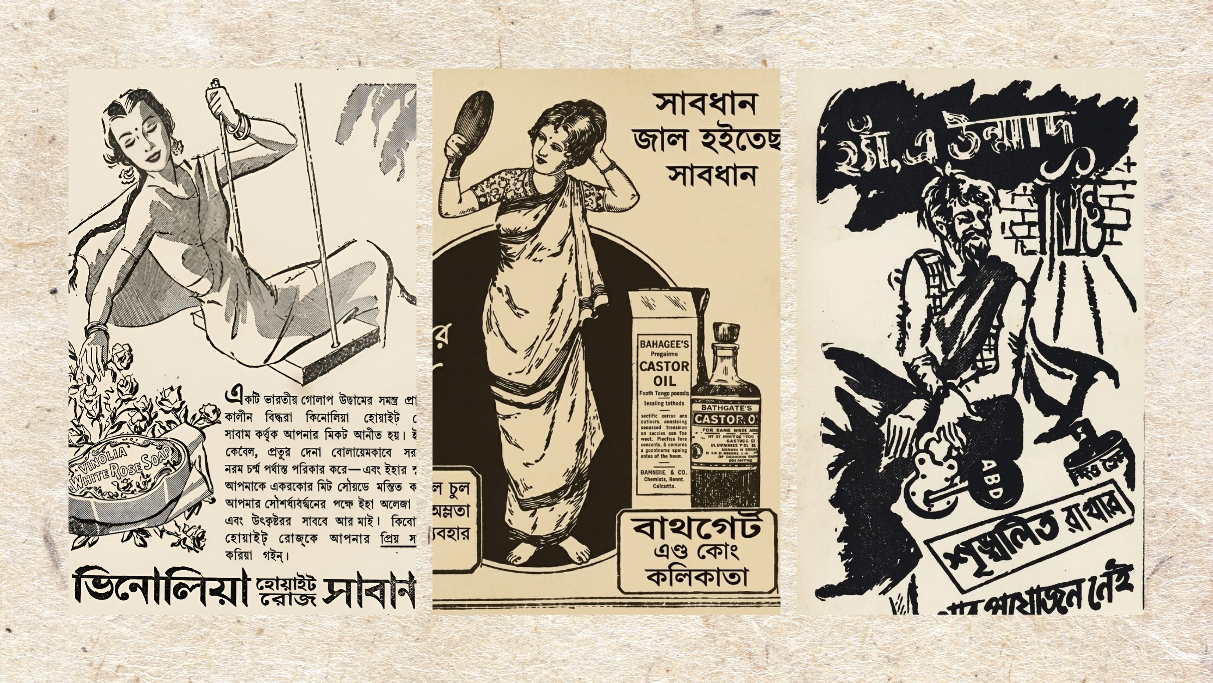
Despite creating countless advertisements himself, Jatindra Kumar realised that illustrated dynamic advertisements were often saturated with sheer affectation (‘ন্যাকামি সর্বস্ব’). He cited an example from a hair oil advertisement: “Oh, are you listening? On your way back from the office, please bring six bottles of ‘Golden Hair Oil’ from ‘New Chemical’. Buy them by the dozen to save. My hair, as well as our daughter’s, is falling out completely. Your hair is thinning, too. They say it is a medicated hair oil. Applying it will make your hair as thick as monsoon clouds.”
Here, Jatindra Kumar was taking a direct dig at the copywriter, finding the advertising language utterly melodramatic (‘ন্যাকামি সর্বস্বই’).
Nevertheless, copywriters of that era had to cater strictly to the customs, manners, and speech patterns of conventional middle-class Hindu Bengali families. I use the word “Hindu” deliberately because any discerning observer would notice the glaring absence of non-Hindu faces in both the visuals and text of the mainstream Bengali brand advertisements of that time. This was ironic, considering that many founders of the major brands that gained popularity back then belonged to East Bengal, and their consumer base was by no means exclusive to Hindus. Consequently, advertising visuals repeatedly depicted dhoti-clad Bengali men and saree-clad Bengali women. On the other hand, the presence of non-Hindus in advertising art was strictly confined to occupation-based depictions, such as a Muslim artisan painting a wall in a paint advertisement, or a tailor at work. This is a subject I intend to analyse separately in the future.
Strangely enough, Jatindra Kumar did not delve much into the illustrative aspects of advertising in his text. This omission is rather surprising. However, his use of the phrase “utterly affectation-driven” (‘ন্যাকামি সর্বস্ব’) was undoubtedly a bold and daring observation for its time. It remains a fact that contemporary hair oil advertisements carried an air of distinct artificiality, or affectation. Yet these were far from crude presentations; rather, the opposite was true. There were exceptions, of course. Artists working for reputed advertising agencies were far more sophisticated, crafting modern, artistic advertisements with professional finesse for hair oils, perfumes, soaps, and other cosmetics.
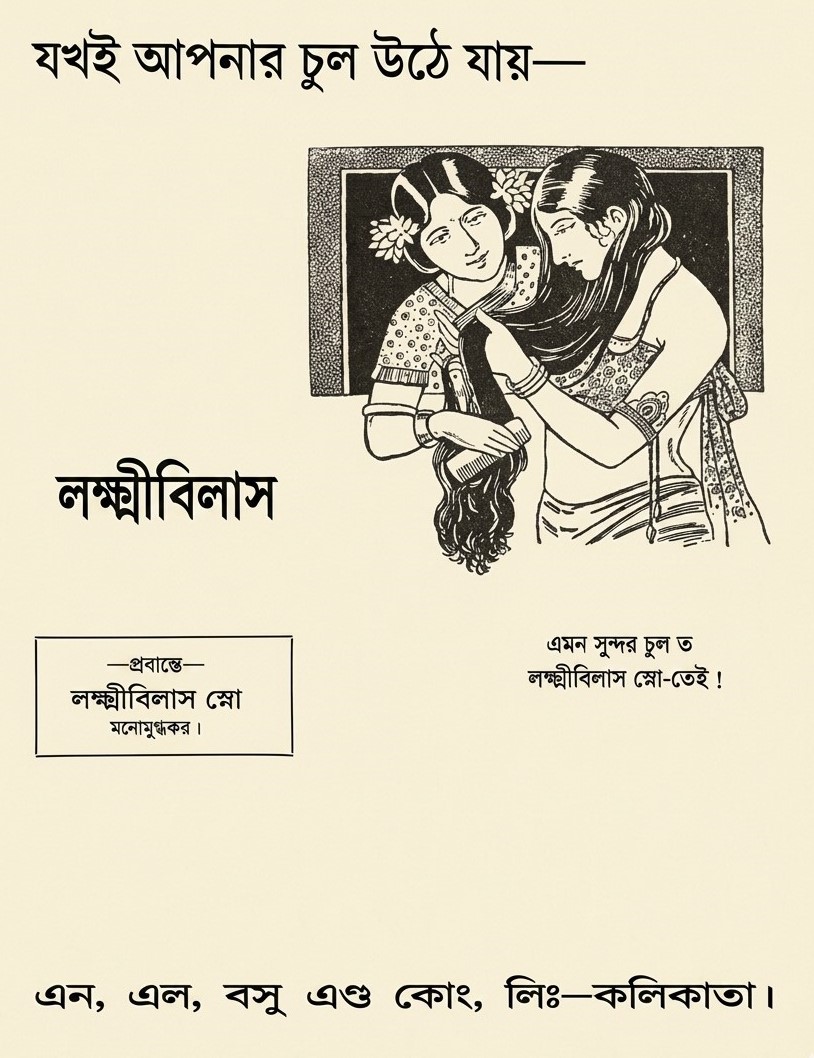
It is common knowledge that there was once an immense demand for hair oil among Bengali women. Kolkata's M.L. Bose & Co. used to advertise their product Laxmibilas Taila in bold, prominent layouts. Naturally, while illustrating these advertisements, artists had to sketch women. One such advertisement read: “If you feel uneasiness in the head, a burning sensation during summer nights that disrupts sleep, or if clumps of hair come out while combing, you must immediately purchase Laxmibilas Oil.” One particular advertisement depicted a woman combing another woman’s hair, a visual that vividly recalls Jibanananda Das's poetic line, “Her hair was like the dark night of ancient Bidisha” ([‘চুল তার কবেকার অন্ধকার বিদিশার নিশা।’]). In the advertisement, referencing Kalidasa’s Meghadūta, the possessor of the tresses, comparable to the darkness of Bidisha city, claims, “Such beautiful hair is only possible by applying Laxmibilas.”
Interestingly, the woman combing the hair is shown in a saree and chemise, while the woman showcasing her hair is drawn in a way that makes the artist's brush appear almost “voyeuristic.” Instead of a contemporary blouse, the artist chose to dress her in a kanchuli (an ancient bustier). The reason behind this choice is obvious: it was not merely to beautify the frame, but to make the advertisement infinitely more alluring. Is this not a clear influence of Hemen Mazumdar? Artists like Hemen drew inspiration from classical iconography to portray voluptuous Bengali women, layering them with masterful brushwork. That advertisement for Laxmibilas oil blended European influence with a distinct subcontinental sensibility. However, that element of artificiality stands out starkly when viewed through a modern lens today. Nonetheless, this advertisement remains an invaluable chronicle of grooming in Bengali society, the expansion of Swadeshi enterprises, and the fine draftsmanship of contemporary line art. The intricate ornaments worn by the women, the patterns on their sarees, the flowers tucked into their hair, and the serene grace of their physical forms instantly evoke the traditional ethos of the “Bengal School of Art.”
This particular artwork bears no artist's signature or initials. As mentioned earlier, while some forgotten advertising artists could be identified by their brief signatures, they operated independently of advertising agencies. This Laxmibilas oil advertisement graced the pages of Kolkata’s periodicals during the 1930s, an era when calendars adorned with Hemen Mazumdar’s paintings had become immensely popular. Advertising artists were well aware that they could not fulfil the commercial objectives of corporate firms by painting Abanindranath Tagore’s spiritual Bharat Mata. They needed to draw scenes from real life, no matter how artificial or melodramatic (‘ন্যাকামি-সর্বস্ব’) they might seem. Elevating cosmetic advertisements to an appealing standard was a formidable challenge at the time, but, to secure their livelihoods, the artists simply had to embrace it.
Out of curiosity, I looked up a few foreign illustrations created for hair oil advertisements, one of which was for New York's Velocipede Hair Oil. The visual features a young woman riding a vintage, large-wheeled bicycle, her hair billowing in the wind. However, her tresses can hardly be compared to the “dark night of Bidisha” seen in the Laxmibilas advertisement. Such a comparison was unlikely for Western women, as the foreign lady's hair was cropped quite short. This advertisement from the 1860s claimed that the oil was so delightfully fragrant that whoever applied it would leave a trail of aroma wherever they went.
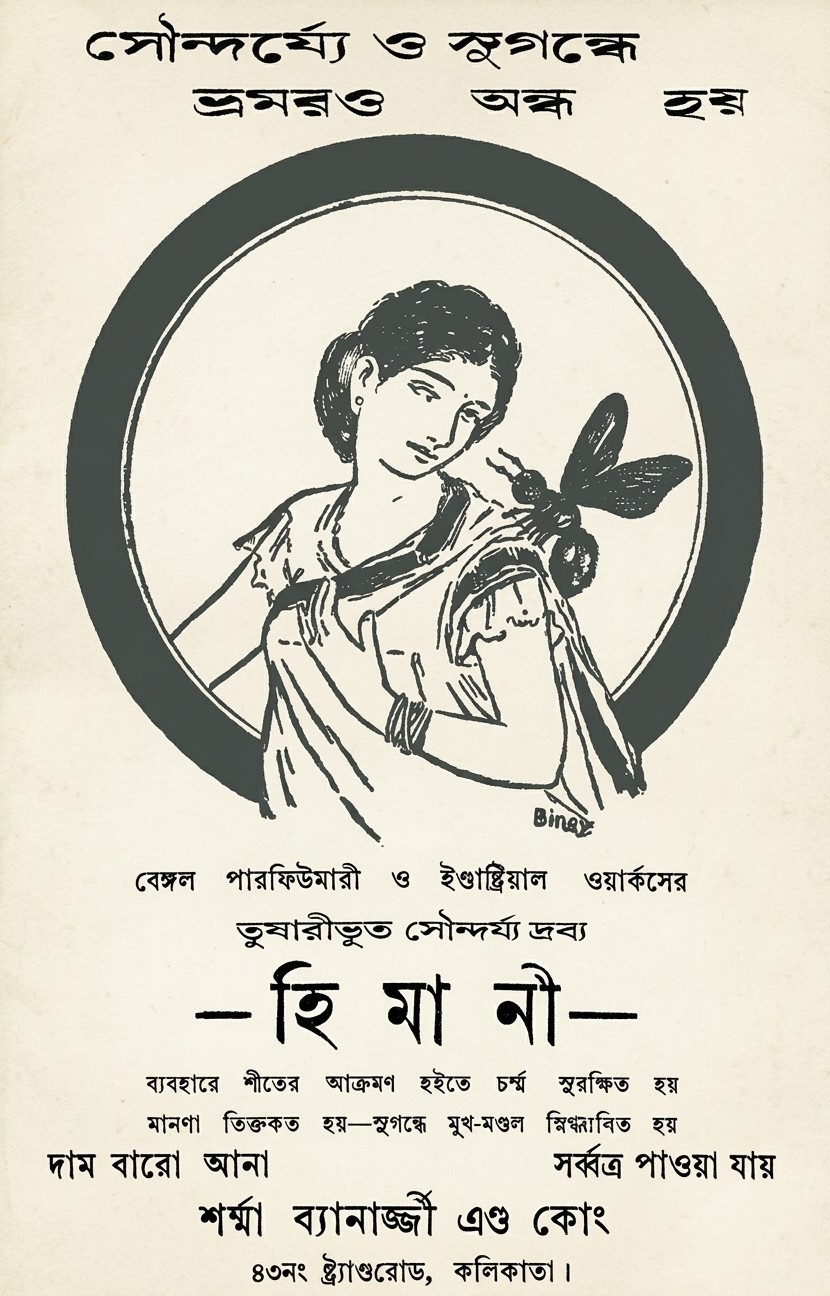
The mention of the word “fragrance” reminds me of another advertisement. This was for Himani, the famous snow and grooming cosmetic manufactured by the Bengal Perfumery and Industrial Works and distributed by Sharma Banerjee & Co. We are all familiar with Rabindranath Tagore’s immensely popular song in which a bumblebee arrives at the window, humming tales of the beloved. Upon the insect's arrival, the poet's worldly chores are abandoned: “The day fades away as I weave a web of melodies” ([‘বেলা যায় গানের সুরে জাল বুনিয়ে’]). This song was composed in 1911. While the bumblebee’s message of “awakening the flowers” remains an evocative call for Tagore lovers to step out of their homes, the presence of bumblebees in poetry dates back to the classical era of Kalidasa. And the ultimate magnet for such a “romantic” insect is, naturally, the lotus flower.
In my childhood, I had not read Kalidasa's Ritusamhara, but I had read Sunirmal Basu:
“A bumblebee came flying into my room through the window / What message did it bring, can any of you tell? / The bumblebee came humming, singing a song in an incomprehensible tongue / I watch in amazement, with a sullen face...” ([‘জানলা দিয়ে আমার ঘরে আসলো উড়ে ভোমরা,-/ কোন্ বাণী সে নিয়ে এলো, / বলতে পারো তোমরা?/ আসলো ভ্রমর গুনগুনিয়ে / অবুঝ ভাষায় গান শুনিয়ে, / অবাক হয়ে তাকাই আমি, / মুখটি করে গোমরা …।’])
It was only on the threshold of leaving school that our restless minds truly understood the message a bumblebee carries. Everything became crystal clear through Tagore's song, which mesmerised many. Evidence of this profound influence remained captured in the advertising visuals drawn by Bengali artists.
In Kalidasa’s Ritusamhara, the bumblebee confuses a lotus with the iridescent feathers of a peacock. In the advertisement, however, the bumblebee—blinded by beauty and fragrance—flies in to perch directly on the edge of a saree's anchal draped over a Bengali woman's shoulder. Furthermore, to make the bumblebee the centrepiece of the visual, the artist enlarged it to the size of a small bird. The woman is shown tilting her neck and gazing at the bumblebee with an expression that suggests she quite welcomes its arrival. Simply put, on behalf of the advertisers, the artist wished to convey that the scent of this “crystallised product of beauty” was so irresistibly sweet that even the bees had breached the inner sanctum of Bengali homes, much like flies buzzing around the aroma of ripe mangoes. The copywriter’s tagline for this advertisement read: “Even the bumblebee is blinded by beauty and fragrance” (‘সোন্দর্য্যে ও সুগন্ধে ভ্রমরও অন্ধ হয়’).
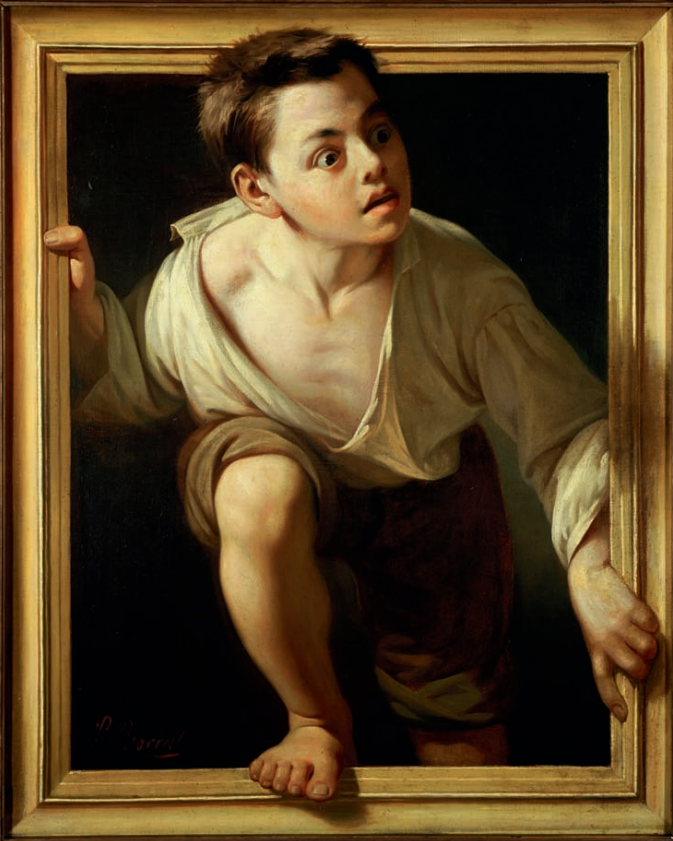
There is no doubt that, for its time, this concept was simultaneously brilliant and bizarre. Most remarkably, such a whimsical theme was executed in an intensely grave and classical style. I do not know whether this innovative presentation was the artist's own brainchild or whether it was drawn according to the copywriter's explicit instructions. Whatever the case, true to the prevailing illustrative style of the day, the visual perfectly complemented the advertising message. It is worth noting the inclusion of a halo or circle in the background behind the woman, much like those found in medieval church art. In Western art, drawing this halo was almost mandatory when portraying Jesus Christ, the Virgin Mary, or Christian saints. In depictions of Mother Mary, the halo would often become highly ornate. In many paintings, Jesus is seen seated with one foot resting upon a circular orb. In this bumblebee advertisement, one of the woman's hands is positioned inside the circle. If we look at the circle not as a halo but as a frame, those familiar with art history might instantly be reminded of Pere Borrell del Caso’s iconic painting Escaping Criticism.
The Spanish artist shattered the rigid conventions of his era by painting a boy whose body extends beyond the frame. With extraordinary skill, Borrell captured the exact fraction of a second before the boy, startled by something incredible in the outside world, steps out from the confines of the frame. Many consider this to be Borrell's masterpiece. Art historians believe that the message behind such a painting marked a powerful shift away from the conventional, romanticised styles of the period towards stark realism. The illustration for Himani Snow similarly blends allegory and surrealism. I say this because, within a circular frame, a Bengali woman is depicted with a giant bumblebee perched on her shoulder. In reality, bumblebees do not settle on humans in this manner, nor are they so massive. Yet here, the texture and fragrance of the woman's skin are portrayed as so enchanting that the disoriented bee has sought refuge on her shoulder. Bringing an element of nature into an unrealistic scale in order to praise physical beauty gave the advertisement an aesthetic, surreal dimension, even if, by modern standards, it might evoke amusement.
That particular Himani advertisement appeared in a daily newspaper in 1922, exactly a decade after Tagore penned Ghorete Bhromor Elo. Thus, it is highly probable that the person who drew the image or wrote the copy to ensure sales was influenced by the lyrics of that song.
Interestingly, I easily recognised the artist behind this advertisement. The artist had signed in English, omitting his surname; it simply read “Binoy.” I realised this was none other than Binoy Kumar Basu. Although he was widely acclaimed as a cartoon artist in his time, he rarely received the recognition he deserved as an “advertising artist” owing to the general disdain for the profession.
Regrettably, this has been a prevalent attitude both at home and abroad. Fine artists are often viewed as the elite, high-caste brahmins of the art world—the masters whose illustrations are deemed monumental. Those who used to draw for short stories and novels are labelled mere illustrators, their names occasionally mentioned at the end of a text, almost as an act of charity. Book cover designers have their names tucked away in tiny print on the printers' page, even though their creations are often stripped off when libraries rebind the books. And if one happened to be an advertising artist, they were practically deemed “untouchable.” At least, that was the prevailing consensus among art critics for a long time. This biased mindset was eventually shattered by pioneering artists like Annada Munshi, O.C. Ganguly, and Ronen Aayan Dutt. Because we were so intimately familiar with their distinct styles, we could often identify the artist from a single advertisement. Yet, it must be said that, regardless of the quality or presentation of the artwork, it was perhaps Binoy Kumar Basu's destiny to be lightly dismissed merely as an “advertising artist”—akin to branding a number onto a slave's skin. Above all, art enthusiasts always maintained a somewhat dismissive attitude towards the advertising pioneers of the early era.
Binoy's preferred domain was caricature. Rebatibhushan Ghosh once remarked that he greatly admired the cartoons of this forgotten artist and eagerly awaited Binoy's work in the periodical Sachitra Sishir. Although the bumblebee advertisement was not drawn in a cartoonish style, it inherently contained a rich source of humour. After all, none of us has ever witnessed a bumblebee entering a home drawn purely by the lure of a cosmetic snow.
Sandip Dasgupta has spent nearly three decades working in the editorial offices of newspapers and news portals. He has authored several history-based books, and a subject particularly close to his heart is the illustrations created by Bengali artists.
Send your articles for Slow Reads to slowreads@thedailystar.net. Check out our submission guidelines for details.
Forgotten story of Jeanette Van Tassel, the American woman who flew over Dhaka in 1892
Beyond 1947 / A personal essay
Abul Mansur Ahmad / A global quest in search of a nation

Chand Bibi and the forgotten history of Muslim women’s political resistance
Women’s voices in Nazrul’s Dhumketu

How Milad-un-Nabi shaped Muslim cultural life in colonial Bengal
What Rashomon teaches us about truth and human behaviour

Why Chittagong never became a maritime city

The many worlds of Ghulam Murshid