


Plastic factories run at 30% capacity amid energy crisis
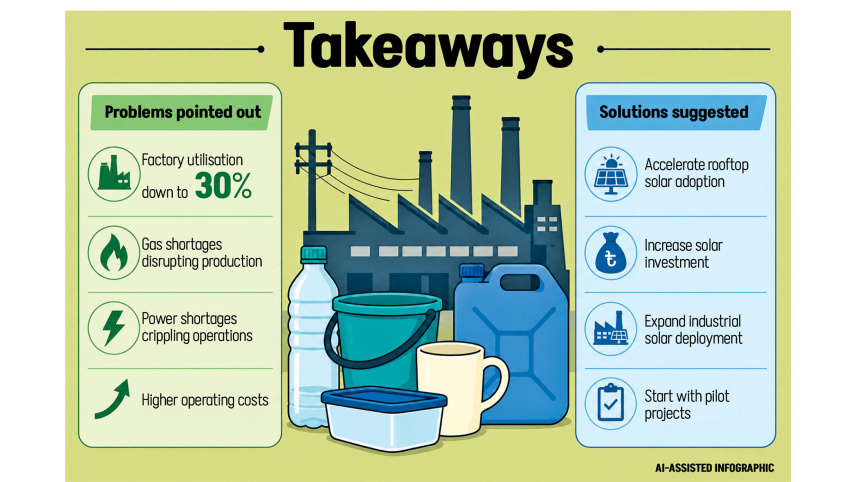
Bangladesh’s plastic manufacturers yesterday urged faster adoption of rooftop solar, claiming factory utilisation has dropped to as low as 30 percent amid a prolonged energy crisis, making renewable energy essential to sustaining production, lowering costs and remaining competitive.
The call came at a seminar on “Renewable Energy: The Future of Sustainable Manufacturing”, organised by the Bangladesh Plastic Goods Manufacturers and Exporters Association (BPGMEA) and the STAC Foundation, a non-profit organisation, at the association’s conference room yesterday.

Shamim Ahmed, president of BPGMEA, said uninterrupted electricity is critical for the plastic industry.
“Our main raw material is plastic, but without power we cannot run our factories,” he said.
According to Shamim, the industry’s operating capacity has deteriorated sharply because of persistent gas and electricity shortages.
“A few days ago we were saying factories were operating at around 50 percent capacity. Now I am not even sure whether we are operating at 30-40 percent. Many factories cannot even reach 30 percent capacity,” he said.
“This situation has continued since the gas crisis began. Business leaders have repeatedly raised the issue with the government because without reliable energy, it will not be possible to sustain industrial production,” he said.
On sustainability, Shamim said reducing dependence on fossil fuels was essential to cutting carbon emissions and urged industries to adopt resource-efficient and cleaner production (RECP) alongside environmentally conscious product design.
“Human activities are placing increasing pressure on the environment. As industrialisation and development accelerate, environmental impacts are also growing,” he said.
Referring to China’s rapid expansion of renewable energy, Shamim said Bangladesh should accelerate investment in solar power to build a greener and more sustainable industrial base.
Renewable energy expert and consultant Md Hasan Mahmud Khan said rooftop solar offers industries a practical way to reduce electricity costs while improving long-term energy security.
Factories are under pressure from rising electricity tariffs, volatile diesel prices for generators and dependence on the national grid, Hasan Mahmud said, adding that rooftop solar can offset a significant share of daytime electricity demand, reducing both operating costs and carbon emissions.
A typical rooftop solar system consists of solar panels, inverters, mounting structures, cables, protection equipment and monitoring devices, according to the expert. Addressing concerns over rooftop strength, he said properly designed industrial buildings can safely accommodate solar installations.
Industries can choose from grid-connected, net-metering and hybrid systems depending on their operational needs. While battery-backed hybrid systems ensure power during outages, they also increase costs and are best suited to critical loads, he said.
Quazi Anwarul Haque, vice-president of BPGMEA, described rooftop solar as Bangladesh’s most practical and cost-effective renewable energy option.
He stressed the importance of proper installation, technical support and maintenance, encouraging factories to begin with small pilot projects.
Former BPGMEA president Shahedul Islam Helal said large-scale implementation would require robust systems for measuring electricity generation and managing payments, while maintenance costs for rooftop solar installations also need greater clarity.
KM Iqbal Hossain, senior vice-president of BPGMEA, said that while the garment sector has made notable progress in adopting green technologies, future solutions must be environmentally friendly, affordable and easy to maintain.
He also highlighted the potential of large-scale battery storage to support industrial use of solar power.
BPGMEA directors Noor Alam Bachchu and ATM Syeedur Rahman Bulbul, along with senior officials from different plastic manufacturing companies, also participated in the seminar.
 For all latest news, follow The Daily Star's Google News channel.
Comments