


Sustainable plastic, packaging crucial for high-value exports
Bangladesh’s plastic and packaging industry could unlock significant export opportunities, but only if it adapts quickly to the global shift towards sustainability, industry leaders and policymakers said yesterday.
Speaking at a seminar titled “Bangladesh’s New Export Frontier: Sustainable Packaging Industry” at InterContinental Dhaka, they said environmental compliance is rapidly becoming a prerequisite for market access rather than a competitive advantage.
 For all latest news, follow The Daily Star's Google News channel.
 Presenting the keynote paper, Khaled Mahmud, a professor at the Institute of Business Administration (IBA) of Dhaka University, said sustainability now ranks alongside cost, product protection and shelf appeal in buyers’ decisions.
“What a product is wrapped in is no longer merely a procurement decision. It is increasingly a matter of market access, brand reputation and regulatory compliance,” he said.
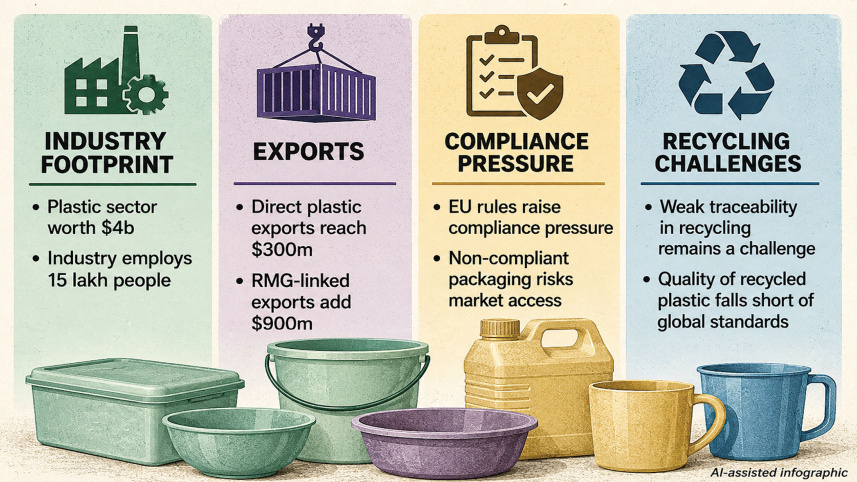
According to him, Bangladesh’s plastics industry has grown into a major manufacturing sector, meeting about 83 percent of domestic demand. The local market is estimated at $4 billion, while the broader industry is valued at $6 billion to $7 billion and employs around 15 lakh people.
The sector contributes roughly 1 percent to GDP and accounts for only 0.5 percent of global plastic and packaging trade, he added.
He also said direct exports reached about $200 million in the latest fiscal year, while another $900 million worth of plastic and packaging products were exported indirectly through the garment sector.
Mahmud identified tightening regulations in export markets, weak traceability in recycling, high costs of sustainable production and Bangladesh’s graduation from least-developed country status as the industry’s key challenges.
He pointed to the European Union’s Packaging and Packaging Waste Regulation (PPWR), under which packaging sold in the bloc will need to meet recyclability and recycled-content requirements from 2030.
“Packaging that cannot demonstrate recyclability and recycled content may simply become unsellable in the European Union,” he said.
Md Nuruzzaman, additional secretary at the Ministry of Industries, said the government would consider industry recommendations while aligning policies with sustainability standards.
He stressed the need for safer, greener packaging and called for the introduction of Extended Producer Responsibility (EPR), under which producers would share responsibility for managing packaging waste.
Md Razzaqul Islam, deputy secretary and director of the Business Promotion Council at the commerce ministry, said the sector’s global footprint remains well below its potential despite its growing capabilities.
He noted that packaging has been named the ministry’s “Product of the Year” and urged businesses to invest in recycling and waste collection systems as environmental compliance becomes increasingly important for exports.
Kamruzzaman Kamal, marketing director of Pran-RFL Group, said many export markets, particularly in Europe, now require packaging materials to contain at least 25 percent recycled content.
Bangladesh recycles large volumes of plastic waste, but the quality of recycled materials often falls short of international food-safety and compliance standards, he said.
Without better recycling technology and higher-quality recycled inputs, exporters risk losing access to premium markets, he added.
Debabrata Roy Chowdhury, director of legal, regulatory and corporate affairs at Nestlé Bangladesh, said local suppliers capable of meeting global standards are well positioned to serve international markets.
He called for policy support and a review of duty structures to encourage investment in sustainable packaging.
Safius Sami Alamgir, president of the Bangladesh Flexible Packaging Industries Association (BFPIA), said packaging has evolved from a supporting service into a critical component of modern manufacturing.
With the global packaging market exceeding $1 trillion, Bangladesh has an opportunity to expand exports significantly if it can position itself as a reliable supplier of sustainable packaging solutions, he said.
Bangladesh Plastic Goods Manufacturers & Exporters Association President Shamim Ahmed said Bangladesh’s packaging industry already supplies multinational companies, including Nestlé, Unilever and Coca-Cola, and meets international standards.
He urged policymakers to recognise deemed exports and extend incentives, saying the sector has the potential to attract foreign investment, diversify exports and become a stronger contributor to economic growth.




Comments