


Govt to assess Family Card impact: Khosru
Highlights
- Govt to conduct regular Family Card impact assessments
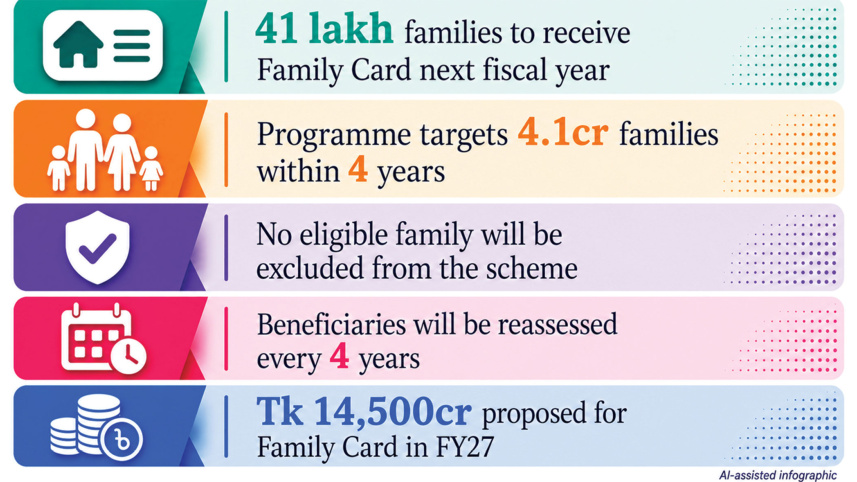
- Around 41 lakh families to get cards next fiscal year
- Tk 14,500 crore proposed for the social protection scheme
The government will conduct regular impact assessments to evaluate how Family Card beneficiaries are using their allowances and whether the programme is improving their living standards, Finance Minister Amir Khosru Mahmud Chowdhury said yesterday.
“Since a significant portion of revenue will be spent on this programme every year, it is essential to determine whether the allowances are bringing meaningful changes to beneficiaries’ lives,” he said after chairing the fourth meeting of the Cabinet Committee on Family Card Distribution at the secretariat in Dhaka.

The finance minister said the government wants to measure the programme’s impact on beneficiaries’ overall well-being, including improvements in areas such as health and education.
He stressed that no party-affiliated individuals were involved in selecting beneficiaries and urged officials to pay special attention to small ethnic communities.
At the meeting, Social Welfare Adviser Abu Zafar Md Zahid Hossain said no eligible family would be excluded from the programme.
He said field-level, door-to-door data collection had identified various challenges, prompting revisions and improvements to the programme’s guidelines and policy framework.
According to him, 41 lakh families will receive Family Cards in the next fiscal year, while the programme aims to reach 4.1 crore families over the next four years.
Responding to questions from journalists, Zahid said some families had declined to apply for the programme, while others lacked National Identity Cards (NIDs).
In some cases, authorities facilitated NID registration for eligible individuals. Field verification also identified people who had returned from abroad and settled in the country.
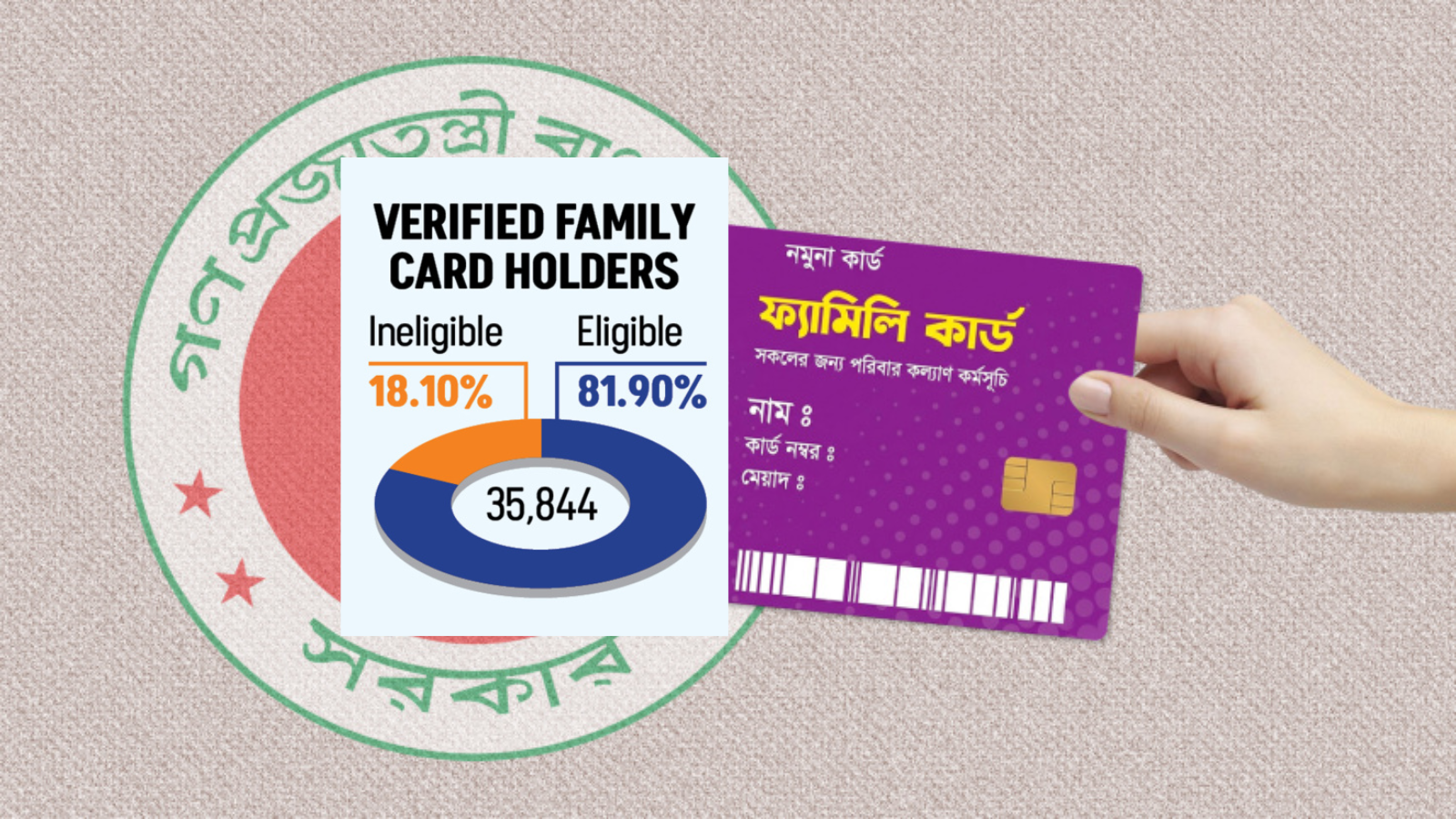
“The programme’s strength lies in direct household verification,” he said, adding that the process helped identify inconsistencies and ensure that only eligible beneficiaries were included.
He also clarified that families headed by widowed fathers raising children would be eligible for support under the programme.
The adviser said the overall programme would be reviewed every six months, with evaluations conducted by the ministries of social welfare and finance, as well as independent third parties. Several internationally reputed universities have expressed interest in assessing the programme, he added.
Asked when the Family Card policy would be published, he said it had received in-principle approval and would be forwarded to the prime minister for final approval before being made publicly available on the government’s website.
At the meeting, the administrative costs for implementing the programme were approved. The committee also finalised the Family Card Piloting Implementation (Revised) Guidelines 2026 and granted in-principle approval to the draft Family Card Implementation Policy 2026.
Officials said beneficiaries would be reassessed every four years. Families whose economic conditions improve would be removed from the programme, while newly eligible households would be included.
The Family Card Programme was a key social protection pledge in the Bangladesh Nationalist Party’s (BNP) election manifesto.
Launched shortly after the current government led by Tarique Rahman took office, it is designed to expand gradually across the country by 2030.
To promote women’s empowerment, cards are being issued in the name of mothers or female heads of households, strengthening women’s economic and social standing within families and communities.
 For all latest news, follow The Daily Star's Google News channel.
 The government also plans to gradually replace the allowance-based components of other social protection schemes through the Family Card system. Ultimately, the programme is expected to evolve into a universal social identification platform.
In his budget speech, the finance minister proposed allocating Tk 14,500 crore to distribute Family Cards to 41 lakh women in the coming fiscal year.
During the pilot phase, 60,044 female heads of households have received allowances under the programme.
Farzana Sharmin, state minister for social welfare; Mir Shahe Alam, state minister for local government, rural development and cooperatives; Finance Secretary Md Khairuzzaman Mozumder; Social Welfare Secretary Mohammad Abu Yusuf; and Planning Secretary SM Shakil Akhter also attended the meeting.
Comments