


IPOs don't tempt big companies

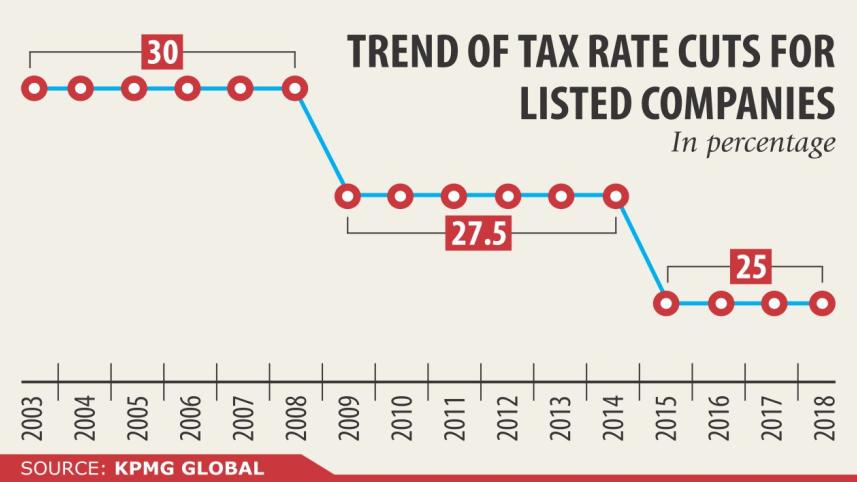
Lengthy process, legal bindings to publish all information and inconvenience of holding annual general meetings put off big groups from getting listed despite the privilege of 10 percent lower corporate tax.
So much that the capital market last year witnessed the lowest initial public offerings and also the smallest amount of funds raised since 2009.
 For all latest news, follow The Daily Star's Google News channel.
 “Big companies should come to the capital market to enhance their reputation and ensure good governance,” said Tapan Chowdhury, managing director of Square Pharmaceuticals and former president of the Bangladesh Association of Publicly Listed Companies.
Chowdhury said the regulator always keeps an eye on the listed companies, which must ensure accountability in every step.
“Many companies don't want to do that level of scrutiny. But this accountability is good for any company.”
He urged the government to increase the corporate tax incentive.
Merchant bankers said the revenue concealing tendency is a big reason for not getting listed. Most companies don't want to pay tax at all, so tax incentives don't work on them.
“Lack of governance in every sphere is the main problem,” said Khairul Bashar Abu Taher Mohammed, secretary general of the Bangladesh Merchant Bankers Association.
Big business groups are reluctant to publish information about their companies for many reasons, and they don't want any legal bindings. It takes more than a year to get the approval for IPO in the book-building system, so the companies would have to wait a while to raise funds, said Mohammed, also the chief executive of MTB Capital.
“Entrepreneurs can't make any plans on the basis of IPO capital due to the lengthy time for listing,” said Md Salauddin Sikder, managing director of Imperial Capital.
For instance, Bashundhara Paper Mills, Aman Cotton Fibrous, STS Holdings and Dhaka Regency Hotel held their road shows in 2016, but none of the companies are yet to get listed on the capital market. “The book-building method is a time-consuming exercise,” said Sikder.
Merchant bankers cite the case of neighbouring India, where the IPO processing time has been cut down.
The average time taken by the Securities and Exchange Board of India in processing draft offer documents has reduced from 78 days in 2016-17 to 61 days in 2017-18.
Some entrepreneurs also blame the high costs for IPOs.
In the fixed-price method, the issuer will have to expend 2 percent for Tk 100 crore raised, 4 percent for Tk 50 crore, 6 percent for Tk 40 crore, 8 percent for Tk 30 crore, 9 percent for Tk 20 crore, and 10 percent for Tk 15 crore.
In the book-building method, the IPO cost may be 1-1.5 percent of the amount raised.
So, the government should make the big companies get listed on the stock market, said Abu Ahmed, a former chairman of Dhaka University's economics department.
In 2010, the Bangladesh Securities Exchange and Commission gave an order that if the paid-up capital of a private company exceeds Tk 40 crore, the company will have to convert itself into a public limited company.
If the paid-up capital of a company exceeds Tk 50 crore, the company will have to apply for an IPO.
But no one is paying any heed to the order. Almost 350 companies are listed with the Large Taxpayer Unit of the National Board of Revenue and they are all making profits and have huge capital base. But most of them are not listed.
In the last 10 years, RAK Ceramics and Grameenphone were the only two multinational companies that went public. “These non-listed big companies have requested for more time, which we are giving them,” said Saifur Rahman, spokesperson of the BSEC.
Listing is helpful for a company's long-term sustainability, said Md Moniruzzaman, managing director of IDLC Investments. Bangladesh's stock market has a severe shortage of good securities. The government has been looking to offload shares of its companies, but that is yet to materialise.


Comments