


Bangladesh signs trade deal with S Korea

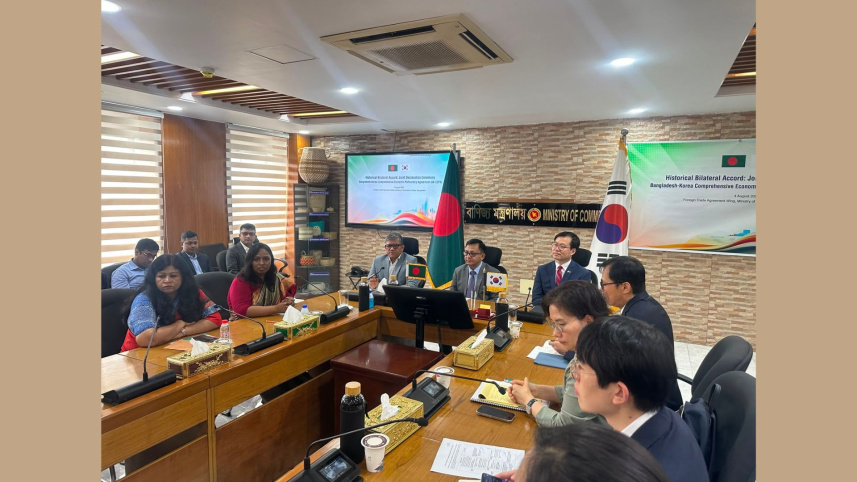
Bangladesh has signed a free trade deal with South Korea under which 97 percent of its goods will get preferential access to the $2 trillion market, as part of its preparations for graduation from the least-developed country bracket that stands to eat up to $17.5 billion worth of exports.
This is the second full-fledged trade agreement signed by Bangladesh with an Asian giant, following the Economic Partnership Agreement with Japan on February 6.

Similarly, 87 percent of South Korean goods will get preferential market access to Bangladesh as part of the Comprehensive Economic Partnership Agreement (CEPA), which was announced by Commerce Minister Khandakar Abdul Muktadir and South Korean Trade Minister Han-Koo Yeo at a joint press conference in Dhaka yesterday.
The deal will not only cover the tariffs, but also trade in goods and services, investment and Rules of Origin.
Han-Koo termed the deal a historic milestone in the bilateral relationship spanning more than 50 years.
Korea and Bangladesh have a long history of economic partnership over the last 50 years, especially in textiles, like the Korean Youngone invested in Bangladesh, he said.
Bangladesh’s big population and good industrial base are attractive to Korea.
“Many global companies are trying to expand or diversify their business, and Bangladesh is a unique place for trade and investment,” Han-Koo said.
The signing of free trade agreements such as CEPA with Korea will pave the way to becoming a trillion-dollar economy by 2034, Muktadir said, adding that negotiations are underway with nearly a dozen countries and trade blocs such as the EU and the Regional Comprehensive Economic Partnership (RCEP).
Bangladesh has targeted Korean investment as well as the duty-free export of goods such as garments, leather, jute and jute goods to Korea, he added.
Last fiscal year, Bangladesh exported goods worth $421 million to South Korea, down 9 percent year-on-year, according to data from the Export Promotion Bureau.
Bangladesh imported goods worth $614 million from South Korea during the July-December period of the last fiscal year, according to the latest available data.
In fiscal 2024-25, imports reached $1.2 billion, up 33 percent year-on-year, according to data from the Bangladesh Bank.
“This is a good signal is good -- it shows we can negotiate with big economies,” said Mohammad Abdur Razzaque, chairman of Research and Policy Integration for Development
Bangladesh should have such FTAs with several countries and trade blocs such as the EU and the RCEP, said M Masrur Reaz, chairman of the Policy Exchange Bangladesh.
“Regardless, this is an encouraging development with regards to trade integration,” he added.
Faruque Hassan, former president of Bangladesh Garment Manufacturers and Exporters Association, termed the signing of CEPA with Korea a “very good and positive” step.
However, Bangladesh should study the Korean market comprehensively to make the best of the deal, he said.
Meanwhile, Bangladesh’s plea for an extension of the LDC graduation for three more years up to 2029 is waiting to be approved in the UN General Assembly to be held next month in New York at the UN Headquarters.
 For all latest news, follow The Daily Star's Google News channel.
Comments