


Glummest bourse

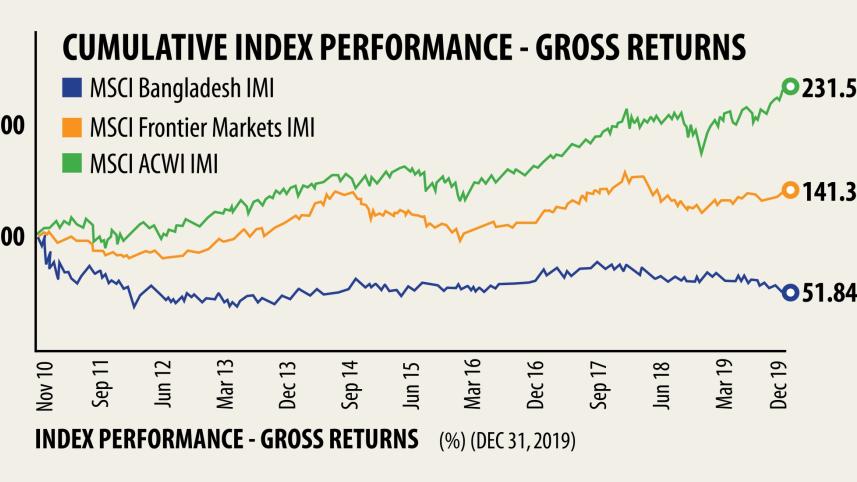
Bangladesh’s bourse has the bleakest outlook out of all the frontier markets, due to which foreign investors are jumping ship.
Frontier markets are less advanced capital markets in the developing world. They are more established than the least-developed countries but still less established than the emerging markets because they are too small, carry too much inherent risk, or too illiquid to be considered emerging markets.
 For all latest news, follow The Daily Star's Google News channel.
 MSCI, an American finance company, publishes indexes covering the global stock market for non-US markets.
It provides an index for Bangladesh too, which is sinking. With 40 constituents, the index covers approximately 99 per cent of the free float-adjusted market capitalisation in Bangladesh.
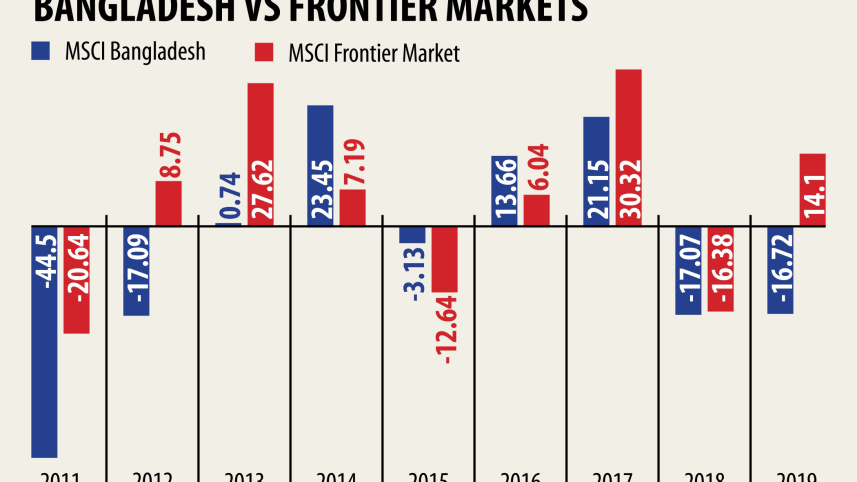
“As the Bangladesh market looks the gloomiest, foreign investors are selling their stakes and shifting to other frontier markets,” said a top merchant banker requesting anonymity.
In the last ten months, foreign investors sold more shares than they bought. So, their net foreign investment was Tk 986 crore in the negative between the months of March and December last year.
Most of the listed banks are suffering from default loans and liquidity shortage, so their credit growth came down -- and that impacted their earnings. Moreover, Grameenphone is sparring with the telecom regulator over an audit claim.
“These have battered foreign investors’ confidence,” the merchant banker said.
The foreign investors also fear a depreciation of the local currency though the finance minister quelled such a possibility.
“On one hand, the earnings of listed companies are taking a hit. And on the other, the rest of the frontier markets are doing well, so foreign investors are leaving,” he added.
The dividend yields of Bangladesh is 3.33, whereas it is 4.04 for frontier markets, according to data from MSCI.
“Many companies are making good money but they are not sharing the spoils with the general shareholders,” said a stockbroker requesting anonymity.
The price-to-earnings ratio (P/E), which relates a company’s share price to its earnings per share, in Bangladesh is 9.81 in contrast to 12.53 in frontier markets.
A high P/E suggests that investors are expecting higher earnings growth in the future compared to companies with a lower P/E.
In this situation, the Bangladesh Securities and Exchange Commission need to ensure corporate governance in the listed companies and check market manipulation such that the pricing of stocks become viable and their dividend yields become higher, the stock broker said.
At the same time, market manipulation has impacted fair valuation of stocks, he said, adding that the regulator should earnestly work towards bringing in well-performing companies and pushing the government towards tackling the problems of the banking sector.




Comments