


Govt plans national AI policy to boost efficiency, transparency: PM's adviser
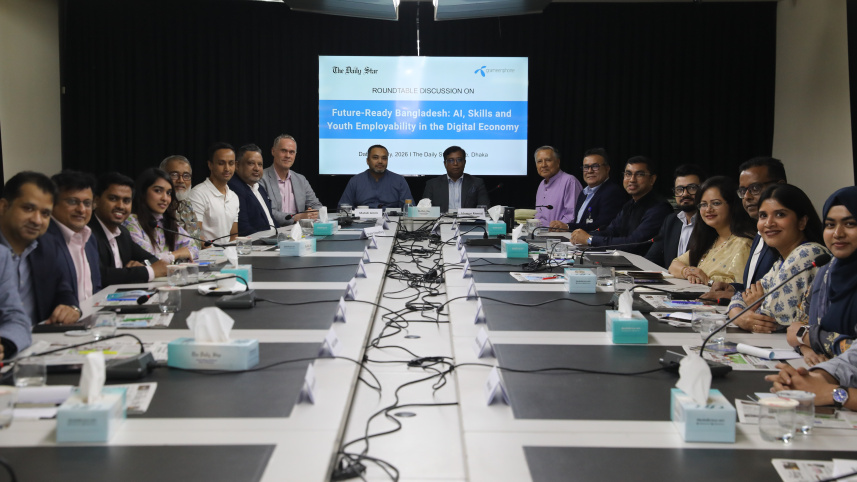
The government is planning to prepare a national artificial intelligence (AI) policy aimed at making public services faster, more transparent and accountable while improving efficiency across government operations, an adviser to the prime minister said today.
"AI is not a choice anymore," said Mahdi Amin, adviser to the prime minister, while speaking at a roundtable titled "Future-ready Bangladesh: AI, Skills and Youth Employability in the Digital Economy", jointly organised by Grameenphone and The Daily Star at The Daily Star Centre in Dhaka.

He said AI would be integrated into government programmes ranging from social safety nets to public service delivery, project monitoring and policymaking.
"We are considering introducing a national AI policy. We want to use AI to make government services faster, more people-centric, and ensure greater transparency and accountability," he said.
According to Amin, AI can significantly improve the monitoring and supervision of public projects, helping overcome bureaucratic delays while strengthening governance.
"Our government's ethos is to ensure transparency and accountability after a long time, and AI can help us achieve both," he added.
He said the government sees itself primarily as a policy facilitator, creating an enabling environment where the private sector will lead economic growth.
"No government can implement policies in isolation. We will provide the platform and opportunities, while the private sector will drive growth," he said.
Emphasising public-private collaboration, Amin said reforms in education, skills development and entrepreneurship would require stronger industry-academia partnerships.
He acknowledged that Bangladesh's education system remains largely theory-driven and said reforms would focus on practical skills and employability.
As part of the reforms, technical and vocational education will gradually become mandatory from class six in all schools, with technical and vocational education and training (TVET) laboratories to be established nationwide over the next two years.
The government also plans to expand language education, extracurricular activities, sports and cultural programmes to prepare students for future jobs.
Highlighting the country's demographic dividend, Amin said creating employment through private investment, entrepreneurship and overseas opportunities would remain a major priority.
He said the government is pursuing deregulation and business-friendly policies to encourage investment, simplify company registration and support entrepreneurs, particularly outside Dhaka.
Measures are also being considered to improve access to fiscal support and affordable financing for women entrepreneurs and small businesses.
Calling AI only one part of a broader transformation, Amin said Bangladesh also needs greater investment in research and development, stronger university-industry collaboration and a modern education system that bridges knowledge with practical application.
"Technology must be embraced across sectors. Combined with partnerships with the private sector and need-based education, it will help us deliver on the promises we made to the people," he said.
Mamun Ahmed, chairman at the University Grants Commission of Bangladesh; ASM Amanullah, vice chancellor of National University; Otto Magne Risbakk, chief financial officer of Grameenphone, and Mahfuz Anam, editor and publisher of The Daily Star, also spoke at the event.
 For all latest news, follow The Daily Star's Google News channel.
Comments