


How AI is reshaping primary healthcare in Bangladesh

In Bangladesh, even for common illnesses such as fever, headaches or high blood pressure, many people bypass nearby primary healthcare facilities and head directly to large hospitals. The result is overcrowded hospitals, rising healthcare costs, longer waiting times and delayed treatment. Yet, evidence from the World Health Organization (WHO) suggests that nearly 80 percent of health problems can be prevented or effectively managed at the primary care level through timely preventive healthcare.
The underlying challenge is the limited access to and utilisation of preventive and primary healthcare. Preventive and primary healthcare is still not part of everyday life for most citizens. Routine screening, early risk assessment, and health education and awareness are often overlooked until illness becomes severe. Many people do not prioritise preventive services, and spending money on healthcare is frequently seen as necessary only when disease strikes. This mindset leads to delayed treatment, increased complications, and rising healthcare costs for families. It also places an unsustainable burden on hospitals that should primarily be serving patients requiring specialized care.

The consequences of weak primary healthcare are becoming even more serious as Bangladesh faces a rapid rise in non-communicable diseases such as diabetes, hypertension, obesity, and mental health disorders. These conditions are no longer confined to older populations; they are increasingly affecting working-age citizens and threatening the nation’s productivity. Bangladesh has a large youth population and the potential to benefit greatly from a demographic dividend, but that opportunity is at risk if chronic illnesses continue to spread without early detection and preventive intervention.
This is where artificial intelligence (AI) is beginning to change the conversation. Rather than replacing healthcare providers, AI is helping shift healthcare from treating illness to preventing it. Around the world, AI-powered healthcare solutions are expanding rapidly, and Bangladesh has developed an innovative model that combines AI with community-based healthcare to bring preventive and primary healthcare to people's doorsteps.
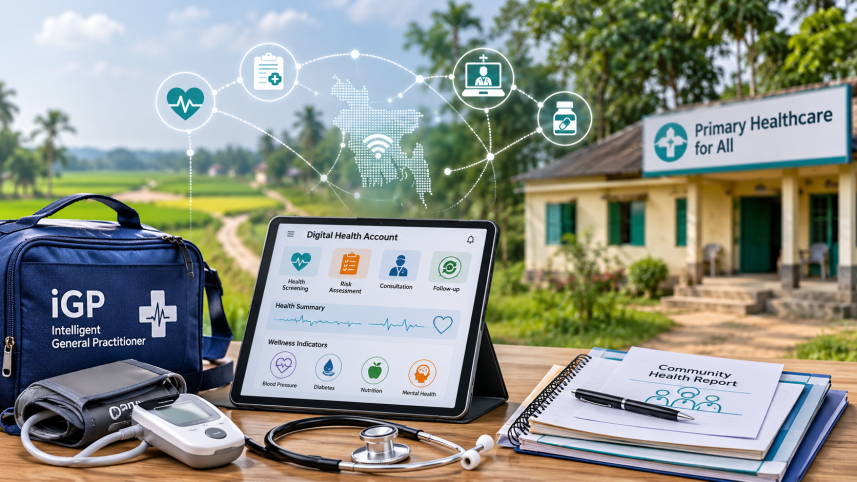
Known as the Intelligent General Practitioner (iGP) Model, this people-centred healthcare system empowers trained Community Health Workers (CHWs) with AI-powered clinical decision support, Internet of Things (IoT)-enabled Point-of-Care Diagnostic (POCD) devices and an integrated digital healthcare ecosystem. Equipped with these technologies, health workers visit households in the community to provide health education, conduct periodic health screenings and risk assessments, perform triage, refer patients to physicians whenever necessary, and provide follow-up to ensure continuity of care.
Every individual receives a Digital Health Account, allowing their health information to be securely stored and updated over time. This enables continuous monitoring and early detection of diseases long before complications develop. Imagine a farmer’s wife in Kurigram whose routine health screening reveals high blood pressure despite having no symptoms. With early identification, lifestyle counselling, medical advice, and timely treatment can begin immediately—preventing a future stroke or heart attack. Without preventive screening, the disease might only have been discovered after a life-threatening emergency. This illustrates the real value of preventive healthcare—detecting risks before they become emergencies.
One of Bangladesh's greatest healthcare strengths has always been its Community Health Workers. Their contribution to family planning, immunization, and maternal health has earned global recognition. The iGP model builds upon this success by empowering these frontline workers with AI-driven technology. Instead of focusing on a limited number of services, a single health worker can support the healthcare needs of every member of a family—from newborns and children to adolescents, pregnant women, adults and the elderly. An AI Co-pilot assists health workers in analysing health risks, identifying possible diseases, recommending appropriate next steps, and determining whether patients require referral or follow-up. When needed, patients can immediately access doctors through 24/7 telemedicine services or receive care at nearby GP Centres staffed with physicians, nurses, paramedics, and midwives. If specialized treatment is required, the system ensures functional referral to secondary or tertiary hospitals. As a result, patients receive the right care at the right time while hospitals can focus on those who truly need specialized treatment.
In this way, the model creates a connected, people-centred healthcare ecosystem linking Union-level services with specialized hospitals. In rural areas, it integrates Community Clinics, Union Health and Family Welfare Centres and Union Sub-Centres with digital health technologies. In urban settings, where door-to-door services are more challenging, catchment area-based GP Centres staffed by doctors, nurses and paramedics provide accessible primary healthcare and referral services while strengthening community participation and health awareness.
The scope of services is equally comprehensive. Beyond common infectious diseases, the model covers hypertension, diabetes, nutrition, maternal and child health, adolescent health, mental health, elderly care, growth monitoring, breast cancer screening, eye screening and other non-communicable diseases. These services are aligned with World Health Organization guidelines and Bangladesh's Essential Service Package.
Most importantly, this is not simply a research concept; it has already been implemented with measurable results. Over the past decade, more than 3 million people have benefited from the model through community-based preventive and primary healthcare services. More than 2.5 million individuals from over 450,000 families across 65 rural catchment areas have been served in partnership with local NGOs and development organizations, while over 3,000 female Community Health Workers have been trained and empowered to deliver quality healthcare.
The model has also successfully expanded into urban settings. Under UNICEF's leadership, in partnership with PHD, Nari Maitree, and CMED Health, 6 ‘Aalo Clinics’ have already delivered healthcare services to nearly half a million urban residents living in underserved communities. Building on the evidence and lessons generated from this initiative, the Directorate General of Health Services (DGHS), with support from UNICEF, organized a National Experience Sharing Workshop on 9 July 2026. The workshop showcased the evidence-based outcomes and field experiences of the ‘Aalo Clinic’ model, providing valuable insights for future government policies and strategies to strengthen urban primary healthcare.
Building on this momentum, in partnership with BRAC, the ‘Amader SuSastho’ initiative in Uttara, Dhaka, has introduced an affordable, technology-enabled primary healthcare model designed to serve individuals and families across all income levels, demonstrating that quality healthcare can be accessible and affordable for everyone. The initiative illustrates that by combining public-private partnerships, AI and community-based healthcare, it is possible to establish an effective, sustainable, and people-centred primary healthcare system in urban Bangladesh.
Another significant advantage of this technology-enabled model is its affordability. Comprehensive primary healthcare can be delivered for approximately $1.5 per family per month in rural areas and $3 per family per month in urban areas, excluding medicines, vaccines and family planning commodities.
Beyond digital healthcare, the iGP Model also presents an opportunity to build a green healthcare system. Equipping every Union GP Centre with a rooftop solar net-metering system could significantly reduce electricity costs while lowering carbon emissions. It would also create opportunities to generate carbon credits, providing an additional revenue stream that could strengthen the financial sustainability of primary healthcare while advancing Bangladesh's vision of climate-resilient and carbon-neutral healthcare.
The Government of Bangladesh has placed strong emphasis on strengthening primary healthcare alongside introducing Digital Health Accounts and e-Health Cards for every citizen as part of its ongoing health sector reforms. In this context, experts believe that the AI-powered, community-based iGP Model can serve as a strong foundation for the country's future healthcare system. They also believe that by delivering accessible, affordable, and quality healthcare services, the model has the potential to address up to 80 percent of common health problems at the community level.
The initiative can also contribute to the government's goal of developing a skilled health workforce and strengthening human resources for health. It has the potential to engage nearly 100,000 trained Community Health Workers in delivering technology-enabled preventive and primary healthcare services, enabling quality healthcare to reach people's doorsteps more efficiently.
The future of healthcare is unlikely to be defined simply by building more hospitals. Instead, it depends on creating a health system that is proactive rather than reactive—one that identifies disease risks early, makes regular health screening a routine part of life, and ensures people receive timely guidance and intervention before illnesses become severe. By combining artificial intelligence, digital health technologies, and empowered Community Health Workers, the iGP Model provides a practical and effective blueprint for that future.
For decades, healthcare has largely focused on treating diseases after they occur. Today, however, the global paradigm is shifting towards preventing illness before it begins. For a densely populated country like Bangladesh, successfully embracing this transformation could reduce healthcare costs, improve workforce productivity, accelerate progress towards Universal Health Coverage (UHC), and contribute significantly to achieving the Sustainable Development Goals (SDGs).
Investing in preventive and primary healthcare today is not merely a health sector priority—it is an investment in the nation's long-term social and economic development. The Government of Bangladesh has set a vision of ensuring Digital Health Accounts, e-Health Cards, and strong primary healthcare services for every citizen. The iGP Model offers a practical and timely pathway to translate that vision into reality. At the same time, it can strengthen healthcare infrastructure, develop a skilled health workforce, improve service quality, accountability and transparency, while ensuring accessible, affordable, people-centered healthcare reaches every community.
Most importantly, the iGP Model is not only relevant for Bangladesh; it also offers a promising pathway for achieving UHC across other low- and middle-income countries (LMICs). Efforts to adapt and implement the model are already progressing in several LMICs. As an innovation originating from Bangladesh, this AI-powered, community-centred healthcare model has the potential to become a global example of how technology, skilled human resources and community engagement can ensure accessible, affordable, sustainable, and high-quality healthcare for all.
 For all latest news, follow The Daily Star's Google News channel.
Professor Khondaker Abdullah Al Mamun is the vice president for AI, innovation & entrepreneurship at Washington University of Science and Technology (WUST), USA. He is also a professor in the Department of CSE at the United International University (UIU) and founder and director at the AIMS Lab and Institute of Research, Innovation, Incubation, and Commercialization (IRIIC) at the UIU.
Comments