


Reckitt Benckiser profits off people’s heightened hygiene habits amid pandemic

Reckitt Benckiser Bangladesh witnessed robust growth in sales and profits in the pandemic-ravaged first half of 2020 on the back of higher sales of hygiene products.
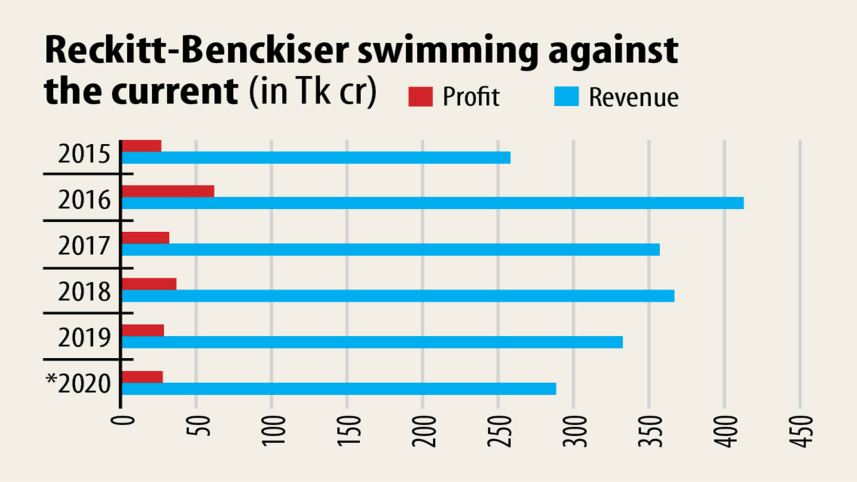
Profits of the local subsidiary of the Anglo-Dutch multinational consumer goods soared 54.28 per cent to Tk 27.17 crore in the first half.
 For all latest news, follow The Daily Star's Google News channel.
 Between January and June, sales grew 28.87 per cent year-on-year to Tk 258.57 crore.
"Our profits and sales grew in the quarter as the demand of some of our products were high," said Md Nazmul Arefin, company secretary of Reckitt Benckiser Bangladesh.
Reckitt Benckiser, which got listed in the Dhaka Stock Exchange in 1987, joined the group of the multinational companies listed with the DSE that made a profit despite the pandemic.
British American Tobacco's profit grew a whopping 69 per cent in the second quarter of 2020 on the back of lower operating costs.
Indian fast-moving consumer goods company Marico Bangladesh's net profit increased by 17 per cent to Tk 99.66 crore in the April-June quarter.
Reckitt Benckiser's earnings per share, subsequently, rose 54.26 per cent to Tk 57.51 in the first half and 53.39 per cent to Tk 33.47 in the second quarter.
The news though failed to cheer the market. The company's stock traded 2.34 per cent lower at Tk 3,572 yesterday.
"Stock investors knew that Reckitt Benckiser's profitability is higher during the pandemic because the multinational company's top-selling products are hygiene-related," said a top official of a leading stockbroker.
Incorporated in Bangladesh in 1961, the company is engaged in manufacturing and marketing household and toiletries sanitisation products, pharmaceuticals and food products.
Its brands include Finish, Lysol, Veet, Dettol, Air Wick, Durex, Mortein, Strepsils, Woolite, Vanish and Harpic. In Bangladesh, the most popular product of Reckitt Benckiser was soap and Dettol.
In 2019, Reckitt Benckiser widened its market shares in the bar soap category and is holding the top position in the toilet cleaner category.
Owing to the pandemic, the company sees quite a few short-term challenges, such as supply chain disruptions, the volatility of international trade and currencies markets, general economic downturn across the world and Bangladesh impacting consumer confidence and affecting consumption patterns.
Sourcing of raw materials has been a problem because of the global lockdown but the company has had a stock of enough raw materials to produce products for Bangladesh, Arefin said.
"We maintain a level of stock in our company all the time," he told The Daily Star.
Like others, Reckitt Benckiser faced challenges to market products during the pandemic-induced shutdown. However, it managed to keep the supply smooth, Arefin said.
The huge demand for hygiene products may peter out once an effective virus to treat the virus is available, the company secretary said.
"However, some people have become used to using hygiene products and they would continue to do so."




Comments