


War further clouds private credit demand

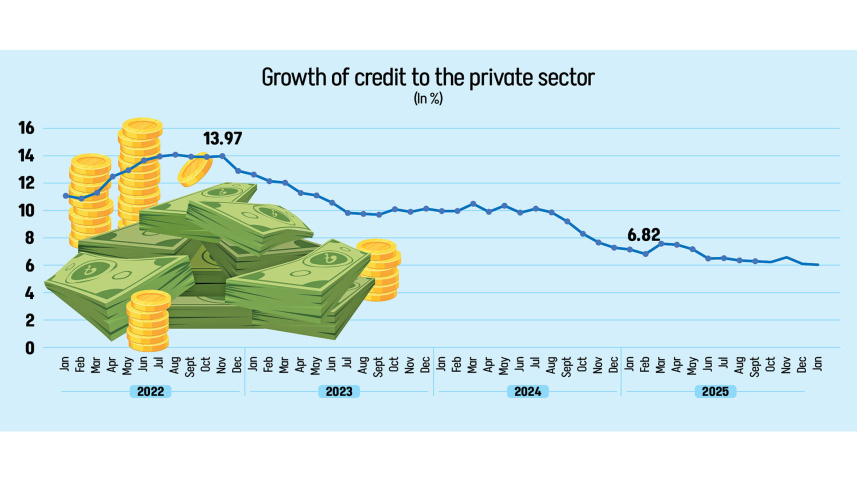
Credit growth to the private sector has been staying around 6 percent as businesses continue to be shy about taking on fresh projects amid economic uncertainty.
In January, banks’ credit to the private sector grew by 6.03 percent, the lowest in at least five years. This makes it the eighth straight month of below 7 percent growth in credit demand.

The ongoing US-Israel war on Iran has already made oil and gas prices volatile and created fears of a ripple effect on the global economy and of stoking inflation. This has dampened the prospect of a sharp recovery in private sector credit demand and the much-needed spike in fresh investment.
“The Middle East crisis has made things volatile. It appears that the situation is not conducive. Under such circumstances, it is uncertain whether anyone would consider making fresh investments,” said Mati Ul Hasan, managing director of Mercantile Bank PLC.
Since the launch of US-Israel attacks on Iran in February, oil prices have soared. They hit nearly $120 per barrel last week as Iran effectively blocked the Strait of Hormuz, a key maritime chokepoint through which one-fifth of the world’s oil travels.
The price of Brent crude, the benchmark international oil contract, briefly dipped below $100 on Friday. It closed at $103.14 per barrel, and has soared by more than 42 percent since the start of the conflict, according to an AFP report.
Like other economies, the spike in oil prices, a key commodity, has also created concerns here, as Bangladesh meets 95 percent of its oil and 30 percent of its gas through imports.
The South Asian country imports over 60 percent of its crude oil from Saudi Arabia, the United Arab Emirates (UAE), Oman, Kuwait and Iraq. For liquefied natural gas, the country imports most of the energy from Qatar.
Worries have also increased because of the spike in shipping costs following the escalating war.
Hasan said the impact of the war has been visible in the foreign currency market. The taka has weakened against the US dollar.
“Our existing clients are worried about the risk of higher import costs,” he said.
“Businesses are in a stressful situation. They do not have the mindset to go for fresh investment now. They are likely to wait to see where things settle down.”
Bangladesh’s private investment fell for the third consecutive year, reaching 22.03 percent of gross domestic product (GDP) in the fiscal year 2024-25, the lowest level in 11 years.
The consistent slowdown in credit demand in the private sector means investment will remain subdued, the much-needed boost to the economy will be delayed, and there will be fewer jobs than required in the country.
Ashikur Rahman, principal economist at the Policy Research Institute (PRI) of Bangladesh, said that in periods surrounding national elections, it is quite common for entrepreneurs to delay major investment decisions until there is greater clarity regarding the political and policy environment.
As a result, demand for credit from the private sector tends to remain subdued. At the same time, banks have also become more cautious in extending loans because of concerns about asset quality and the broader macroeconomic environment, he said.
“Restoring confidence through political stability and credible economic reforms will therefore be critical for reviving private sector credit demand,” he said. However, the emerging geopolitical tensions have added another layer of risk to the macroeconomic outlook.
“Any escalation in the conflict in the Middle East could push up global oil prices and disrupt energy markets. For an energy-importing country like Bangladesh, this would increase the import bill, put pressure on the balance of payments, and complicate inflation management,” he added.
 For all latest news, follow The Daily Star's Google News channel.
Comments