


BTRC to auction more lower-band spectrum
Highlights
- BTRC to auction additional lower-band spectrum
- EGSM band chosen over 850 MHz option
- Cross-border interference poses major technical hurdle
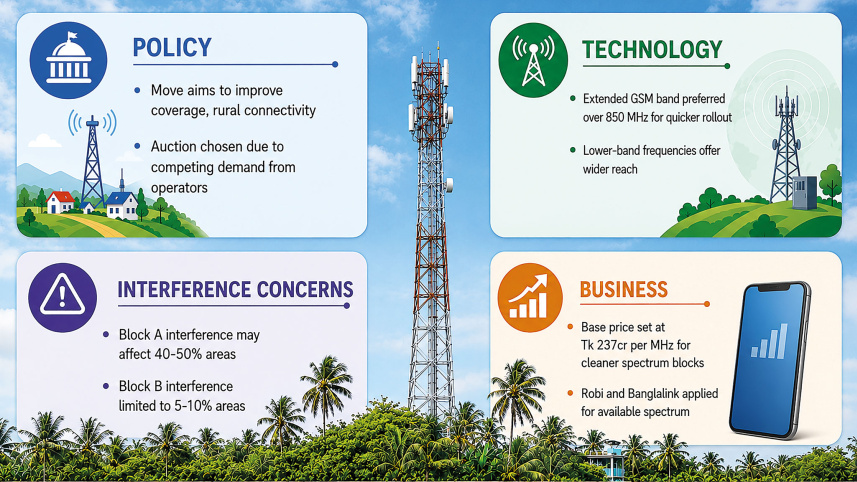
The telecom regulator has decided to allocate additional lower-band spectrum to mobile operators through an auction process, aiming to improve network coverage, indoor connectivity and rural service quality.
The Bangladesh Telecommunication Regulatory Commission (BTRC) made the decision at a recent meeting following recommendations from a technical committee tasked with comparing spectrum bands, setting prices and identifying cross-border interference issues, regulatory officials said.

“The additional lower-band spectrum could help operators strengthen network coverage in both urban and rural areas,” said Major General (retd) Md Emdad-Ul-Bari, chairman of the BTRC.
Spectrum refers to the radio frequencies used to transmit mobile signals. Lower-band spectrum with frequencies below around 1,000 MHz is particularly valuable because signals travel farther and penetrate walls more effectively than higher-frequency bands. This allows operators to cover wider areas using fewer towers, cutting infrastructure costs while improving service quality.
“The additional lower-band spectrum could help operators strengthen network coverage in both urban and rural areas,” said Major General (retd) Md Emdad-Ul-Bari, chairman of BTRC
Since multiple operators have applied for the same spectrum blocks, the commission decided to allocate them through a competitive auction rather than direct assignment, officials familiar with the matter said.
According to a committee report presented at the meeting, the Extended GSM (EGSM) band is more practical for Bangladesh in the short term because almost all mobile handsets in the country already support it for 2G services -- voice calls, SMS and low-speed data.
The committee was formed to compare the 850 MHz and EGSM bands, determine spectrum pricing and identify technical barriers, particularly cross-border interference issues affecting parts of the EGSM spectrum.
In its report, the committee noted that lower-band spectrum could significantly improve indoor connectivity in densely populated cities while helping operators reach remote areas.
However, it also identified major interference challenges in parts of the EGSM spectrum, particularly in border areas near India.
To assess the scale of the problem, mobile operators monitored interference levels across Rajshahi, Rangpur, Mymensingh, Sylhet, Cumilla, Chattogram, Khulna, Barishal and Cox’s Bazar, as well as several parts of Dhaka.
Apart from Dhaka, testing was largely carried out at sites between roughly 5 and 50 kilometres from international borders. For technical analysis, the committee split the 8.4 MHz block of EGSM spectrum under consideration into two portions.
The first, Block A, consists of 5 MHz of spectrum in the 880-885 MHz and 925-930 MHz frequency ranges. Frequencies in this band can travel long distances and penetrate buildings effectively, making them particularly valuable for coverage in dense cities and remote areas.
According to the report, interference levels in this block were extremely low in Rajshahi and Khulna. However, significant interference was detected in Rangpur, Mymensingh, Sylhet, Cumilla and Chattogram, especially in border-adjacent areas.
The committee estimated that interference in Block A could affect approximately 40 to 50 percent of Bangladesh’s total geographic area.
The second portion, known as Block B, includes 3.4 MHz spectrum in the 885-888.4/930-933.4 MHz range.
The committee found that interference in this block was comparatively lower. Significant interference was observed only in Rangpur, while most other regions remained practically interference-free.
The report stated that the interference impact in Block B would likely remain limited to around 5 to 10 percent of the country’s area, making it more commercially attractive for operators.
Despite these challenges, the committee concluded that the EGSM band should still be considered more suitable than the 850 MHz band for short-term allocation because of handset compatibility and immediate deployment feasibility.
The 850 MHz band offers stronger signal reach and better building penetration, but relatively few handsets in Bangladesh currently support it, limiting how quickly operators could put it to use.
 For all latest news, follow The Daily Star's Google News channel.
 There is one limitation worth noting for the EGSM band as well. Since Bangladesh still has relatively low smartphone penetration, only around 60 percent of users may be able to use the band effectively for data services.
For commercial allocation, the committee proposed dividing the same 8.4 MHz into three blocks -- one of 1.6 MHz and two of 3.4 MHz each -- based on operator demand. Robi Axiata currently holds the 1.6 MHz portion, while both Robi and Banglalink have applied for the two 3.4 MHz blocks.
Apart from deciding to auction the spectrum, the commission also endorsed the committee’s pricing recommendations and agreed to forward them to the Posts and Telecommunications Division for policy approval.
For the lower-interference 3.4 MHz block, the committee recommended setting the base price at Tk 237 crore per MHz for a 15-year period, matching the government-approved benchmark price for the 700 MHz band.
However, considering that the spectrum would only remain available until 2030 and that some limited interference still exists in certain areas, the commission said the government may consider reducing the base price by up to 10 percent.
For the more interference-prone 5 MHz block, the committee proposed a larger discount. Operators argued for a steeper reduction -- between 30 and 40 percent below the Tk 237 crore benchmark -- on the grounds that cross-border interference would prevent them from using the spectrum nationwide. However, the commission settled on a maximum discount of 25 percent.
The committee further recommended that operators use technical filters and mitigation tools to minimise interference and improve coexistence within the band.
Comments