


Stick to April 10 deadline
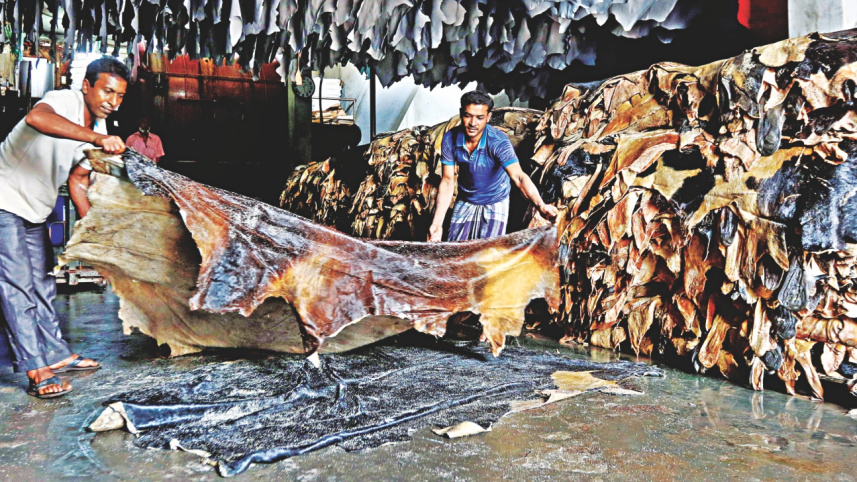
Environmentalists yesterday urged the government to remain firm in its stance about relocation of the tanneries from the capital's Hazaribagh to Savar by the new deadline, April 10.
"The government must cancel the plots (given in Savar) of tanneries that will fail to relocate within that time. They must disconnect the gas, electricity and water supply lines of the factories in Hazaribagh after the deadline," said Md Abdus Sobhan, general secretary of Poribesh Bachao Andolon (Poba).

He was speaking at a press conference on "Relocation of the tanneries: Prevailing circumstances and things to do" at Poba office in the capital yesterday.
He said the tanneries in Hazaribagh had been polluting the Buriganga for the last 65 years by thousands of litres of untreated and toxic liquid waste, which posed a serious risk to human and animal health.
Poba members, who visited the site on Sunday, observed that if the tannery owners wanted to relocate, they would have done so by now.
Following a High Court verdict in 2001, steps were taken to shift 155 companies to a leather-estate in Savar, on the outskirts of the capital.
The government took up the project to build the infrastructure of the estate including roads, water, electricity and gas supply lines, and a common effluent treatment plant (CETP).
By 2013, plots were allotted, and Bangladesh Small and Cottage Industries Corporation (BSCIC), the government agency, which is implementing the tannery estate project, has approved the lay-out plan of 152 industrial units out of the 155 in the Savar site.
"However, in the last three years only one company has completed the full set-up to start production," said Sobhan, adding that another 56 had built factory buildings, but only 28 were in the process of installing leather tanning drums, an essential part of the tanning process.
Refuting tannery owners' allegation that they did not have utility connections, Sobhan said the main gas and water pipeline was installed by the government.
He said the owners were responsible for connecting their factories to the main supply pipeline, and for electricity connections, they needed to have own sub-stations.
Similarly, the tannery owners also need to install waste screening structures inside their own industrial unit before sending the sewage to the CETP, he added.
Sobhan said for the CETP to be functional, it required waste, which could not form if the firms did not start production.
Prof Delowar Hossain, designer and consultant of the CETP, said out of the three Effluent Waste Pumping Stations, one was complete, through which 8,000 cubic metres of sewage could be collected.
"The equipment needed for the electricity connection is at the site. All that is needed now is installation of the switchboard," he said.
Tipu Sultan, managing director of Bengal Leather Complex and former chairman of Bangladesh Finished Leather, Leathergoods & Footwear Exporters' Association (BFLLFEA), said the assessment of gas supply required for the industrial units was going on.
"Many new factories are not getting gas, but the government promised to give us gas. We are doing the assessment and it would take about a month to get everything ready," he said, adding that shifting by April 10 was not realistic.
He referred to the "incomplete" CETP as one of the reasons for the delay in shifting.
Ironically, tanners do not use a CETP in Hazaribagh now.
 For all latest news, follow The Daily Star's Google News channel.
 When asked if the production of tanneries depends on CETP, Sultan said no. "But if we relocate there and dump the waste in the Dhaleshwari River, locals will attack us by blaming us for polluting Dhaleshwari after Buriganga."
Comments