

Sylhet at a standstill
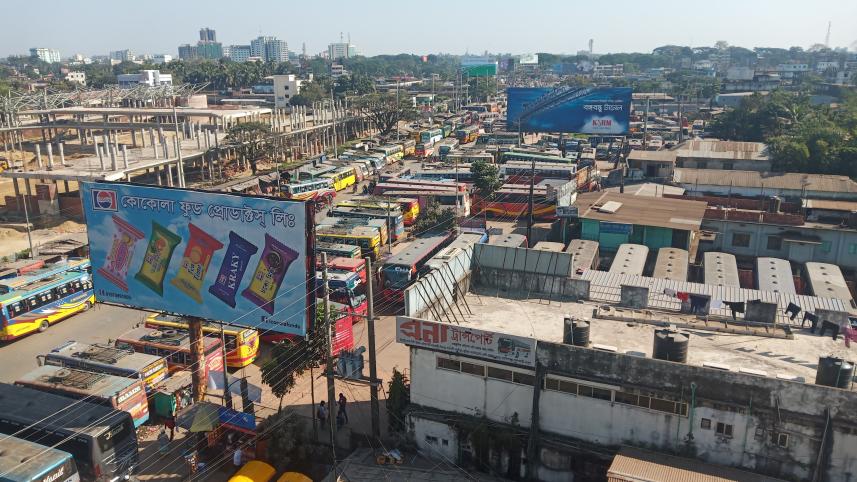
Road communication of Sylhet division with the rest of the country remained suspended since yesterday following a 72-hour transport strike.
"Greater Sylhet Stone-related Traders and Workers Union" in association with transport workers reportedly enforced the strike at 6am with a demand to resume stone extraction.

They also assured of following environment-friendly manual methods if the district administration allowed them to begin the extraction.
Environmentalists, however, warned that the stone workers never followed environment-friendly methods to extract stones and will not do so even if permission is given again.
Meanwhile, people of the division continued to suffer as no vehicles left or entered Sylhet as transport workers blocked all the access points since yesterday morning. The strike is being observed in Sylhet, Moulvibazar and Habiganj. Sunamganj district's transport workers did not join the strike.
Saikat Das, a private job holder of Madina Market area in the city's Zindabazar, said finding no other alternatives, many like him had to walk to work. "Even rickshaws were hard to find due to the demand."
Extracting stones from different quarries and nearby sites using heavy machineries had become a serious environmental concern over the decade, and finally the administration managed to control the situation this year in four upazilas (Companiganj, Gowainghat, Jaintiapur and Kanaighat) of Sylhet.
In 2010, the High Court issued an order to stop use of machineries for extraction following a writ petition filed by Bangladesh Environmental Lawyers Association.
But stone traders continued to use illegal means while extracting stones.
At least 76 workers died in the pits from January 23, 2017 to January 20 this year, according to media reports.
Till this February 10, several HC and government orders were issued to stop stone extraction and during the first months of coronavirus pandemic, the administration started enforcing laws in this regard.
The Bureau of Mining Development also stopped leasing out quarries.
Abdul Jalil, convenor of the union that called the strike, said, "There are around 15 lakh seasonal stone workers who work in the quarries during the season -- from December to March. Moreover, there are thousands of transport and stone-crusher workers. We are demanding that the authorities ensure livelihood of these people."
"We urged the administration to give us a timeframe to resolve the issue. As they failed, we're continuing our strike and urged public transport workers to join our cause," he said.
To avert the strike, Sylhet District Administration organised a meeting with stone and transport leaders and workers on Monday afternoon, but there was no fruitful outcome.
Abdul Muhit, general secretary of Road Transport Workers Union's Sylhet district unit, said, "We and stone transport workers are all part of Bangladesh Road Transport Workers' Federation. That's why we had to stand with them to realise their demands and the federation also instructs us that way."
Contacted, Selim Ahmed Folik, president of the federation's (Sylhet) divisional unit, said, "When the stone transport workers call strike, they block all roads and public transport also faces problem. That's the reason we had to stand with them so that their problems can be resolved for good."
However, Folik, also the president of Road Transport Workers Union's Sylhet district unit, said he did not know if the federation instructed anyone to join the strike.
Meanwhile, environmentalists continue to raise concerns over the issue, saying that the demands of stone traders and workers are "unfair" and "unjust".
Abdul Karim Kim, general secretary of Bangladesh Paribesh Andolon (Bapa), Sylhet chapter, said, "There's no way stone traders will extract stones manually, they never did. Yet, they are trying to pressurise the government through enforcing the strike in connivance with transport workers, causing sufferings to people".
 For all latest news, follow The Daily Star's Google News channel.
 "We demand that they should not be given permission to extract stone," he said.
Contacted, Mohammad Mashiur Rahman, divisional commissioner of Sylhet, said, "The government has banned stone extraction in Sylhet to save the environment. We are trying to come up with an amicable solution through talking with the stone traders and workers. However, we don't know why transport leaders and workers joined the strike, it's only causing suffering to people."


Comments