


Waning human rights, political space, detentions may be causes
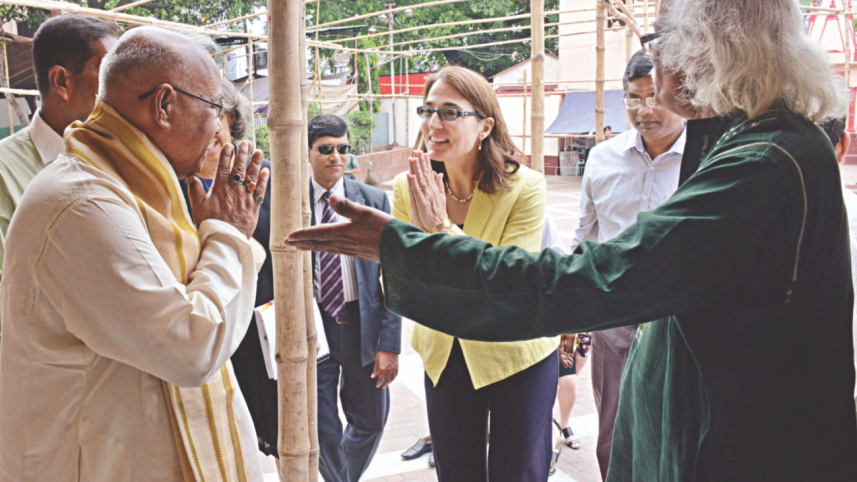
Undermining human rights, restricting political space and arbitrary detention can give rise to radical ideologies, extremism and violence, said US State Department Under Secretary Dr Sarah Sewall yesterday.
She avoided a direct reply to a journalist's query on whether she sees Bangladesh as a breeding ground for extremism as the US did not find the last national election inclusive while the then opposition alleged their activists were detained arbitrarily.
 For all latest news, follow The Daily Star's Google News channel.
 However, addressing a public lecture organised by the Dhaka University's (DU) Department of International Relations at its auditorium, she said, "In many countries around the globe we find the state behaviour, particularly in security sector, can see the extremist violent narratives."
She said Islamic State activities were spreading and that violent attacks on secular thinkers, including Avijit Roy, and on Hindus, Christians and Shias went against Bangladesh's tradition of peaceful co-existence and tolerance.
Extremism is not linked to any religion, but to bad governance, abuses and restrictions on free speech, said the under secretary for Civilian Security, Democracy and Human Rights who arrived on a three-day visit on March 29.
She said extremist ideologies were not very new but the way these were spreading now was a new global challenge, demanding stronger preventive state policies and inter-state collaboration.
She pointed out that apart from army or police deployment, policies were required which engaged youths and women in promoting tolerance and respect towards others' opinions, cultures and traditions.
On whether poverty is linked to violent extremism, the former teacher of national security and human rights at the John F Kennedy School of Government at Harvard University said there were many low income communities that were law-abiding citizens.
However, sociological research and analyses are required to understand the link, said the teacher who joined the state department on February 20, 2014.
Vice Chancellor Prof AAMS Arefin Siddique, the department Chairman Prof Ehsanul Haque and US Ambassador Marcia Stephens Bloom Bernicat also spoke.
Dr Sewall also visited Dhakeshwari Temple and met minority groups. "One of the interesting elements we discussed with them is the need for equal protection under the law," she told journalists afterwards.
The laws themselves do not cause concern but unequal enforcement, she said, stressing the need for very strong statement from political leaders and community leaders on ensuring equal rights for all.
The state has to have stronger efforts to ensure there is equal protection of all under the law and there is no culture of impunity for those who are perpetrating communal violence, Dr Sewall said.
Comments