


4 fictional case studies in incel pathology
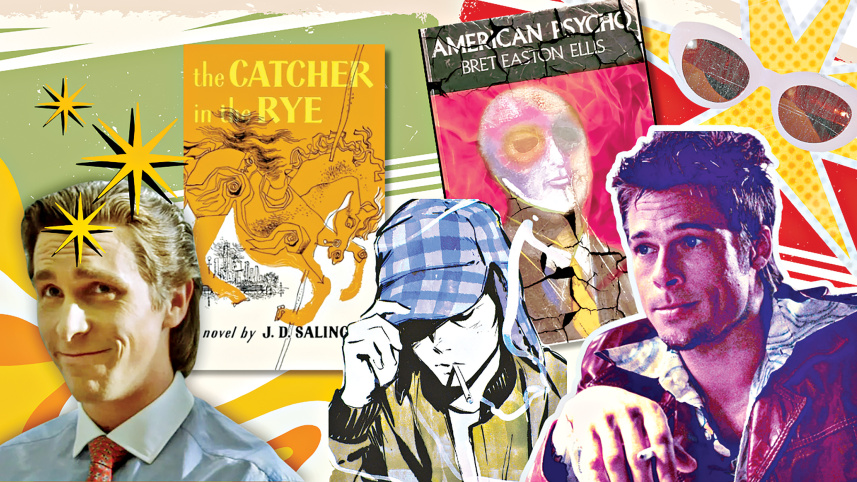
You should never judge a book by its cover, but you can definitely judge a person by the covers lining their bookshelf. The term ‘incel’, shorthand for ‘involuntary celibate’, gained traction through internet subcultures. But incel ideology long predates the word itself. Inceldom is about sexual absence, of course, but also how the loneliness caused by celibacy is converted to entitlement. Literature, particularly those taking place in modern settings, has always featured alienated men struggling with their masculinity, desire for intimacy, and their role in society. Today, the term has been relegated to a mere derogatory slang slung around as a stand-in for “you have no social life.”
The following are books populated with characters that embody—or orbits close to—what is now called inceldom. If you know someone who agrees with any of these characters, it may be time for an intervention.

Notes From Underground
Fyodor Dostoevsky; Richard Pevear, Larissa Volokhonsky (translators)
Vintage Classics, 1864
The Underground Man is frequently referred to as a proto-incel in modern literary discourse, and with good reason. A spiteful, self-loathing, misogynistic middle-aged man squatting under a railway track in self-imposed isolation, the Underground Man displays almost all traits synonymous with inceldom. A true hallmark of the incel archetype is wounded masculinity, and the Underground Man reeks of it, using his self aggrandising narration as a way to mask it. The titular notes themselves function as not only the narrative structure, but as a key component that is widespread in inceldom. Incels—the social pariahs of modernity—resort to manifestos to express their thoughts and inner turmoils in a monological manner, for incels often cannot engage in dialogue, thanks in part to their social awkwardness.
The Underground Man’s sense of self-importance and ego stands at a crossroads with his wounded masculinity; his spite and loathing towards people beneath his social standing—such as sex workers like Liza—stands in the way of his desire for affection and intimacy. When he is rejected by Liza, he retaliates through a barrage of verbal assaults, calling it his intellectual superiority.
The Catcher in the Rye
J.D. Salinger
Little, Brown and Company, 1951
Holden Caulfield is an incel without the misogyny. Unlike the Underground Man, he does not convert rejection into entitlement. His discomfort with sexuality stems from grief, fear, and innocence. When faced with sexual opportunity, he withdraws rather than lashing out. Women are not his enemies; he idealises and protects them, almost like a white knight. This is seen when he is protective of Jane Gallagher, particularly in relation to Stradlater, the two of which can be likened to the “Stacey” and “Chad” archetypes popular in inceldom. However, Holden is merely sexually inexperienced, and is uncomfortable with adult sexuality. He is not contemptuous towards it, nor blames women for his shortcomings. His contempt is rather directed at society, and all of its “phonies.”
Holden is often forgiven for his sexual juvenility in literary discourse because of the sexual trauma he alludes to having gone through himself throughout the novel. Perhaps this is the singular factor keeping Holden Caulfield from turning into the Underground Man, and what makes The Catcher in the Rye such a longstanding beloved coming of age novel. Because despite Holden Caulfield’s faults, underneath he is just a kid trying to do good.
Fight Club
Chuck Palahniuk
W. W. Norton & Company, 1996
“I am Joe’s Enraged, Inflamed Sense of Rejection”: The unnamed Narrator of Fight Club occupies a different sphere of inceldom. He is not celibate nor overtly misogynistic, but he shares with incels disdain for society, sexual frustration, and a fragmented masculinity. Also of note, the narrator literally has to invent an alter ego, Tyler Durden, in order to access desire and intimacy with his love interest Marla Singer. That relationship itself is awkward and dysfunctional, yet the narrator never directs those failings towards Marla. Instead, he directs his rage at late-stage capitalism, emasculation, and the loss of meaning in modernity.
Tyler Durden’s rhetoric is anti-feminisation and embracing a masculinity that is almost mystical, all of which overlaps with incel talking points. However, to Palahniuk’s credit, he does not romanticise this worldview. Tyler Durden is not a solution for the narrator’s predicament; he is a symptom born out of his most violent, depraved fantasies. The book’s narration reads like a manifesto itself, and the narrator’s repetitive deadpan declarations reasserts how these are the innermost thoughts of a person who is on the verge of moral collapse.
American Psycho
Bret Easton Ellis
Vintage Books, 1991
 For all latest news, follow The Daily Star's Google News channel.
 Patrick Bateman represents the opposite extreme of inceldom. Where incels are defined by social exclusion, sexual rejection, and wounded masculinities, Bateman is defined by having excess of all that a traditional incel claims to desire. He has the looks of a “Chad”, is privy to consensual sexual encounters, is financially stable, and has a favourable social standing. Despite all of these, Bateman still feels hollow, and is a raging misogynist.
The character highlights how inceldom is not simply about celibacy, but also about the loss of morals and dehumanisation. He does not hate women because they reject him, rather because he does not recognise their humanity. Patrick Bateman’s violence is compulsive, spontaneous, and nihilistic; it is not a reaction. The women have not done him any wrong. Much like the Underground Man, Bateman sees himself as superior. But unlike the former, Bateman takes action in a postmodern world, showing how the tides have changed with time, and how he is one of the most repulsive portrayals of an incel in literature.
Sajal Hossain Dhaly is a contributor at Star Books and Literature. He is a final year undergrad student who loves fantasy literature, gym culture, and playing the guitar to his cat. Send him your epic fantasy hot takes @sajalhossain.dhaly@gmail.com.
Comments