


Faith, patriarchy, and resistance: Banu Mushtaq on ‘Heart Lamp’
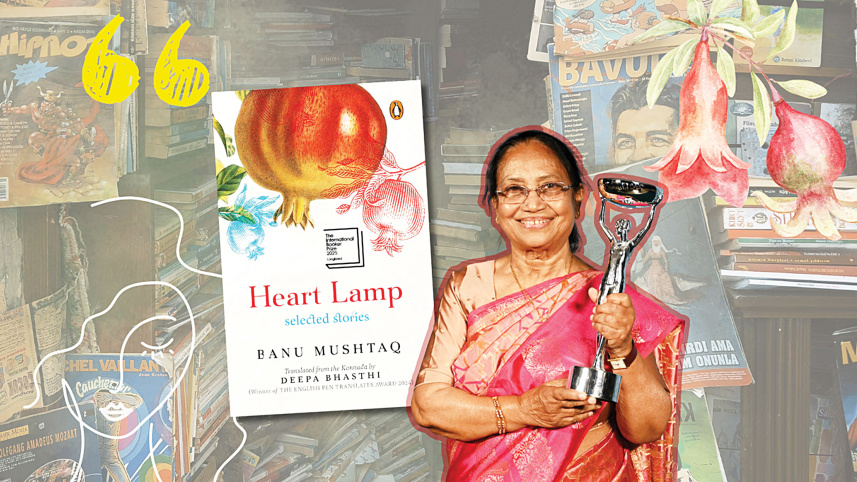
Banu Mushtaq, an Indian writer who writes in Kannada language, was awarded the International Booker Prize in 2025 for “exploring the lives of those often on the periphery of society” in her collection of short stories, Heart Lamp (And Other Stories Publishing, 2024). The collection dominantly focuses on the havoc wrought on Muslim women by the Muslim men and their ensuing plight. Taking a dig in Granta magazine at what he sees as the lopsided portrayal in these stories, Thomas Meaney writes: “Heart Lamp could have been titled ‘The Bad Deeds of Muslim Me’.” However, some of the stories realistically flag the fraught questions about the ingrained issues of marriage, religion, and ignorance in the Muslim community. In this interview, Mushtaq talks about the Booker-winning collection and her journey of becoming a novelist.
When did it first strike that you should write fiction, and what was the first piece you wrote?
 For all latest news, follow The Daily Star's Google News channel.
 The realisation that I should write fiction did not happen as a sudden flash. It arrived quietly, like a whisper that insists on being heard. The very first piece I wrote was a short story titled “Naanu Aparadhiye?” (“Am I the Culprit?”). It was published in 1974 in the weekly supplement Prajamata, a reputed Kannada literary platform at the time.
When I wrote that story, I was moved by a single idea, just one burning question in my heart. I wrote it down and then, strangely, my mind became completely blank afterwards. The story simply rested with me for a long time; I did not know what to do next. At that stage, I had no literary circle, no mentor, not even the vocabulary to understand something as simple as the instruction to “write only on one side of the paper.” There was no one to guide or correct me.
Later, during a personal visit to Bengaluru, I happened to notice the nameplate of the editor of Prajamata while walking on the street. With a mix of innocence and courage, I stepped in, introduced myself as a writer, and asked him how one should send stories for publication. He was amused, but he guided me with remarkable kindness. I rewrote my story exactly as instructed and sent it. Then began the long wait—one year of checking, hoping, and slowly letting the anticipation settle in my heart.
So, my beginning in literature was not just about writing, it was about patience, innocence, learning without guidance, and holding on to a quiet belief that words find their way, even when life takes us elsewhere.
What would you like to say on the affinity between religion and patriarchy as it subtly reflects in the character of Abdul Khader in the story “Fire Rain”?
When we speak of religion and patriarchy, we are not speaking of faith itself, but of the structures that have settled around faith. In “Fire Rain”, the character of Abdul Khader, the mutawalli of the mosque, precisely carries this layered complexity. The mosque is a sacred space, but even sacred spaces are not immune to the social hierarchies that shape our everyday lives.
What I try to express, in my writing and in my lived politics, is that patriarchy is not a single-faced enemy. It operates through many doorways, religion, domestic relationships, caste power, media influence, and political authority. It can look respectable, even pious. It can speak softly, quote scripture, and claim moral purpose, yet it works to diminish women’s agency, intellect, and presence.
So, when we see Abdul Khader asserting authority in the name of religious propriety, what truly speaks is not Islam, but patriarchy wearing a religious mask. The mosque, therefore, is not an exception. No institution—religious or secular— is free from these power dynamics unless we consciously interrogate them. The struggle, then, is to reclaim these spaces, so that faith does not become a fortress of control but remains what it is meant to be: a refuge of justice, compassion, and dignity for all.
Suffering of children in a fraught marriage is another often ignored problem that you have explored in the story “Heart Lamp”, where the character of Salma embodies the suffering of a child. How do you look at this issue?
In our society, child rights and child psychology are among the most ignored aspects. We often assume that children are mere spectators to the conflicts unfolding around them, as though they are too young to absorb emotional harm. But children do not just witness pain, they inhale it. In a fraught marriage, the child becomes the silent corridor where every unspoken argument echoes.
In “Heart Lamp”, Salma is not merely a character; she is a metaphor for all those young hearts who are forced to grow up in the shadow of adult failures. Her silence is not emptiness; it is a language of deep wounds. I wanted to show that when a family fractures, it is the child who gathers the broken pieces with bare hands.
As a society, we talk about children as the future, but we rarely protect their present. We forget to ask what the quarrels, the neglect, the emotional storms are doing to their sense of self. Children deserve dignity, emotional safety, and the right to be heard.
This is an excerpt. Read the full interview in The Daily Star and Star Books and Literature websites.
Dr Mohammed Farhan teaches English at Jamia Millia Islamia, New Delhi. He often writes on books, and interviews authors for various reputed English dailies including The Hindu, Hindustan Times, and Hindu Business Line, among others.
Comments