


Stories from under the waves
Finding an independent bookstore in a new city is one of my most cherished travel experiences. Travelling to a new city and not visiting a local independent bookstore is something that has hardly ever occurred to me. These stores are like small windows to me—providing a glimpse of the local culture and history, and the literary pulse of the city.
The last time we were in Dallas, Texas attending a wedding, I carved out a slice of my busy time to go on my pilgrimage to a locally owned, independent bookstore: Interabang Books. After browsing their collection of books, I struck up a conversation with the friendly bookseller, and he recommended me Twist.
 For all latest news, follow The Daily Star's Google News channel.
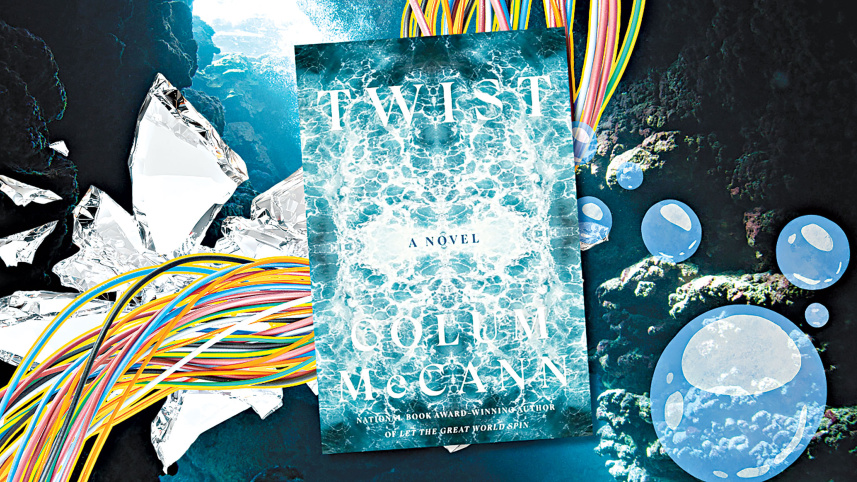
 Twist’s snappy title, the palette of the dark greenish blue jacket of the book, and the author’s name caught my eye. I have a soft spot for Irish literature, and remember reading Angela’s Ashes (Scribner, 1996) by Frank McCourt. In his memoir, McCourt, with his “literary Irishness”, crafted the dark humor and hardship of growing up in Ireland. It deeply moved me.
So I bought Twist.
Twist is a story within a story that explores themes of isolation in the digital age and human connection and disconnection. “We are all shards in the smash-up. Our lives, even the unruptured ones, bounce around on the sea floor. For a while we might brush tenderly against one another, but eventually, and inevitably, we collide and splinter,” Fennell contemplates. This sombre soliloquy reflects his eagerness to repair his own shards caused by his heavy drinking. Part thriller, part fact, part self-reflection, in essence it is a novel about a writer, about broken cables, the sabotage and repair of underwater cables, and a man named John Conway.
Anthony Fennell, a heartbroken Irish journalist, is on an assignment from an online journal to write about the lives of a cable repair vessel. The first commercial cable was laid at the bottom of the English Channel in the 1850s. Since then, a vast network of cables has become an important part of the global economy. Fennell goes off to Cape Town to join the cable repair boat, “Georges Lecointe”. The boat departs into the ocean to begin the long journey from South Africa to Ghana, and the task is to fix an undersea cable that has been broken since a storm hit Congo, disrupting internet access for many in Africa. He meets the crew and the mysterious, charismatic mission chief of the vessel, John Conway.
I had no idea before I started reading Twist that so much of our lives bounce around under the sea. Although the book does not mention the Bay of Bengal, I could see a connection with current concerns—as it is there that the shipping routes of Southeast Asia intersect, where energy routes and data cables intersect, where the geopolitical ambitions of major powers intersect.
Conway is an experienced diver and extremely knowledgeable about the ocean’s endless depth. He repairs cables that carry all the world’s information. He is also in a difficult relationship with Zanele, a South African actor. While Conway is sailing in the deep sea, Zanele is busy with her performance of Beckett’s “Waiting for Godot” in the UK. There, she is attacked with acid during a performance.
Fennell’s original goal was to document the repair mission, but Conway’s erratic behavior intrigues him. Gradually he becomes obsessed with unearthing the real Conway, and just when they are about to finish their job, Conway disappears, leaving everyone on the boat in awe. The story line shifts as the title of the book hints.
It is fascinating to read Fennell’s story about contradictions in the real world, his gripping description of human beings struggling to survive in the deep sea. He talks about love, hate, peaceful conflicts, wars, the sabotage of those cables, the scale of beauty of the natural world and anger at humanity’s capacity to destroy it. “All the myopia. All the greed. A new cable would make billions of dollars for its owners… The old colonialism was dressed up in a tube. It snaked the floors of our unsilent seas,” he says.
As a reader I am intrigued by the narratives of the novel that reflect the broad themes of globalism, human suffering, and the gap between instant global connectivity (enabled by the cables) and the real-world crises: “The news of the bombing—and that is what most of the world heard—had shot through the media within a couple of days. It hit all the major websites, amid the stories of the pandemic and the hurricanes and the evacuations and the drowning of refugees and the other sundry horrors that the world delivered.” I recall reading the remark by a British admiral in the book, “the next war will not begin in the air like they did in the past century but there is a high probability it will begin underwater “.
Twist is a remarkable and highly informative novel. In today’s world, we are divided, and we are lost and lonely. Although the heart of this story revolves around Fennell’s struggle with issues of breakage and repair of human nature, it has a deeper narrative of mystery, idealism, and our digital vulnerability. It is part fictional and part meditative, with a multilayered structure. I had no idea before I started reading Twist that so much of our lives bounce around under the sea. Although the book does not mention the Bay of Bengal, I could see a connection with current concerns—as it is there that the shipping routes of Southeast Asia intersect, where energy routes and data cables intersect, where the geopolitical ambitions of major powers intersect.
Atiya Rumni Mahmood is a long-term resident of Maryland, who studied at the University of Dhaka and the University of Maryland at College Park, and worked in the greater Washington DC metro area in corporate finance and accounting. She enjoys cooking, gardening, reading, and travelling.
Comments