


A wintry account of the human experience
In my early 20s, I moved to New York and started going to a commuter college. I lived far from campus, so in order to get to school, I had to take a bus and then the subway, adding up to an hour of commute each way. My classmates all commuted from various parts of the city; some of them ran to work right after classes. Having been surrounded by friends all my life and not yet knowing how to enjoy my own company, I felt extremely lonely. One winter evening, on my way back home, I was informed that my train would not be stopping at a particular station, so I would have to brave my way through the winds of Manhattan to take another train, two blocks from where I was. Another person was in the same position and we started walking to the other station. We made small talk, only to realise we were both into writing. We exchanged numbers, and soon became rather unlikely friends—I was an English major; he had just graduated with a degree in Computer Science and was now working for a bank. What brought us together was our loneliness in the maze of a city that lures you in and makes you suffer until you finally fall in love with the sight and sound and smell of it. Our loneliness was informed by the fact that we felt like two nameless individuals in an ever-busy city.
 For all latest news, follow The Daily Star's Google News channel.
 The lives of the two couples, with their inner conflicts, converge although their issues do not intersect. I expected the conflicts—internal and external—to lead to a major explosion of sorts but Miller prevents anything like that from happening. What transpires, however, is something much closer to life: frictions result in reactions—some of them intense, but kept realistic through Miller’s measured prose. When something happens—a character finding out something, for example—it is not loudly announced. Instead, the prose gently leads us to the event.
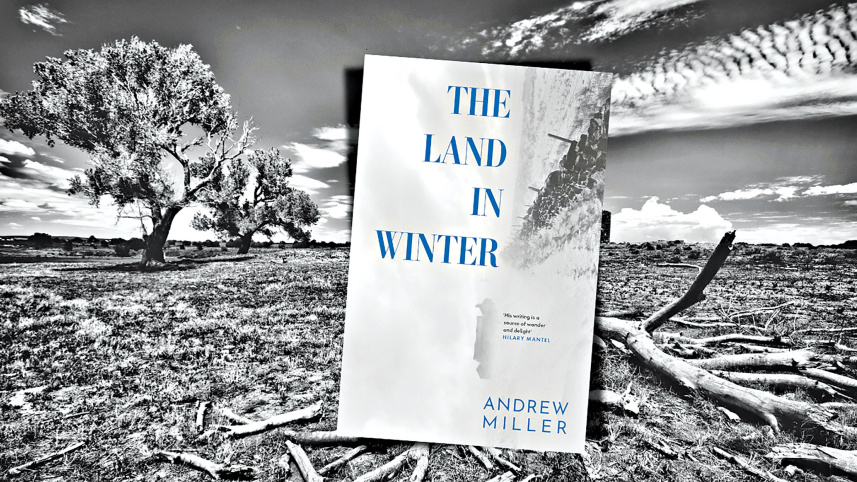
In Andrew Miller’s The Land in Winter, we encounter loneliness, except, as opposed to New York, it is set in a small village where nothing much happens. It is this isolation that brings neighbours Irene and Rita together. The two women could not be more different from each other: Irene, married to a doctor, is from an upper-middle class family in London, whereas Rita worked as a dancer before marrying Bill, who has just moved to the village to become a farmer. The two women form a friendship, something that would perhaps be impossible in a big city where class, background, and social circles inform friendships. In a village that seems stuck in wintery nothingness, all those factors become unimportant.
The village, of course, is not stuck in nothingness, wintry or not. I grew up reading Agatha Christie, and I remember how Miss Marple used to observe the complexities of human nature reflected in the lives of the residents of her village. Unlike Christie’s characters, Miller’s characters are not conspiring and plotting against one another (this is not a mystery novel). However, scratch the surface and you will find the potential for disasters. Eric, Irene’s husband, is having an affair with Allison, who happens to be rich and, to make matters more inconvenient, also married—happily so, on the surface. When he visits her, he has to make calculations: he is, after all, a doctor in a small village. What will happen if the villagers get to know about the affair?
As Eric struggles to keep his affair a secret, his neighbour Rita has to take care to silence the voices in her head. Her husband, Bill, navigates issues of his own as he tries to succeed at being a farmer after having received an elite education. His father is an immigrant who changed his last name in order to sound British. He grew wealthy and provided Bill with the best education in the country, and Bill has gone on to become a farmer.
The lives of the two couples, with their inner conflicts, converge although their issues do not intersect. I expected the conflicts—internal and external—to lead to a major explosion of sorts but Miller prevents anything like that from happening. What transpires, however, is something much closer to life: frictions result in reactions—some of them intense, but kept realistic through Miller’s measured prose. When something happens—a character finding out something, for example—it is not loudly announced. Instead, the prose gently leads us to the event. As a result, while people’s feelings and inner landscape are carefully observed and even delved into, it never becomes dramatic. It is this, in my opinion, that makes the novel work so well. The four central characters are realistic—even when I did not approve of their actions, I never thought they were hyperbolic.
Looking back, the way I eventually fell in love with New York and all the meaningful friendships I formed and the people I would go on to fall out with did not happen dramatically—each piece of the puzzle fit into another, the complexities of my human experience paving the way for more of life. Sometimes it was only in retrospect that I realised how anticlimactically I dealt with events that were often quite serious. While I do not mean to suggest that The Land in Winter is anticlimactic by any means, I argue it reflects the fact that no matter how complex life is, it is often not proportionally dramatic. It is this fact of life that Miller portrays in the novel, and his four characters are microcosmic representations of the complicated, often ugly, seldom simple human experience.
Shounak Reza is a PhD student in English at the University of Virginia.
Comments